

Section: Technology & AI Author: V Reading Length: ~27 min Sources and further reading: 22 items Topics: AI, electricity, data centres, inference, training, PUE, water, ERÚ, IEA SEO / Working Title: How much electricity does artificial intelligence use?
How much electricity does artificial intelligence use? The question sounds simple only until we notice that we are not comparing one bill. A data centre is not artificial intelligence. Training is not inference. A watt-hour of a prompt is not a terawatt-hour on the grid. And Czech net 58 TWh is not ChatGPT’s bill in Brno. The article is therefore not looking for one percentage that could carry a headline. It is looking for denominators: which year, which boundary, measurement or scenario, and what still does not belong in it.
1. Four numbers on one table are not one share of “AI”
Four numbers lie on one table in the newsroom. A reporter wants to turn the global share of data centres into a sentence about artificial intelligence. An analyst stops them: in 2024 the IEA is measuring data centres, not a pure AI share. An activist cites a median of 0.24 Wh per text prompt in Gemini Apps and multiplies it by an unknown number of queries. An energy specialist shows Czech net 58 TWh for 2024 and a world increase in data-centre use of about 70 TWh between 2024 and 2025. A cloud manager puts Microsoft’s 37,026,353 MWh of electricity for FY2025 on the table and asks how much of that is specifically AI [3][9][14][16].
At first glance this is a dispute about whether artificial intelligence is energetically small or large. In fact each person is holding a different denominator. The reporter holds the global bill of all data centres. The analyst holds the IEA definition. The activist holds a unit of inference at one service and one method. The energy specialist holds a country’s annual balance. The manager holds a corporate bill that includes cloud for customers who need not be using generative AI.
That is why everyone can be partly right and the shared headline still wrong. A number without a year, a boundary and a scope is not information. It is raw material for a misunderstanding.
A data centre is not the same as “AI” and a watt-hour of a prompt is not the same as a terawatt-hour on the grid.
— Jiný Kontext
2. The electricity of artificial intelligence has at least six layers
The first layer is the chip and the computation. It depends on the accelerator, utilisation, batching, context length, the number of output tokens and whether the system is running in a simple or a more demanding mode. The IEA states that a top-end GPU can draw up to 1,000 W and that the cluster used for GPT-4 was estimated at about 10 MW for the GPUs alone, or about 22 MW with the rest of IT and cooling [2].
The second layer is training. It is one-off, peaky and concentrated. The third is inference, that is serving: repeated operation after every query, summary, translation, image generation or agent run. The fourth layer is data-centre infrastructure. PUE says how much electricity above the IT load is used by cooling and other operations. The fifth is water, where on-site water differs from water used in the power sector. The sixth is the electricity system, including local grids and the annual balance.
The sentence “AI used electricity” is therefore the start of a diagnosis, not its end. Failure may sit in the model, in the computation, in cooling, on the grid, in the emission factor, in the water scope, or in reading a 2030 scenario as a 2024 bill.
This layering also changes the political question. Connecting a large campus is planned one way; the carbon of one service is judged another way; and deciding whether a firm should use a demanding agent workflow for a task a smaller model can handle is a third. The grid does not see “AI” as an abstract capability. It sees power, offtake, time, place and reliability requirements. The user, in turn, does not see the grid. They see an answer on a screen. Between these two views sit the data centre, its cooling, electricity contracts and operating rules.
That is why it is so easy to talk past one another. One person is dealing with the global climate, another with a local transformer, a third with an API bill and a fourth with water at the cooling site. All of them can use the word consumption. They are not talking about the same boundary. A good sentence about AI electricity must say which layer it stands on. If it does not, it begins to look like a general explanation while describing only one link in the chain.
3. The best number is the one whose denominator you can bear
The energy debate does not need the strongest sentence. It needs a number that knows what it measures. The cheap error is to round the share of data centres so that local pressure on the grid disappears. The expensive error is to issue a 2030 projection as 2024 accounts. Still more expensive is to multiply 0.24 Wh by an unknown number of tasks and pretend that the text median of one service explains global infrastructure.
| Type of failure | What it looks like | How to test | What limits the harm |
|---|---|---|---|
| Data centres passed off as AI | The bill of all DCs becomes a share of artificial intelligence | Check whether the source speaks of DCs, AI-focused DCs, or inference | Separate the computation boundary from the infrastructure boundary [1][3] |
| A scenario as an account | The year 2030 appears without the word projection | Ask for the year and the method | State the 2024/2025 measurement separately from the 2030 scenario |
| Wh times an unknown count | A prompt figure is used for a conclusion about the grid | Look for the count, the mix of tasks and the percentile | Do not add the Gemini median to the global DC bill [9] |
| Mixing water | 500 ml for GPT-3 is set against 0.26 ml for Gemini | Compare model, year, on-site and total scope | Two bills side by side, not one verdict [12][13] |
| The Czech Republic as payer for AI | 58 TWh is read as the bill of one application | Separate a country’s annual net from the world increment of DCs | Use order-of-magnitude comparisons with a caveat [16] |
A number is good when we can put it into a sentence without a hidden swap. Year. Population. Unit. Boundary. Measurement or scenario. What is in it and what is not.
The same rule holds for comparisons meant to help the reader. Households, states or firms are useful orientation aids if they remain orientation. When the IEA likens a large data centre to households, it is showing a scale of power and offtake. It is not saying that a household has the same daily profile, the same location, the same tariff or the same importance for the grid [2]. When we set the world increment of DCs beside Czech net consumption, we are showing an order of growth. We are not saying that it is the same territory or the same decision.
The best number is therefore not necessarily the largest or the smallest. It is the number that can be checked. If a source states 415 TWh, the year 2024 and all data centres, it can be used. If a source states 0.24 Wh, a median text prompt and Google’s method, it can be used as well. The error appears at the moment when one number starts doing the work of the other.
4. A data centre is not artificial intelligence
The IEA, in the report Energy and AI, states that data centres used about 415 TWh of electricity in 2024, some 1.5 percent of world electricity use. From 2017, according to the report, their use grew by about 12 percent a year. Of those 415 TWh, according to the IEA, 45 percent fell to the United States, 25 percent to China and 15 percent to Europe [1][2].
That is a firm orientation point. It is not, however, a bill for pure AI. Data centres serve streaming, enterprise cloud, e-commerce, storage, databases, traditional servers and many other services. AI-focused centres are a subset that is growing faster, because they contain a large number of accelerators for training and running models. If 1.5 percent is turned into the share of artificial intelligence in world electricity, the object of measurement has changed.
It does not follow that data centres are negligible. Local pressure on the grid can be high even when the global share looks small. The IEA repeatedly points to the concentration of demand and to connection constraints. What must be said is simply: data centres in 2024, not artificial intelligence as a whole.
A local problem can, moreover, be the opposite of a global headline. A world share of around 1.5 percent in 2024 looks small in one sentence. In a particular region a few projects can change grid planning, the need for backup sources and the pace of construction. Energy systems are not decided by a world average. They are decided by a node, a line, a capacity reservation and the time when offtake appears.
It is therefore more precise to say that AI is one of the motors of new demand for data centres. It is not precise to say that every data centre is AI. And it is not precise to be reassured by a global percentage if a local connection is hitting capacity. One sentence must carry both sides: the global bill of all DCs and a local electrical constraint are not the same.
5. 485 TWh and +17 percent is a data-centre bill, not a ChatGPT bill
In the update Key Questions on Energy and AI the IEA states that data-centre electricity use reached about 485 TWh in 2025, almost 500 TWh, and stood slightly above 1.5 percent of world electricity use. Year on year, according to the IEA, it rose by 17 percent. The difference against 2024 gives an increment of about 70 TWh [3][4][5].
That is a large movement in energy. It is still, however, all data centres. When Czech net consumption of 58 TWh in 2024 is set beside it, we get an order-of-magnitude comparison: the world’s annual increment of DCs is larger than the Czech Republic’s full-year net consumption. It is not a claim that the Czech Republic is paying for AI, nor that every new TWh belongs to chatbots [16].
For 2030 the IEA states a projection of about 950 TWh, around 3 percent of world electricity demand. The older report Energy and AI worked, in the Base Case, with about 945 TWh. Both values belong to a future scenario, not to the accounts of 2024 or 2025 [1][3].
6. AI-focused centres are growing faster than all data centres
In a press release on 2025 the IEA states that the electricity use of AI-focused data centres grew year on year by about 50 percent. That is faster than total data-centre use, for which it states 17 percent, and faster than world electricity use, for which the press release mentions about 3 percent [5].
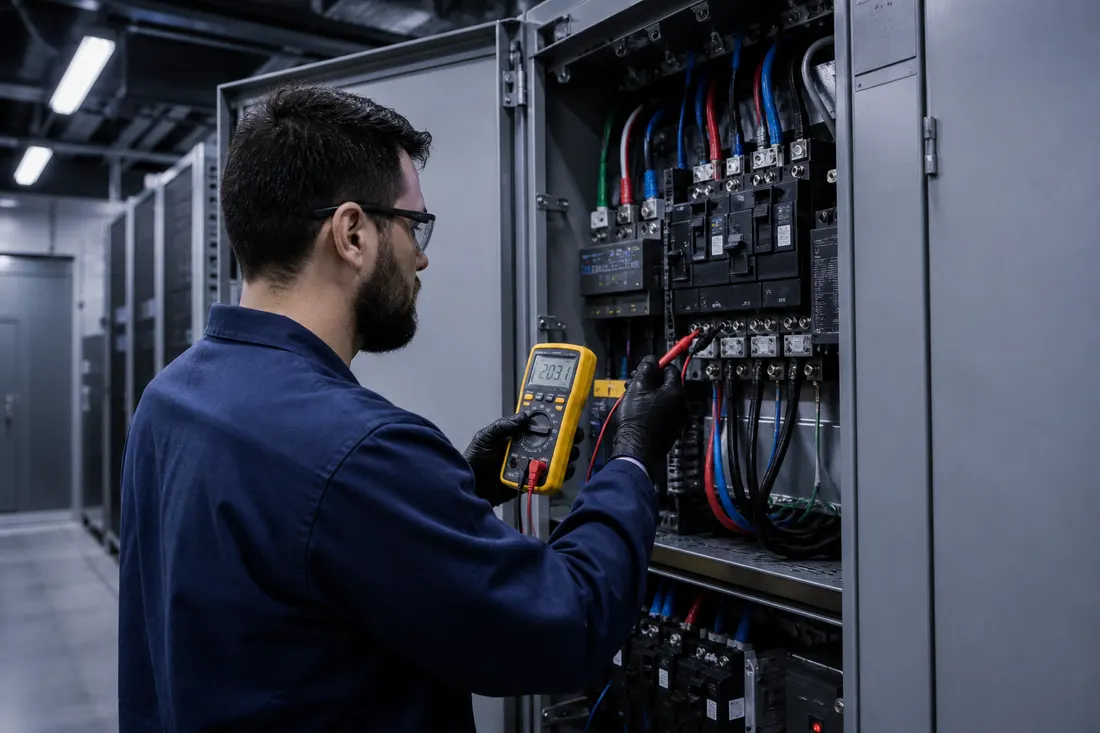
That is a reason to take AI seriously. Not because every data-centre bill may be rewritten as AI, but because its subset is growing fast. In the Base Case for 2030 the IEA states that AI-focused centres may exceed three times the starting level and reach about 465 TWh. The definition applies to centres with a large number of accelerators for training and running models [4].
A caveat holds here as well. 465 TWh in 2030 is not a measured share of artificial intelligence in all world electricity. It is a scenario for a defined category of data centres. It fits the question of how the grid should prepare. It does not fit a sentence without a year and without a definition.
7. Training is not inference
Training is the making of a model. Inference is its use. Training can be energetically concentrated and visible in the media, because it happens as a large campaign on many accelerators. Inference is less conspicuous, because it is spread across billions of individual requests whose cost depends on input length, output, model, batching and mode.
Luccioni, Jernite and Strubell, in their work on AI energy, report historical corporate estimates: according to the cited Patterson et al., about 60 percent of Google’s ML energy in 2022 fell to inference and 40 percent to training; according to the cited AWS material from 2019, 80 to 90 percent of ML cloud fell to inference [7][8][21].
These numbers must not be frozen as today’s world ratio. The mix changes with reasoning modes, agents, video, longer context and new models. They do, however, show an important principle: a large training run is not the whole bill. Everyday operation of models can, in the sum, be decisive, even if one answer looks small.
In inference there is still another hidden difference: the number of steps. A simple query may mean one model call. Agent work may mean a plan, a search, the reading of documents, several drafts, a check, a correction and another pass. The user still sees one task. The data centre sees more computation. That is why the average cost of a prompt cannot, by itself, be transferred to tasks that contain many prompts inside.
Here energy meets product design. When an application sets an expensive mode for every query, it can waste. When it turns that mode on only where a simple model is not enough, it can save without a loss of quality. The difference between training and inference is therefore not only a technical definition. It is a rule for where to look for savings: once when the model is built, and again at every use of it.
8. 42.4 GWh of one GPT-4 training run is not a global share
The IEA, citing Epoch AI, states an energy estimate of about 42.4 GWh for one GPT-4 training run. The background speaks of training lasting about 14 weeks, 25,000 GPUs and a load factor of 84 percent. Daily use of around 0.43 GWh is likened in the report to about 28,500 households in advanced economies on the given day [2][20].
It is a good number for a sense of scale. It is not a global share. It measures one training run, not the inference that followed, not the whole data centre, not every repetition of experiments and not every service on the market. The IEA also uses order-of-magnitude analogies: one large data centre can have use comparable to about 100,000 households and the largest under construction up to about 2 million households. Such analogies help with size. They are not an accounting identity of Czech households [2].
Training numbers therefore belong in sentences with a precise boundary. One training run. An estimate. A particular model. Particular assumptions. The moment we turn them into a sentence about all of artificial intelligence, we change a peak into a year and a campaign into operations.
9. 0.24 Wh of a prompt is not 415 TWh on the grid
Google, in a study by Elsworth and co-authors, reports for a median text-generation prompt in Gemini Apps a value of 0.24 Wh, 0.03 g CO2e and 0.26 ml of water. The method includes the accelerator, host CPU and DRAM, idle capacity and fleet PUE. Google states a fleet-wide PUE of 1.09 and a 33-fold drop in energy per median prompt over the 12 months to May 2025 [9][10][11].
That is an important correction of older impressions that every text answer must necessarily be of a large order. It is equally dangerous, however, to use it the other way as a universal excuse. It is the median of text prompts of one service, one method and one fleet. It does not measure video, agents, long reasoning, other providers, other PUE or the tail of very demanding tasks.
How to test a prompt against the grid
Does the source have a count of tasks and their mix? Is it a median, a mean, or the tail of the distribution? Is it text, image, video, a coding agent or a long search? Does PUE belong in the number? Is it one fleet with a PUE of 1.09, or another data centre? Without a count and a mix, Wh and TWh do not add.
10. Even if ordinary searches were simple AI text, it would still be less than 4 TWh
The IEA, in Key Questions on Energy and AI, states a hypothesis: even if all ordinary searches were a simple AI text query, use would be less than 4 TWh a year, hence less than 1 percent of current data-centre use [3][4].
This sentence is useful precisely because it is narrow. It speaks of simple text queries. It does not speak of agents that make tens of calls. It does not speak of video generation. It does not speak of long context, of private search in documents or of training a new model. And above all it does not speak of the whole data-centre bill.
It does not follow that inference is always small. It follows that an ordinary text prompt and worldwide data infrastructure are different units. If someone has a count of tasks, their mix and a measurement per task, they can estimate. If they have only the median of one service and a feeling for the volume of the internet, they do not have a bill. They have a multiplication missing one factor.
The practical implication is simple. A firm that deploys AI in document search, customer support or a coding agent should not count one universal prompt. It should measure its own typical task: how many calls arise, how long the input is, how much output is discarded, how often the work is repeated and when a more expensive mode is switched on. Only then can one speak of use per accepted result.
11. PUE is not the consumption of a model
PUE, power usage effectiveness, is the ratio of a data centre’s total electricity to the electricity of the IT load. When Google states a fleet PUE of 1.09, that means that for 1 kWh of IT load there is 0.09 kWh of extra infrastructure. That infrastructure includes cooling, power delivery and other operating overhead [9][10].
PUE is therefore not a property of a model. It is not “how hungry a transformer is”. It is a property of a data centre and of its operation. Another campus, another climate, another cooling design and another use of capacity can give another result. Strubell, Ganesh and McCallum, in their 2019 paper, used a global average PUE of 1.58 from 2018. That belongs to their estimate and cannot, without adjustment, be transferred to Google in 2025 or to Czech operations [6].
PUE also shows why training, inference and cooling should not be mixed. If we ask about the computation of a model, we care about the IT load. If we ask about the grid, we care about the data centre as a whole. If we ask about carbon or water, the energy mix, the place and the time are added.
PUE is also not an excuse. A low PUE says that a data centre has little overhead above the IT load. It does not say that the IT load itself is small. A very efficient centre with a huge number of accelerators can use a great deal of electricity. Conversely, a worse PUE in a smaller operation may be locally less significant. That is why PUE should not be used as a standalone badge of virtue. It belongs beside absolute offtake, capacity utilisation and the source of electricity.
A good question is: how much electricity goes into IT, how much does infrastructure add, and how often is the computation actually used? If accelerators wait for a peak, idle capacity may appear in the method as part of serving. If they run at high utilisation, the price of latency and of cooling changes. PUE helps to read operations. It does not close the energy bill.
12. Electricity is not carbon and carbon is not water
One TWh of electricity does not have the same carbon everywhere. It depends on the generation mix, the time of offtake and the location. For the Czech Republic in 2024, ERÚ reports net electricity generation of 69 TWh, 3.9 percent less year on year. The export-minus-import balance fell from 9.2 to 6.7 TWh. Installed photovoltaic capacity rose from 3.3 to 4 GWe and generation from PV plants rose by 24.2 percent year on year. Nuclear and steam both fell year on year [16][17].
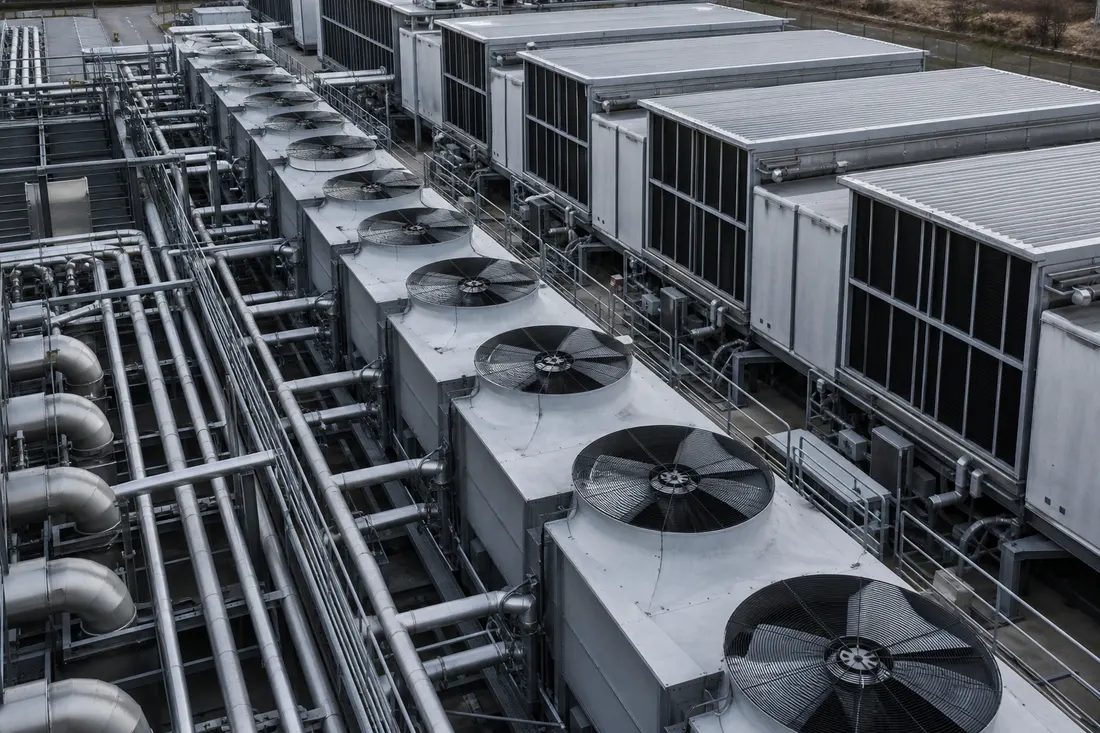
These numbers do not state the carbon footprint of one Czech prompt. They give context to the denominator. The same offtake on a grid with a different mix has a different emission impact. The same computation at a different time may have a different marginal source. And the same data operation may have a different water footprint according to cooling and to water used in electricity generation.
That is why it is wrong to convert electricity, carbon and water into one sentence without a scope. Electricity is a physical account of offtake. Carbon depends on generation. Water depends on cooling, location and method. When these layers are distinguished, the debate is less striking, but more precise.
In the Czech setting this caveat is especially important. ERÚ gives annual figures on the system, generation, consumption and the balance. It does not say what carbon footprint a particular AI service has when a Czech user calls it through a foreign cloud. Such an answer would need to know where the computation ran, at what time, with what electricity source and what contractual instruments the provider uses. The annual Czech mix is context, not the GPS of one prompt.
Water, likewise, is not a universal converter of blame. Cooling in a dry region has a different meaning from offtake in a place with a different water balance. Water for electricity generation is not the same as water evaporated on site. Both can be relevant. They must not, however, be added without a label and compared with a number that measures only one of them.
13. On-site water is not a total water footprint and Li is not a rebuttal of Google
Li, Yang, Islam and Ren estimate that training GPT-3 in the United States at Microsoft data centres may have used 5.4 million litres of water in total, of which 0.7 million litres were on-site. For GPT-3 inference they report about 500 ml of water per 10 to 50 medium-length answers, depending on place and time. This is on-site plus off-site water, hence also water tied to electricity generation [12][13].
Google, by contrast, reports 0.26 ml of water for a median text prompt in Gemini Apps according to its method and its operations in 2025 [9][11]. These two numbers are not a direct dispute about one thing. Li speaks of GPT-3, another year, another scope and the inclusion of water in the power sector. Google speaks of a median prompt in Gemini Apps, another infrastructure and another boundary.
It does not follow that one number is the truth and the other a lie. It follows that water without a scope is even more dangerous than electricity without a year. The 500 ml range must not be turned into a constant for every present query. And 0.26 ml must not be turned into a ceiling for all tasks and providers.
14. 626,155 pounds of CO2e from 2019 is not ChatGPT in 2026
Strubell, Ganesh and McCallum estimated in 2019 that training a large Transformer with neural architecture search could reach 626,155 pounds of CO2e. They used, among other things, a US grid factor of 0.954 lb/kWh and a PUE of 1.58. It was one research pipeline tied to an architecture search according to the work of So and co-authors. BERT trained on a GPU without such a search was, in their table, an order of magnitude lower [6].
This number played an important role. It recalled that research search for models has a physical bill. It is not, however, correct to make it the carbon footprint of ChatGPT in 2026. Hardware, data centres, PUE, the energy mix, the models, the method of serving and the scale of use have all changed. Moreover it was training and architecture search, not ordinary inference.
The old number therefore belongs to the history of measurement and to the argument that the energy of AI should be visible. It does not belong in a headline about the present global share. When an order-of-magnitude illustration becomes accounting, it stops helping.
15. Microsoft’s 37 TWh is a company bill, not the world’s share of artificial intelligence
Microsoft, in its Environmental Data Fact Sheet, reports for FY2025 electricity of 37,026,353 MWh, or about 37.0 TWh. It is the bill of the whole firm. It includes global operations and cloud services for customers who may use AI, but also many services that are not directly tied to generative AI [14].
This number is useful for the question of how large the energy firms among cloud providers have become. It is not useful as a direct share of artificial intelligence in world electricity. If someone adds it to the 415 TWh of data centres, they can easily count part of the same world twice or mix a corporate bill with a category of infrastructure.
The right sentence is narrower: Microsoft as a firm reported, in the given financial year, electricity offtake in the tens of TWh. From that we do not know how much falls to AI, how much to other cloud services and how much to the rest of operations. Without an internal allocation and a method, the number remains a company bill, not a bill of models.
Company bills are valuable even so. They show that digital infrastructure is no longer a marginal item in energy. If a large provider grows, its decisions on location, electricity purchasing, backup sources and cooling affect public grids and investment. The two sentences must simply be kept apart. First: cloud firms have large and growing energy bills. Second: from one company bill the share of generative AI cannot be read without an allocation.
This distinction protects both sides of the dispute. Criticism need not exaggerate in order to be serious. The defence cannot hide behind the fact that the exact AI share is not public. A missing allocation is not proof of zero. It is a reason to formulate the conclusion more carefully.
16. Czech 58 TWh is a country scale. It is not ChatGPT’s bill in Brno
ERÚ, in a report dated 18 February 2025, states that net electricity consumption in the Czech Republic in 2024 was 58 TWh, 0.6 percent less year on year. It also mentions a drop in the local consumption of large enterprises. In the same context ERÚ reports net generation of 69 TWh, 3.9 percent less year on year [16][17][18].
A comparison with the IEA is strong if it stays precise. The world increment in data-centre use between 2024 and 2025, about 70 TWh, is larger than full-year Czech net consumption. That shows the order of the speed of growth of global infrastructure. It does not say that the Czech Republic used less than AI, nor that a Czech data centre runs at such a volume. The dossier has no ERÚ figures on the use of particular Czech data centres in TWh.
Before a comparison with the Czech Republic
Are you comparing a country’s annual net consumption with the annual increment of the world’s data centres, or with the inference of one application? Does the sentence contain generation of 69 TWh, or consumption of 58 TWh? Is it a Czech mix, world growth, or a company bill? Without these three answers the Czech number serves more as rhetoric than as a measurement.
17. The question is not how much “AI” uses. It is which bill, which year and which boundary
The energy bill of artificial intelligence cannot be cancelled by one prompt coming out small. It cannot be inflated by renaming all data centres as AI. We need fewer labels and more denominators.
When someone states a percentage, they must state the year. The year 2024 with 415 TWh of data centres is not the year 2030 with a scenario around 950 TWh. They must state the boundary. All data centres are not AI-focused centres, AI-focused centres are not one prompt, and one prompt is not a video agent. They must state the scope. Is IT load in it, PUE, carbon, on-site water, total water, or a company’s electricity purchase? And they must say whether it is a measurement, an estimate, a company method or a scenario.
Three tests of the denominator
Year: a 2024 measurement, a 2025 update, or a 2030 scenario? Boundary: all data centres, AI-focused centres, training, inference, or one service? Scope: electricity, cooling, carbon, on-site water, total water, or a company bill?
Without a year, a definition and a boundary between training, inference and cooling, a share must not become a headline.
— Jiný Kontext
The right question is therefore not how much AI uses. It is: which bill are you reading just now — data centres, AI-focused centres, one training run, a median prompt, water or a firm — in which year, and what of that is still not the share of artificial intelligence on the world grid?
Related texts in this series
- ChatGPT vs. Gemini vs. Claude vs. Grok… — a ranking does not measure a watt-hour.
- IEA Energy and AI: 415 TWh of data centres in 2024 is an infrastructure bill, not the bill of one chat.