

Choosing a voice assistant for a child is not only a contest in correct answers. It depends on the topic, the age, the privacy settings, the way the product reacts, and whether the child has room to challenge the answer. A fluent voice can be a useful interface, but fluency itself confirms neither truth nor pedagogical suitability.
What we know: Voice systems can err, process children’s data, and by their fluency raise trust in an answer. On sensitive topics, verification by an adult and a clear privacy setting are therefore appropriate.
What we do not know: From the studies cited one cannot derive a single long-term effect on all children, nor claim that every assistant reacts in the same way. The result depends on age, topic, product, settings and the way it is used.
1. A child’s question and a machine’s answer are not the same
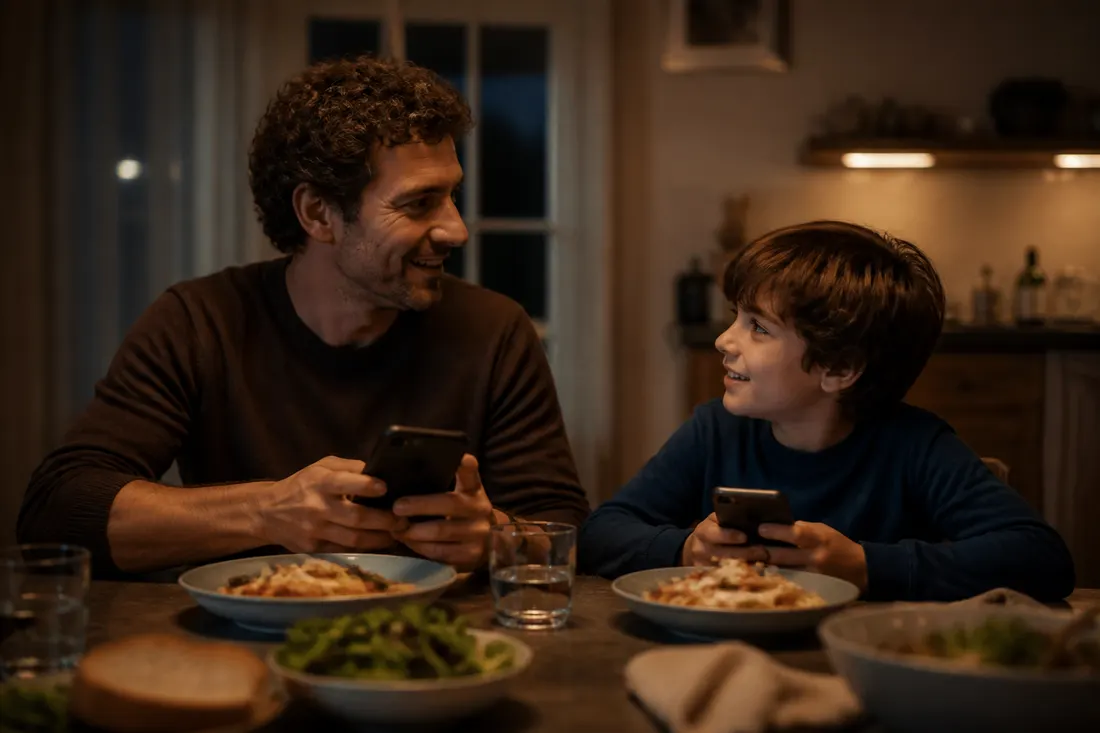
Picture the kitchen of a Czech household. One parent wants a voice assistant because the child asks questions in the car and that parent is driving. The other would rather switch the speaker off, because they dislike a five-year-old giving orders to a stranger’s voice. The teacher would be glad if children stopped handing in essays that sound the same. School IT wants an account with supervision. A grandparent sees a miracle: at last someone answers “why”. The child itself only wants to know why the leaves fall, and does not want to wait.
At first glance this is a dispute about technology. In fact each person is describing a different problem. One parent compares hands on the steering wheel. The other describes the tone in which the child learns to speak to people. The teacher describes the authenticity of the assignment. The school describes permissions and data. The grandparent describes the availability of an answer. The child describes the cost of waiting.
A product can succeed in a quiz and at the same time be unsuitable for sensitive children’s questions. A household therefore has to separate factual accuracy, the manner of the reply, privacy, the possibility of parental control, room for a further question, and the seriousness of a possible error.
A brand is worth comparing only after the task has been named. A factual query, language practice, a sensitive conversation and mere playback of content have different risks and require a different degree of supervision.
A voice is not a teacher. An answer is not a dialogue. Fluency is not certainty. And the patience of a machine is not upbringing.
— Jiný Kontext
2. What happens between the question and the answer
When a calm sentence comes out of the speaker, it is easy to form the impression that “the assistant said it”. But the result usually arises in a chain. Each layer can raise the quality, lower it, or change the type of error. Two products with the same base therefore need not answer in the same way, and the same product can behave differently according to the account, the mode, and whether an adult is standing with the child.
Five layers of one voice answer
- Base model: language ability, knowledge, typical limits and a leaning toward certainty.
- Mode: a quick answer, a child’s profile, search, limits on length.
- Working setup: system instructions, history, the “personality” of the voice, a control loop.
- Sources and tools: the web, an encyclopedia, a household account, connected applications.
- Governance and responsibility: who owns the account, what is recorded, who may continue the question.
The base model determines an important part of the abilities, but it is not the only actor. An application can insert a child filter before the question, attach a history, shorten the answer, or, conversely, deliver it in a tone that sounds like infallibility. The same question in the car, in the kitchen and alone in a room is not the same exercise.
This is where the first error of the public debate is born. A headline announces a contest between a human and a machine, but in fact it compares two different chains: a tired parent at 21:40 and a product with endless capacity. Or, conversely, it measures that an assistant can list photosynthesis and then presents the result as a verdict on upbringing. An honest comparison has to state not only the brand, but also the age of the child, the presence of an adult, the type of question, the tools that are switched on, and the method of control.
This layering is not an academic detail. It determines where to turn when something fails. If the answer did not know yesterday’s weather, the web may have been missing. If it overlooked that the child was asking out of fear, the context failed. If it delivered certainty where “I don’t know” would have been enough, the problem is in the tone. The sentence “AI got it wrong” is the beginning of a diagnosis, not its end.
Illustrative scheme: The same model can, in another mode, with another adult and another question, create a different habit.
3. The best assistant is the one whose error the child can bear
In children’s use, beside factual accuracy, the type of error and the chance to correct it quickly matter. A wrong date in a quiz has a different impact from a self-assured answer to a sensitive question. Pronunciation can be practised again; the long-term effect of frequent ready-made answers is, however, uncertain without longitudinal data and must not be presented as a proven cause of behaviour.
In its recommendation on generative AI in education, UNESCO stresses that tools should serve learning, not replace it, and recommends human supervision especially with children.[11] Risk does not grow only with the frequency of error. It also grows when a calm voice tempts disproportionate trust.
| Type of failure | What it looks like | How to test it | What limits the harm |
|---|---|---|---|
| False certainty | A fluent answer without “I don’t know” | Questions where the source is not enough | A required “how do you know”; the presence of an adult |
| Omission | A correct fact; a condition or a feeling is missing | A check with “and what if?” | Asking further together |
| Error of context | The machine hears the words, not the reason for the question | The same question with an adult and without one | Asking together, not the smart speaker alone |
| Linguistic shortcut | Orders instead of a conversation | A recording of the child’s tone toward people | An adult modelling politeness |
That also changes the question we are asking. We are not asking only which assistant will answer best on average. We are asking which one will fail in a way that the household can catch. Creative play can bear more obvious nonsense; on health, school or personal distress the cost of hidden certainty is higher, and the answer deserves verification by an adult. With a small child it is especially important not to read fluency as evidence.
A practical assessment should include whether the system will admit uncertainty, what permissions it has, and whether a parent can set or later check the use. A product with a lower quiz score can be more suitable in a particular household if these limits work better.
4. What the Mini-Census says and what it does not
Data on children and technology are needed, because they replace part of impression. The problem begins at the moment when one percentage starts to stand for the whole of upbringing.
Almost 84 thousand pupils aged 9–15 from 5.5 thousand classes and 1.1 thousand schools took part in the Mini-Census of the Czech Statistical Office in 2025. It is an educational project of ČSÚ, not a random sample of the whole population of children in the Czech Republic. A press release stated that nine out of ten children had already used tools of artificial intelligence at some point; a more detailed text in Statistika a My put the same survey at 87 percent of pupils and 3 percent who do not know what it is. The difference is in rounding and in the age groups: among nine-year-olds more than half had used AI, among fifteen-year-olds essentially everyone.[1][2]
Only 2 percent of respondents did not have their own mobile phone. According to the ČSÚ summary, less than a quarter of all participating children already owned one before starting primary school. Among today’s fifteen-year-olds it was 15 percent, among today’s nine-year-olds 33 percent. A fifth of children spend more than five hours a day on the internet.[1][2]
| Indicator (Mini-Census 2025, pupils aged 9–15) | Value | What the number does not measure |
|---|---|---|
| Pupils who have already used AI | 87 % | The quality of use; the presence of an adult |
| ČSÚ press summary | “nine out of ten” | The exact interval by age |
| A phone before Year 1 | less than a quarter | Whether it was a voice assistant |
| A phone before primary school among nine-year-olds | 33 % | The same cohort as among 15-year-olds |
| Online more than 5 hours a day | 20 % | The share of voice versus a screen |
The IRTIS survey of Masaryk University from May and June 2025 asked 2 607 children and adolescents aged 9–17 at 99 schools. They used generative AI most often for an essay or a paper (42 percent) and for a summary of a longer text (39 percent); 29.5 percent ask AI for a recommendation of what to do, watch, listen to or buy. This is a different population, a different tool and a different method from the Mini-Census.[3]
Five facts without which a percentage is only an advertising number
- The exact age, the school and the method of selection.
- Whether it was voice, text, or “some AI”.
- Whether the child answered alone, or with a teacher in the room.
- The period of collection and the wording of the question.
- What the child counts as “use”.
A public indicator helps one to understand that voice and AI are not a matter only of secondary school. A decision about upbringing has to be made by other work: observation of whether another question follows the answer, or silence.
5. Compare modes of use, not mascots
The table splits voice modes by the task they are meant to perform in the household and by the failure that a family test is meant to catch. It does not determine a universal ranking of brands.

| Mode | Main operating stance | What to check in a week | Typical reason for the choice |
|---|---|---|---|
| Voice on a parent’s phone | A quick fact, navigation, a timer | Whether the child asks alone; the tone of orders | The hands are busy |
| Smart speaker | A household hub, music, weather | Recording, profiles, night use | Comfort of the room |
| Child’s account | Filters, limits, supervision | What the filter lets through and what it withholds | Lower content risk |
| School AI | An essay, a summary, an explanation | Whether a procedure remained, or only the text | An assignment that can be described |
| Asking together | An adult hears the question and the answer | Whether a second question arises | Upbringing, not a fact |
The rows are not a judgment on brands. The same vendor offers several modes, and each can change within a few months. The map is meant to prevent another error: that a family buys an excellent model in a mode that cannot see the child, cannot say “I don’t know”, or locks the child into a habit from which it is later hard to walk away.
How to read the scheme: Neither the position nor the size of the elements expresses a score. The diagram separates the content of the answer, the tone of the interaction, the permissions of the product and parental control.
6. Fluency is not infallibility. It is acoustic authority
When choosing whom to trust, a child can orient itself by eye contact, intonation, facial expression and the reactions of those around it. Voice output lacks part of these cues, and fluency can work as a signal of authority. The degree of trust, however, differs by age, situation and the child’s experience.
In a paper on children’s interactions with voice search, Lovato and Piper described questions, repairs and communication failures. These are observations of particular interactions, not evidence that every child treats the assistant as a teacher, or that every product deliberately closes the question. The study supports the need to watch whether a particular mode allows a follow-up question and admits uncertainty.[4]
In a review of smart speakers and children, Common Sense Media describes a device that enters household life as a voice that is always available: music, questions, purchases, jokes. At the same time it points to privacy and to the fact that children may not understand when recording is on.[7] That is a property of a particular mode, not an automatic property of every telephone.
What needs to be tested
The first trial concerns tone. Ask a question to which there is no single sentence, and watch whether the assistant admits uncertainty. The second concerns repair: state a knowingly wrong assumption and watch whether the machine corrects it or nods along. The third concerns the source: can one tell from the answer where the claim came from? A product that answers a second earlier need not be better if a minute later nobody knows why it answered in that way.
For a parent who wants one broad service, integration can be decisive. For upbringing the sentence “we have Siri” is not enough. One needs to know the account, the filter, the recording, the presence of an adult, and the boundary beyond which a human has to take the answer further.
7. Language without emotion is not politeness
Human dialogue is two-way. When a child asks an insensitive question or uses an aggressive tone, an adult can react with a change of expression, a pause or an explanation. Some products or modes that have been studied answer an order and a request in a similar way, or with a scripted reaction; others already distinguish tone and politeness. The behaviour has to be checked on the particular version.[7]
Beneteau and colleagues analysed communication breakdowns in which children shortened sentences, repeated commands or raised their voice.[5] Druga and Ko followed family patterns around smart devices.[6] These are particular households and recordings, not evidence of long-term damage to language. The results show a possible risk that repeated instrumental commands will narrow the room for negotiating meaning; the size and duration of the effect cannot be determined from them.
A pleasant voice can hide the same old problem
A well-intoned sentence acts as a sign of understanding. It is not automatically one. On a question about school, guilt or fear one has to check especially whether the system mistook a child’s thesis for a dictionary definition, omitted an inconvenient exception, or fused two different meanings into a smooth but empty sentence. The quality of the wording lowers the cost of listening. At the same time it can raise the cost of discovering that the question was left untouched.
Sherry Turkle described the same logic outside voice assistants: a technology that simulates a conversation can reduce the appetite for undergoing the discomfort of a real conversation.[10] The book is not an experiment on Siri. It is a warning that patience without a relationship is not the same as a relationship.
8. The gap between the question and the answer is a learning space
Part of learning arises in the formulation of a hypothesis, the search for a source and the follow-up questions that come after. An immediate answer can shorten this space if no check or further question follows it; by itself, however, it does not necessarily end the process of learning.
A possible risk is the crowding-out of time in which a child bears uncertainty, formulates a hypothesis and looks for connections. The sources cited here do not provide longitudinal evidence that a voice assistant itself causes impatience or permanently weakens this skill. It is a hypothesis that can be watched in a particular family by the questions that follow and by checking together.
An illustration, not a report. A seven-year-old asks the speaker: “Why are some people mean?” The assistant offers a shortened definition. The child switches the device off. The question was closed; the fear from a school situation remained. The same question to a father can start twenty minutes about what happened at break. The information is secondary. What is primary is that someone heard the reason for the question.
A machine can supply data. It can also end the process before the data are enough. The difference is not in the botany of leaves. It is in whether a second sentence follows the first.
9. The 5 C framework: screen time is the wrong unit
In its 2019 recommendations for children under five, the World Health Organization does not treat voice assistants as a separate product. It treats movement, sedentary behaviour and sleep. This is a narrow age frame, not a manual for Siri. There is still a useful distinction in it: measuring only minutes in front of a screen is not enough if sleep, movement and a relationship are being lost.[8]
In the policy statement Digital Ecosystems, Children, and Adolescents (Pediatrics, 2026), the American Academy of Pediatrics leaves simple minute limits and moves to a digital ecosystem. It recommends the 5 C framework: Child, Content, Calm, Crowding out, Communication. Artificial intelligence is mentioned in the text as a phenomenon that has yet to receive a separate statement.[9] This is a clinical recommendation for families and paediatricians in the USA, not a law for Czech households. It does show, however, that the unit is not the brand, but the mode.
Five C’s in the practice of voice
- Child: age, temperament, whether the child can already separate a voice from a person.
- Content: a fact, a game, an order, or a question about guilt and fear.
- Calm: whether the voice is not replacing falling asleep and the regulation of emotion.
- Crowding out: what has given way — a book, movement, a conversation, boredom.
- Communication: whether the child asks together with an adult.
A voice assistant can be a useful tool. For small children and sensitive topics the recommended safe mode is the presence of an adult who verifies the answer and develops it. That is not an empirically necessary condition of every use, nor a legal requirement.
10. How to check a finished answer
Before a voice assistant, a child had to check whether an adult knew. With an assistant it checks something more complicated: whether the sentence fits the question, whether it is complete, whether it is more certain than it may be, and whether it was even worth asking alone. A citation from an encyclopedia is navigation toward evidence. It is not automatic evidence.
One answer can combine three true sentences into a false conclusion. The first describes leaves, the second autumn, the third “because the tree wants to”. Each part sounds right, but the synthesis is anthropomorphic. At other times the system uses a good dictionary on a question that did not want a dictionary. The child asked about a classmate’s meanness. It received a definition of antisocial behaviour.
A four-step check of a child’s answer
- Existence: the claim can be verified.
- Authority: the source is appropriate for the given age.
- Support: the sentence really answers the question that was asked.
- Scope: it fits that this is a fact, not a relationship, fear or morality.
On a sensitive child’s question a jointly formulated question and a source that can be looked up should come first. A fluently spoken answer must not become certainty if its support cannot be opened or does not agree with the source.
A system is good when it shortens the path to a check, not when it replaces the check. For the weather a quick answer may be enough. On a question about people the last step has to be taken by a human who hears the child.
11. The patience of a machine is not the memory of a dialogue
A great willingness to answer fifty times is often translated into the sentence “the assistant has a patience that a parent does not”. Technically a system can accept fifty repetitions. It does not follow that the fiftieth repetition is learning. It can be a loop in which the child learns that the world has no right to say “enough now”.
The memory of the product is another layer. It can keep a name, a favourite song, past questions. That helps continuity. It also creates a risk of an outdated assumption: that the child is still five, that it is still afraid of the dark, that it still lives at grandmother’s. The system can “remember” a context that no longer holds.
The documentation of particular large models describes a context window as information available for a given interaction, not as a guarantee of lasting understanding.[22] The size of the context and the handling of history differ among voice products and cannot be compared in general without their documentation. Even a long context does not guarantee that the system will use every relevant piece of information.
How to test a long series of questions
Insert a known untruth into the series and watch whether the system corrects it or carries it on. Ask about a contradiction between the first and the fifth answer. Require it to say what it does not know. Repeat the task with an adult and without one. Do not evaluate only the correct botany. Record whether the child asks another question after the answer, or walks away.
On a large corpus of household questions, a well-designed conversation and a smaller relevant context is usually better than a mechanical “ask Siri about everything”. The whole world in a speaker is not a strategy of knowledge. It is often only a faster way to hide the decisive sentence in the middle of certainty.
12. Privacy is not a switch. It is the whole voice flow
The question “is it recording us?” is important, but too narrow. A family also has to know where recordings are stored, for how long, who listens to them, whether records are kept, which third parties process speech recognition, and whether a connected application sends the voice on. “We do not use it for advertising” does not mean “we keep nothing”.
The GDPR gives children special protection and regulates the conditions of consent in connection with information-society services.[20] Article 50 of the AI Act requires providers of systems intended for direct interaction to inform a person that they are communicating with an AI system, unless that is obvious from the circumstances; further duties depend on the role and the use.[21] A school deployment is not the same as a household speaker, and a concrete classification requires a legal assessment.
The practical minimum is a map of the flow. It begins with the child, continues through the microphone, the cloud, the model, the history and the parent’s account, and ends at the place where the recording can be deleted. Without this map, a claim about privacy is only a description of one part of the pipe.
That is why Common Sense Media stresses settings, the wake word, and who in the household understands the indicator lights.[7] The difference is not cosmetic. The same child can have a parent’s phone, a school tablet and a speaker in the kitchen. A weekly test has to record on which device the child is asking, what is switched on, and who is responsible for the settings. Otherwise the family tests comfort and by mistake presents it as a security property.
13. The price of an answer is the price of raw material, not the price of understanding
The market uses several price languages at once. A parent pays a subscription or nothing, because the voice is “in the phone”. A school pays for licences. A child pays attention. An adult pays the time they no longer had to spend explaining — or the time they will later spend repairing a habit.
A cheap assistant can be excellent for a timer and the weather. The same assistant can be expensive on a task that the child repeats until it gets certainty, and that in the end requires half an hour of human conversation that no longer takes place. An expensive ban can be pointless for navigation. It can, however, be cheaper on a question with a high cost of error if it reduces the number of false certainties.
The real price of an accepted answer
Device + account + the child’s voice + verification + repairs + a conversation that was crowded out + a habit of a closed question.
The result is cheap only when it passes a check and can really be used — as a start, not as an end.
That is why it is useful to measure the price per accepted second question, not the price per first answer. Accepted means that the child or the adult continues, verifies, or knows that the source is not enough. This metric can reverse a ranking that looked unambiguous from speed.
14. What to switch on for which work
A household trial should rest on the age of the child, the type of questions and the parental control that is available. The table proposes comparing two modes on the same questions and under the same conditions, not compiling a general ranking of brands.

| Need | First group of candidates | Decisive test | Unacceptable shortcut |
|---|---|---|---|
| Timer, weather, a route | Voice on a parent’s phone | Whether it stays with the command | Leaving the child alone with an open web |
| A fact for school | Asking together + a book or a primary source | Support for the sentence; a second question | Mistaking fluency for correctness |
| A question about people and fear | Only a human; an assistant at most as a start | Whether an adult hears the reason | An encyclopedia instead of a conversation |
| A school essay | A school account; a ban on handing in the first output | The procedure, a citation, a sentence of one’s own | Measuring only the text that was handed in |
| A child without supervision | Switched off, or a strict child’s profile | Recording, purchases, night use | Relying on a parent’s consumer account |
| Language practice | A human; the machine only as an echo | Politeness toward people | Training orders on a speaker |
Czech use needs a separate test. An English assistant will not measure whether it keeps the meaning of “prázdniny”, inflects a name correctly, understands after-school care, or fails to translate a local abbreviation. A test set should contain diacritics, an “I don’t know” question, a question from school, and a question to which the correct answer is “come and tell me”.
Some households in the end need several modes. One for the timer, a second for facts asked together, a third switched off in the room. That is not a failure of upbringing. It is the same decision as using one tool in the kitchen and another on a bicycle. The condition is that the split is intelligible and that the child knows where the final authority arises.
15. A weekly test that will say more than a ban on the phone
A choice can be made without a year-round ban and without switching the device on on impulse. A short, disciplined week is enough. Its aim is not to prove that an assistant can do something impressive. The aim is to find situations in which it fails, and to see whether the household can catch them.
Seven days from impression to a rule
- Day 1: Write down 15 to 25 real questions of the child, their frequency and the cost of error.
- Day 2: Prepare the same questions in two modes: alone and with an adult.
- Days 3–4: Repeat each important question at least three times. Keep a register of tone, certainty and the second question.
- Day 5: Check recording, the account, deletion of history, purchases and night use.
- Day 6: Count how many answers closed, and how many opened a conversation.
- Day 7: Stress tests: a question about guilt, a known untruth, “why are people mean?”, a forbidden purchase. Decide according to the matrix and set a date for the next review.
The evaluator watches factual correctness, completeness, tone, and whether the child walks away after the answer. Each failure is classified: false certainty, omission, context, a linguistic shortcut, privacy.
The conditions have to be comparable. The same time, the same questions, the same adult. If one mode may search the web and the other may not, we are testing finished working procedures — but we have to name them as such.
The pilot should have conditions for elimination. For example: a single unannounced certainty on health advice, a purchase without consent, a recording that cannot be deleted, or a tone that transfers into speech toward people. A high average “it can do it” must not override an error whose impact the family cannot accept.
The last output is not the name of an assistant. It is an operating rule: what the voice is used for, what it is not used for, which data it may hear, what a human must hear, and when the decision will be opened again.
16. Two similar evenings can have a different mode
With a voice it is especially important not to blur the boundary among a parent’s account, a child’s account and a school tablet. The same child can on Tuesday in the car hear the weather from a mother’s phone and on Wednesday in a room put questions to an open model that nobody hears. Privacy and filters differ. Tone differs. The cost of error differs.
The difference is not cosmetic. The pilot has to record in which profile the test is run, what is switched on, and who is responsible for the settings. Otherwise the family tests the comfort of a shared ride and by mistake presents it as a security property of a night-time speaker.
Before switching the voice on alone
- Find who owns the account and where the recordings are stored.
- Separate the timer from questions about people and the body.
- Introduce joint participation: at least the first week of asking together.
- Check that the child hears the sentence “a machine can err”.
- Establish that a purchase, a third person’s privacy and health advice are forbidden actions.
The largest advantage of a household voice therefore need not be the model. It can be order in the matters at which an adult is present. And the largest weakness need not be a hallucination. It can be a true sentence that closes the wrong question.
17. School: an assignment that can be copied is not the same as an assignment that can be understood
IRTIS showed that Czech children and adolescents use generative AI most often for schoolwork.[3] That changes the unit of the assignment. The assignment need not be “write an essay”, but “obtain a text that looks like an essay”. The ability to accept a brief is only an entrance gate. The system still has to — and the teacher even more so — recognise which part is the pupil’s own, separate observation from interpretation, and state what the pupil did not understand.
UNESCO warns against generative tools becoming a shortcut that bypasses learning.[11] A ban does not follow. What follows is that a school has to test the procedure, not only the surface that was handed in. As with code: measuring only a generated excerpt is a bad test. Measuring whether the pupil can defend the result, repair it and repeat it without a voice is a test closer to the work.
For a teacher a small internal benchmark is therefore useful. Thirty real assignments — in Czech, with a question where the source is not enough, and with a duty to show the procedure — will say more than a ban on the phone in the cloakroom. The public percentage “children use AI” helps to choose the topic of a meeting. The decision has to be made by the lesson.
18. The habit of a finished answer
The first generation of smart speakers sold music and weather. The next sold jokes, purchases and “something like a friend”. Today’s products sell something larger: a place in which a child searches, asks, learns to wait — or learns not to wait.
That is why providers do not compete only for the best answer. They compete for household context. For the microphone, the history, the habits, the school assignment, and for who in the family can still say “come and look for it with me”. The more convenient the ecosystem becomes, the higher the price of leaving it can be. The child stops distinguishing its own question from the product in which it first closed that question.
That does not mean that a voice is bad. It is often precisely a voice that saves hands on the steering wheel and supplies a fact that would otherwise disappear. It means that it should be switched on deliberately. A family needs a portable habit of asking further, an emergency procedure without an assistant, and a regular test of whether the original reasons for the choice still hold.
The best system is therefore not the one that never errs. We do not have such a system. Nor is it the system with the fastest sentence or the most pleasant voice. It is the system whose abilities match the real question and whose errors are visible, reversible, and bearable for the child.
At the moment when the assistant only says what time it is, we are choosing a timer. The moment it answers “why”, teaches a tone and closes curiosity, we are also choosing a structure of learning. And then the question is no longer: “Which assistant is the cleverest?”
What decides is which error the child will see in time, who will help it verify the answer, and whether room for a further question remains after the first sentence.
— Jiný Kontext