
Two paintings hang in the empty hall. Same dimensions, same canvas, same pigments. Every crack in the paint branches off in the same place. Even under a microscope, one surface corresponds to another. This is not an ordinary reproduction, but a thought experiment: the first picture was painted by a man several centuries ago, the second one was just assembled atom by atom by a machine.
As long as the labels are not visible, there is nothing to choose from. Vision receives the same information. Then the labels are revealed. Security, insurance and a crowd of visitors appear in front of one painting. The other can be bought for the cost of the material and operation of the machine.
The first explanation suggests itself: rarity. There is only one original, a copy can be made again. The second is less flattering: snobbery. It is said that people do not pay for what they see, but for the opportunity to say that they own "the real thing".
Both play a role. But neither is enough. If it was only a matter of rarity, then a randomly created spot that exists in a single specimen would have the same weight. If it was only about social status, the information about the authorship should not change the aesthetic experience of a person who never owns the work. But research shows they are making a difference.
And this is where the question begins to fall apart. Perhaps we are not comparing two identical images. Maybe we are comparing two equals appearances — and two completely different things.
01 — The first resolution The price is not an optical test
When we say that a copy is "the same", we need to add in what. It can be the same in color, shape, material, chemically and microscopically. But this does not mean that he has the same past, the same legal status, the same function or the same ability to prove something.
Digital forensics knows a similar difference. Two files can be bitwise identical and have the same checksum. However, content matching alone does not say where they were obtained, who handled them, whether they were created before or after the event, or whether their chain of custody was intact. The identity of data is not the identity of its history.
This is not a peculiarity of the art market. A perfect copy of a wedding ring can have the same weight, purity, and scratches, and still not be the ring that someone received at the ceremony. A replica of a historical seal may leave a matching impression, but it was not the instrument used to authenticate a particular document. Some properties a thing has in itself; others gain by which she participated in. To confuse the two groups is to pre-decide the argument in favor of what can be measured on the surface.
In a work of art, these layers often merge into a single word: value. In reality, there are at least several different values. Aesthetic — what we experience when looking. Historical — of which the subject was a part and a witness. Epistemic — what can reliably prove to us. Market value — how much people are willing to pay for it. Institutional — what a museum, connoisseur or catalog recognizes as an original. And personal — how a particular person relates to him.
A perfect copy can take over the first of them almost completely. Some others may imitate. He cannot get others because they are not inside the picture as another pigment. They exist in a relationship between image, people and time.
Editorial illustration
The same image state does not mean the same object
02 — Provenance History as an invisible property
Let's imagine that an unsigned painting is found in the depository. Restorers examine it and find nothing out of the ordinary. A year later, convincing documentation appears: the work was created in the studio of a well-known painter, went through a specific collection and captures the decisive phase of his work. Not a single atom has changed on the canvas. Yet almost everything the institution and the market say about him has changed.
This may seem like evidence that value is just a deal. But the agreement does not have to be arbitrary. A historical original is not only a bearer of a pleasant image; is also a physical node in the event network. It was present during a certain creative act, it aged in specific conditions, it bore the interventions of restorers, movements, damage and traces of ownership. A perfect copy can reproduce these traces as a shape. He cannot become their originator or witness.
The crack in the old painting is the result of his life. The same crack on the new copy is a consequence of the information about this life. Visually they are identical; it causally goes in the opposite direction.
Origin is not another layer of pigment. It is a property of the relationship between the subject and the past.
That's why provenance — the documented history of a work's ownership and movement — isn't just a fancy pedigree attached for the sake of an auction. It is one of the tools we use to verify whether a given object really continues the life we attribute to it. Of course, it can be incomplete, wrong or fake. But that doesn't mean the past isn't important. It shows why the quality of the evidence is important.
In this sense, the price of the original can be understood partly as a price for unbroken causal continuity. We don't just pay for the image. We pay to be able to say reasonably: this is the subject the story is really about.
03 — Psychology of authenticity Contact, Performance and the "Magic" of Origin
But people don't just judge the originals as historians. Part of our relationship to them is more intuitive and less easily defended. In a series of five experiments, George Newman and Paul Bloom investigated why people place more value on original works of art than on exact duplicates. Their results showed two recurring components: the perception of unique creative performance and the importance of physical contact with the author.[1]
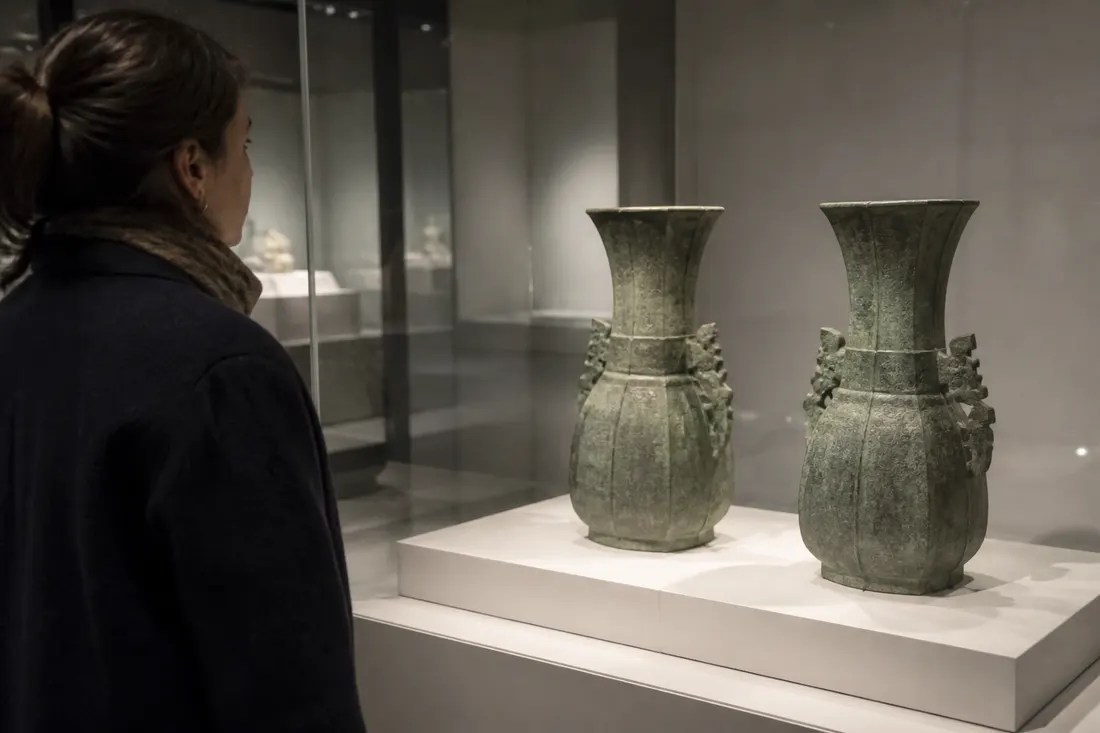
In other words: for many people, the original contains more than just the composition. It also contains an activity trace. A brush stroke is not just a line of color; it is where the author's decision has turned into material. A copy may exactly repeat the result of the move, but it is not itself created by that decision.
The second mechanism is often referred to as "contagion" — the belief that contact with a significant person transfers something of their identity to the object. It is not necessary to understand it literally as supernatural energy. It is often a shorthand for psychological closeness: a handwriting, an instrument, a garment or an image allows one to feel a more direct connection with a person who is no longer present.
However, even creative effort is not a reliable measure of quality. Hours of work can produce mediocre work, and a single quick stroke can be the result of decades of experience. Effort works more like inferential clue: we try to retroactively estimate attention, skill and intention from the finished object. When the copying process shortens this path, we tend to attribute less human input to the result — even though our aesthetic response to its surface remains the same.
This is why an ordinary guitar of a famous musician can command a higher price than a technically superior instrument. Doesn't necessarily sound better. But it functions simultaneously as a relic, a document and a means of imaginary contact.
Newman and Bloom's experiments worked with model scenarios and participants' judgments, not real auction transactions. They support an explanation of why people prefer the originals; they do not prove that every price premium in the market is rational, nor that there is a measurable "essence" of the author in the original.
Moreover, two different judgments are mixed here. One can be reasonable: the original is the direct result of a specific creative act. The second may be an exaggeration: any physical contact with a famous person is said to increase the value almost without limit. The market, prestige and the human desire for closeness can turn a real historical connection into a fetish.
So the original is not valuable either for good reason or from irrationality. Both layers can be present at the same time. Accurately distinguishing their ratio is more difficult than detecting a fake.
04 — Benjamin's problem An aura without mystique
In the 1930s, Walter Benjamin described how technical reproduction weakens the "aura" of the work: its unique presence in time and space, the authority associated with tradition and historical testimony. Reproduction separates the image from the place, allows it to come to the viewer, and replaces a unique existence with a multitude of copies.[2]
The word aura sounds mystical, but it can be read soberly. The original is the point around which verifiable events, institutions, and rituals of attention center. The reproduction conveys pictorial information, not this whole relational system.
However, Benjamin did not just write an elegy for lost exceptionalism. According to him, reproduction also frees art from traditional rituals, widens its accessibility and changes its social function. So the copy need not be the enemy of the original. It may be the reason why we even know the original, why we can relate to it, and why its image has become part of common culture.
The paradox is obvious: the more reproductions there are, the less rare the pictorial motif itself — and the more famous, desirable, and symbolically powerful its only recognized original can be.
05 — First turn When the copy is in a more correct place
So far, the original could seem like a clear winner: it has history, contact with the author and authority. But what if the materially genuine object is torn from the environment for which it was created, while an exact copy returns to it?
Paolo Veronese painted the monumental between 1562 and 1563 Wedding in Cana for the Benedictine refectory of the monastery of San Giorgio Maggiore in Venice. In 1797, the canvas was removed and transported to the Louvre the following year; the Louvre catalog mentions military booty as a method of acquisition.[4]
In 2007, a high-precision facsimile created by Factum Arte was installed on the original wall of the refectory. Bruno Latour and Adam Lowe have shown in this case that the relationship between the original and the copy need not be a simple battle of truth and deception. The material original remains in Paris. However, the Venetian facsimile re-entered the architecture, light, scale and function of the space for which the composition was designed.[5]
Which experience is more authentic? A view of the real Veronese canvas in a different institutional and spatial context? Or a look at later facsimiles in a place where painting originally communicated with Palladio's architecture?
The question does not have one axis. The Narsk Document on Authenticity, created in 1994 for the field of cultural heritage protection, explicitly extended the assessment of authenticity beyond matter itself. It draws attention to form and design, materials, use and function, traditions and techniques, place and environment, spirit and other contextual properties.[3] It is not a table for deciding which image "won". It's a reminder that authenticity can have multiple dimensions that diverge.
Nara frame editorial illustration
One original, two different authenticities
Psychological research offers another unexpected detail. In hypothetical scenarios where people could not see the original directly, a proportion of participants preferred direct viewing of a high-quality reproduction over indirect viewing of the original through a monitor or mirror. The authors themselves emphasize the model character of the situation, yet the result weakens the simple rule "any contact with the original is always the best possible experience".[9]
Thus, a copy can lose as a historical object and at the same time win as a means of seeing. The original may be materially truer, but experientially more distant.
06 — The Second Turn When can there be more originals
The idea of a single original is strongly adapted to painting and sculpture. As soon as we move to other types of art, it starts to fail.
Nelson Goodman distinguished art autograph and allographic. For a typically autographed work, such as a painting, the specific history of creation matters: even a perfectly accurate reproduction does not by itself become a genuine specimen. In an allographic work, identity may be maintained through notation or performance rules. Beethoven's symphony is not the only physical sound ever made; can have many valid implementations.[6]
The distinction is not the same as the division into "one piece" and "many pieces". A graphic sheet can be an autographed work and yet exist in multiple original prints from an authorized die. The museum definition of an edition therefore speaks of a set of identical prints made from the same printing surface; the number can be limited or unlimited.[7]
In the case of a novel, we don't mind that the copy in the library is not the paper the author touched. Text can survive a change in paper, type, and device. With film, technical reproducibility is part of the way the work exists. With a digital image, an exact copy is the norm, not an exceptional technological marvel.
This does not mean that a digital creation cannot have an original. It means that originality moves elsewhere: to the authorized version, timed publication, source files, creative process, author signature, contractual rights, or institutionally recognized provenance. Uniqueness no longer has to reside in bits. He may reside in a legitimate relation to them.
A simplified decision tree
The question "Where is the original?" depends on the type of work
07 — Generative break AI changes the story behind the image
Generative AI adds another layer. Previously, a copy could be suspected of imitating a finished painting. A generative system can create a new image that does not have a single physical prototype — and yet information about its origin changes judgment in us.

In an experiment published in 2023, participants were given images labeled as either human-made or AI-made. In fact, all the works shown were generated by AI and the labels were randomly assigned. On average, images with a human label received higher ratings in, for example, liking, beauty, depth, and attributed value. A second study replicated the result; part of the difference was related to perceived effort and the story the viewer attributed to the piece.[8]
The pixels have not changed. The hypothesis about what caused them has changed.
This can easily be dismissed as prejudice against the machine. And sometimes it really can be. The study itself does not support the claim that human art is objectively superior; examines the effect of labeling in a particular experimental setting. The results of other research are not the same in all situations, and attitudes towards AI vary between people.
At the same time, it would be too simple to declare every difference a mistake. For many viewers, art is not just a visual stimulus. It is an attempt to interpret the action: why someone chose this particular form, what he risked, what he knew, what he wanted to convey, what he defied. If the supposed originator changes, so does the set of meaningful questions.
A simplified psychological model
One sentence next to an image can change the entire chain of interpretation
With the human author, the image can be read as a trace of conscious choice. For a system, it is necessary to first identify where the selection actually took place: in the data, the model architecture, the input, a series of iterations, curated selection, manual intervention, or a combination of these steps. Therefore, the label “created by AI” often obscures more than it explains.
There is a wide continuum between one prompt and months of directed creation. One person takes the first exit; another creates hundreds of variations, changes the composition piece by piece, combines his own drawings, retouches and decides on every detail. Both may use the same model, but their causal role is not the same. It would be equally inaccurate to claim that the photograph was "made by the camera" without asking about the scene, the moment, the lens, the exposure, the selection and the adjustments — or, conversely, to pretend that the tool has no influence on the resulting space of possibilities.
Law answers this problem in a different language than aesthetics. The US Copyright Office stated in a 2025 report that protection can arise where a person has determined sufficient expressive elements, creatively arranged or modified the output; according to him, entering prompts alone is usually not enough. A December 2025 review by the European Parliament stated that the European Union does not have specific rules for the copyright protection of purely AI-generated output, and the existing European standard emphasizes human creativity.[10]
But that's not a verdict on quality. The work may be legally unprotected and aesthetically impressive; legal protected and banal. The law asks to whom and under what conditions to grant exclusive rights. The philosophy of art asks what a work is, how meaning is created, and why origins matter to us.
08 — Composite value So what are we really paying?
When someone pays many times more for an original than for a visually identical copy, they are not paying one price for one quality. He buys a bunch of different claims — some well-documented, some speculative.
No equation will determine their correct ratio. The market price can approximate historical value, but it can also be dramatically distorted by fashion, prestige, the tax environment, investment demand or simple competition from wealthy buyers. Therefore, a high price is not a proof of great art. It's proof that at some point, demand, rarity, and story came together strongly enough.
However, the opposite simplification is equally wrong: that the difference between the original and the copy is only marketing. If we care about the past, authorship, and human action, then causality is a relevant property. It is not visible in the same way as color, but that does not make it fiction.
When evaluating claims of “authenticity,” it is helpful to ask four separate questions: Is the appearance identical? Is the material the same? Is the same origin history documented? And is the subject similarly authorized? The answer to one of them does not automatically determine the others.
This also explains the power of the forgery. A fake is not just trying to create the same image. Attempts to redirect foreign history to a new subject. Its essence is not similarity, but a false causal story. A facsimile that openly admits its nature can be accurate and culturally valuable. A forgery may be technically less accurate but socially more dangerous because it pretends to be an identity it does not have.
09 — Return to the hall The last difference
Let's go back to the two canvases in the empty hall. The machine copied the pigment, the base, the cracks, and every trace of wear. In addition, what if all the records disappeared and no one could find out which one was the original one?
For the market and institutions, the difference might practically collapse. Without evidence, status cannot be reliably assigned. Both things could become equally uncertain candidates. However, this is not the same as saying that their history was the same. One canvas was still created in an ancient studio, the other in a modern machine. We just lost the ability to know which.
This boundary is substantial. The value of authenticity depends on the actual origin and our ability to prove it. Without the first, we have an illusion. Without the other, we may be right, but we cannot legitimately assign it.
A perfect copy therefore reveals something unpleasant about the original. Its exceptionality does not lie entirely on the surface. Part is in the material, part in the event, part in the evidence, and part in the collective attention. Therefore, the original can be historically irreplaceable and at the same time aesthetically replaceable. Therefore, the copy may be ontologically different and yet more convincing to the viewer. And that's why the information on a small label can change the experience more than any image change.
Generative technology did not create this contradiction. She just deprived him of a comfortable hiding place. It forces us to admit that when we look at art we are not just looking at the form. We also observe human decision, risk, time, authority, memory — and sometimes our own desire to be close to something that cannot be repeated.
A perfect copy can inherit every atom of the image. It cannot inherit the moment in which the image first became reality.