

A Model Scene
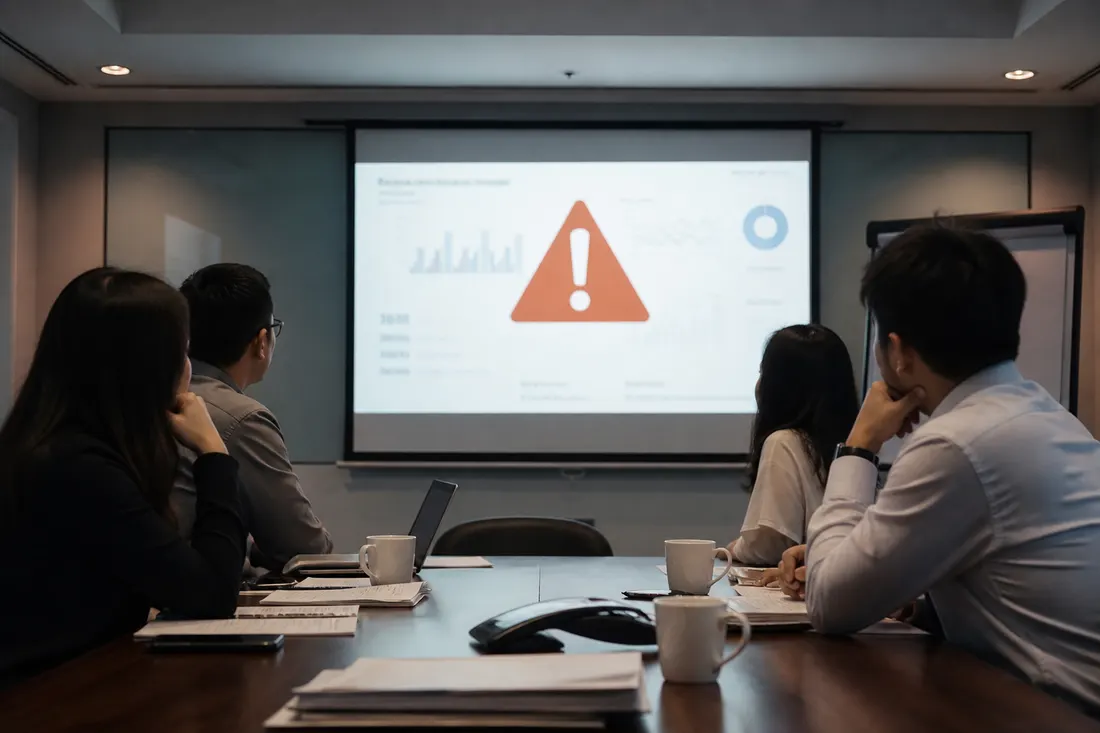
A result that makes no sense glows on the screen. Not dramatically. It is simply a few percentage points outside the range the team is used to. The analyst in the middle of the table notices it first. He looks around. The manager continues the presentation, a more experienced colleague takes notes, and no one looks concerned.
Meeting, 9:17 a.m.
The analyst forms a sentence in his mind: “Shouldn’t we verify that assumption?” Immediately, he starts revising it. Maybe he missed some context. Maybe someone has already looked into it. Maybe the question will sound like a challenge to the work of people with more experience. And perhaps, within five seconds, he will become the person responsible for making the meeting run half an hour longer.
He says nothing. Three seats away, someone else has a similar doubt. But that person has just seen that the analyst — a specialist in the field — is silent. He takes the silence as information. And he stays silent too.
At first glance, the diagnosis is simple: a lack of courage. If the first analyst were more professional, more confident, or morally stronger, he would speak up. The institution would receive a warning and could correct the mistake.
Yet this scene is not only about personal failure. A small information collapse is taking place. Each person has an incomplete picture of reality and uses the behavior of others to fill it in. Once public silence starts being read as private agreement, the group creates a certainty that no one actually possesses.
Silence is not emptiness. It is a message — just often a false one.
01 / First Impression Silence Looks Like Agreement
Organizations like visible signals: reports, minutes, escalations, comments, dissenting statements. What is not spoken or recorded is treated as if it did not exist. Yet every organization also produces invisible signals: withheld questions, unspoken objections, unsent emails, sentences softened until their meaning disappears.
Research on organizational silence describes a situation in which employees systematically withhold information, concerns, or ideas that could matter to the organization. As early as 2000, Elizabeth Morrison and Frances Milliken warned that this is not merely the sum of timid individuals. Silence can become a property of the system: people expect negative feedback to be unwelcome, while management receives fewer and fewer of the very signals that could disprove that expectation.[1]
Such a system does not need to issue a ban on criticism. It is often enough for employees to notice who is considered “difficult,” which questions make the room go cold, and which bad news turns into neutral language on its way upward. The rules of silence never have to be written down. They are inferred from small social consequences.
James Detert and Amy Edmondson coined the term implicit voice theories for these taken-for-granted, often unspoken rules. Their research showed that people carry assumptions about when speaking upward is dangerous or inappropriate: do not challenge the boss without a perfect solution, do not flag a problem you cannot fix yourself, do not bypass the hierarchy, do not step outside the role of a “team player.” These assumptions can guide behavior before a person consciously weighs the specific risk.[2]
That is why the question “Why didn’t he say anything?” is often too narrow. A more precise question is: What information about the cost of speaking up did the system give him in advance?
02 / The Invisible Calculation Two Questions That Come Before the Sentence
When a person considers whether to flag a mistake, they are not weighing only whether their observation is true. Two axes usually meet in a rapid inner calculation.
Will I seem incompetent, disloyal, combative, or oversensitive? Will I jeopardize a relationship, my reputation, my advancement, or my membership in the group?
Will the objection actually be considered, or merely heard? Will I get an answer, or will my message disappear into the hierarchy?
This second axis is easy to miss. A person may not be silent because they fear punishment. They may be silent because they expect futility. If previous comments ended without a response, management’s openness remained a slogan, or criticism was politely received and then ignored, silence may be a rational adaptation to the environment.
That does not make it right in every case. It means an organization cannot repair silence with an appeal to character alone. “Do not be afraid to speak up” does not change the experience that speaking has costs and no traceable effect.
A person is not choosing only between truth and silence. They are choosing between uncertain usefulness and a very concrete social cost.
Authority intensifies this calculation, but not only through fear. A superior is also assumed to possess more information. A subordinate may reasonably conclude that the manager knows the wider context, has access to data they cannot see, or has already consulted someone about the problem. Hierarchy therefore works as an epistemic shortcut: a higher position is easily mistaken for more complete knowledge.
In many situations, this shortcut is useful. Without some trust in the division of roles, an organization could not act. The problem begins when assumed competence becomes a substitute for verification, and subordinates stop seeing their own local knowledge as information management may lack.
03 / The Group When Everyone Borrows Certainty from Everyone Else
The most interesting moment does not come when one person stays silent out of fear. It comes when several people stay silent for different reasons, and each takes the others’ silence as proof that their own doubt is isolated.
Social psychology calls this kind of collective error pluralistic ignorance. A group systematically misjudges the private attitudes, feelings, or beliefs of its members. Individuals may have reservations but assume that others do not share them. Public behavior then sustains a norm that fewer people privately support than it appears.[3]
The important word is collective. It is not merely that one person misjudges their colleagues. The error must be shared: the group as a whole does not know what the group as a whole actually thinks. A room may look calm precisely because every member is carefully hiding their unease.
The loop has a peculiar property: it is stable even though no one consciously wants it. A superior may sincerely believe that their team would report a serious problem. Team members may sincerely believe that the superior does not want to hear unfinished doubts. Each side interprets the other’s behavior, and both can arrive at a mistaken but mutually reinforcing certainty.
That is why even an anonymous survey asking “Can you speak openly here?” may not reveal the whole problem. People may answer yes if they understand openness as the ability to comment politely on ordinary matters. The critical question is more specific: can they challenge the assumption behind their superior’s decision when they do not yet have complete proof and doing so would slow the work?
04 / Unanimity One Voice Changes the Physics of the Room
Solomon Asch’s classic experiments are often reduced to the claim that people blindly follow the crowd. The results themselves are more interesting. Participants had to compare line lengths — a task with an obvious correct answer. Without group pressure, the error rate stayed below one percent. But when the group unanimously gave the wrong answer in front of the participant, participants joined the incorrect view on 36.8 percent of the critical trials. Approximately a quarter of the 123 participants never yielded to the majority.[4]
This is not a picture of unconditional obedience. It is a picture of variable resistance under social pressure. Another part of the experiment is even more important: when a single supporting partner broke the unanimity, the number of errors fell to roughly one quarter of the level under a unanimous majority.[4]
A dissenting voice may not persuade the group. But it can change the social nature of the situation. The first person does not merely introduce a new argument; they break the illusion that the only acceptable view has already been decided. The second person then speaks into a space where a legitimate alternative already exists.
That is why “being first” is qualitatively different from “joining in.” An institution that relies on the first brave person shifts the cost of its own control system onto an individual’s personality. An institution that creates a required space for an independent view turns dissent from a personal risk into part of the work.
05 / Safety Psychological Safety Is Not Comfort
Amy Edmondson defined team psychological safety as a shared belief that the team is safe for interpersonal risk-taking — for example, admitting a mistake, asking an apparently naive question, or expressing dissent. It does not mean permanent comfort, an absence of conflict, or agreement with everything. Nor does it mean lower professional standards.[5]
On the contrary: the purpose of psychological safety is to keep high standards from being concealed by reputation defense. In a low-safety environment, people spend energy trying not to look ignorant, incapable, or disruptive. In a higher-safety environment, they can use that energy to expose uncertainty, learn, and correct mistakes.
Edmondson’s original study of 51 work teams found an association between psychological safety and learning-oriented behavior. The author explicitly cautioned, however, that the cross-sectional design cannot establish causality. A later meta-analysis of 136 independent samples, including more than 22,000 individuals and nearly 5,000 groups, supported the importance of psychological safety across a range of outcomes and organizational conditions.[5][6]
What the Evidence Does — and Does Not — Show
Psychological safety is an important factor, not a magic button.
Research supports its relationship with learning, voice, and team outcomes. It does not justify claiming that a pleasant atmosphere alone produces sound decisions. A group can be open and still be wrong; it can also talk a great deal while evaluating evidence poorly.
What matters is the combination of safety and discipline. Voice must be permitted, but claims must be verifiable. An objection is not automatically right simply because it is brave. A psychologically safe institution is not a place where all opinions are equal. It is a place where the weight of opinions can be determined by evidence, not by the rank of the people who hold them.
06 / Actual Failure Someone Warned. The System Still Did Not Hear
The Challenger and Columbia shuttle disasters are often told as stories in which “no one said anything.” The more precise version is more uncomfortable: people did speak, but the doubt changed as it passed through the institution.

Challenger: The Warning Existed, but the Decision Did Not Preserve It
Before the Challenger launch in January 1986, engineers at Morton Thiokol expressed concerns about the behavior of the sealing O-rings at low temperatures. The original recommendation was not to launch. The Rogers Commission later described how Thiokol management reversed its position after pressure and an internal meeting, while the technical uncertainties were not adequately carried into the final decision. The commission called the decision-making process seriously flawed.[7]
This case shows the difference between the existence of a voice and an institution’s ability to preserve that voice. A warning can be spoken and still disappear when translated into the language of schedules, customer relationships, accountability, and evidentiary standards.
Columbia: Uncertainty Became a Reason Not to Act
After Columbia launched in January 2003, a piece of insulating foam struck the left wing. Engineers requested high-resolution images that could help assess the extent of the damage. The CAIB later described three separate requests for imagery, communication failures, and management assumptions that limited risk assessment. Instead of asking what the images might reveal, attention partly shifted to who was requesting them and whether the request needed to be formally justified.[8]
CAIB also pointed to a reversed burden of proof: the concerns had to prove that the impact was dangerous, instead of the system demonstrating safety under conditions of major uncertainty. Incomplete knowledge was therefore not read as a reason to continue checking, but as insufficient evidence for an alarm.[8]
Challenger and Columbia cannot be reduced to a single psychological mechanism. They involved technical, managerial, budgetary, historical, and cultural factors. That is precisely why they matter. They show that institutional silence is not always an absolute absence of words. It can take the form of communication that exists but is not given decision-making weight.
07 / Experience Success That Teaches the Wrong Lesson
Every system learns from outcomes. But an outcome is not always a reliable teacher. When an organization deviates from a safe procedure several times and nothing bad happens, it may infer from the absence of catastrophe that the deviation was safe. In reality, it may simply have been lucky or operating in a range where the risk does not appear every time.
This creates an asymmetry. The person issuing a warning predicts an event that may not happen. If it does not happen, their concern looks exaggerated. The person advocating continuation scores points each time the system gets through without consequences. Yet a series of successful passes does not necessarily prove low risk; it may simply normalize conditions whose actual safety no one has properly measured.
In such an environment, history becomes an argument: “We have done this many times before.” But experience answers only what happened in past cases. It does not automatically answer whether the process was safe, how close it came to failure, or whether the conditions are different this time.
The Distinction That Matters
“It has worked so far” is not the same as “we know why it is safe.”
The first sentence describes a history of outcomes. The second requires a mechanism, data, and boundaries of validity. An institution begins to go blind when it stops distinguishing between them.
Repeated success can increase the cost of dissent. The longer nothing goes wrong, the easier it is to label a skeptic as someone who does not understand operational reality. A warning is no longer competing only with optimism. It is competing with an institution built on the memory that previous optimism has worked so far.
08 / Loyalty When Loyalty Turns Against the Mission
Loyalty is essential to an organization. It enables cooperation, trust, a willingness to bear costs for the whole, and acceptance of decisions with which an individual does not fully agree. Without loyalty, every institution would be only a temporary cluster of private interests.
But it has at least two forms. The first is directed toward the immediate social surroundings: the superior, colleagues, the team’s reputation, the schedule, and the plan created together. The second is directed toward the organization’s mission: safety, legality, accuracy, patient care, public protection, or the truth of the result.
In ordinary operations, the two overlap. In a crisis, they can diverge.
A person who flags a problem may disrupt local calm precisely in order to protect a broader purpose. From inside the team, however, their action may look disloyal. The stronger the organization’s identity — the more its work is tied to prestige, sacrifice, expertise, or public service — the easier it may be to mistake criticism of a particular decision for an attack on the entire collective.
And this is exactly where loyalty can turn against itself. The organization begins protecting the image of its competence in a way that damages its actual competence. It preserves internal trust by limiting information that would temporarily unsettle that trust. In the short term it appears more unified. In the long term it knows less.
The most loyal person may not be the one who supports a decision most quickly. It may be the one who refuses to let the organization’s mission shrink into protecting its immediate comfort.
09 / The Other Side Silence Is Not Always Cowardice. A Voice Is Not Always Truth.
It would be tempting to end with a simple celebration of dissent. But that too would be a mistake.

People also stay silent because they lack enough information, want to test an assumption first, respect confidentiality, choose a better moment, or know that a competent person is already handling the issue. Not every silence is a symptom of a repressive culture. Sometimes it is a sign of professional discipline.
Nor does every voice improve an organization. An objection may be wrong, self-serving, repeatedly disproven, or phrased in a way that produces more noise than knowledge. An organization has to decide, and a decision always means that some alternatives are not chosen.
Moreover, research on voice and silence is not a finished map with simple causes and universal recipes. Review literature points to different kinds of voice, different motivations for silence, different levels of analysis, and many unresolved questions.[10] The meaning of any one factor changes with the profession, country, power distance, nature of the risk, and whether the issue is ordinary improvement, ethical misconduct, or an immediate threat to life.
The reasonable goal is therefore not to maximize the amount of dissent. It is to increase the likelihood that relevant information reaches a decision in time, in a recognizable form, without its bearer first having to risk social suicide.
Openness without verification creates noise. Verification without openness creates blindness.
10 / Architecture An Institution That Does Not Need Heroes
When an organization says after a failure that “everyone has a duty to speak up,” it may be right — while still avoiding the point. An individual’s duty does not answer whether the system will capture, protect, examine, and return an intelligible response to their voice.
A 2020 systematic review of interventions in healthcare found only fourteen studies, with mixed results. Education or a one-off training session alone was often not enough to change deeply rooted behavior. The authors stressed the need for multilevel, long-term interventions, visible leadership support, and change at both group and organizational levels.[9]
This is an important correction to the popular idea that culture can be changed with a workshop and an open-door poster. People’s behavior is shaped above all by what happens after a doubt is voiced.
The following principles are not a universally causally proven package. They are design implications drawn from research and investigative reports — ways to reduce a system’s dependence on extraordinary individual courage:
-
Separate the report from the person who brought it.
Capture the claim, evidence, uncertainties, and possible impact before judging the speaker’s motive, style, or status. An unpleasant person may be right, and a popular person may be wrong.
-
Collect judgments before public discussion.
A brief independent view, an anonymous preliminary estimate, or an order in which the leader speaks last limits the chance that the first authoritative opinion will set an apparent norm.
-
Create a legitimate second route.
A safety, legal, or expert objection must have a traceable route for escalation outside the immediate line of management. Not as a secret weapon against the boss, but as a known part of the process.
-
Do not let language make uncertainty disappear.
Distinguish between “the problem has not been proven,” “the problem has been disproven,” and “we have no data.” These sentences are not equivalent and must not lead to the same conclusion in a safety-critical decision.
-
Close the feedback loop.
Every serious report should receive an owner, a deadline, a decision, and a rationale. The void after a report teaches people to stay silent more effectively than any prohibition.
-
Assess the quality of the response, not only the number of reports.
More reports may mean more problems, but also healthier visibility. It is more meaningful to track response time, repeated unresolved signals, changes in decisions after new data, and how mistakes are handled.
All these principles share one idea: dissent must not be an exceptional event dependent on one person’s character. It must have a procedural form. Once challenging an assumption is a standard role, the first voice is no longer a public declaration of personal distrust. It is the task being performed.
This does not eliminate conflict or mistakes. It only changes where the costs arise. Instead of an individual bearing them as reputational risk, the organization bears them as time, scrutiny, and temporary discomfort. That is more expensive than a smooth meeting. It is still cheaper than a system that mistakes smoothness for correctness.
11 / Return The First Sentence
Let us return to the room from the opening. The result on the screen still does not add up. The analyst still does not know whether he has found a major problem, a minor error, or merely something that has not yet been explained to him.
After reading the whole story, however, his silence no longer looks like a simple lack of courage. It is part of an information system. His decision brings together authority, reputation, experience with previous objections, colleagues’ silence, the burden of proof, and an idea of what it means to be loyal in this organization.
Perhaps he should have spoken up anyway. Personal responsibility has not disappeared. At the same time, an institution that needs a hero whenever doubt arises has no control mechanism. It has a bet on character.
The first voice matters not because it must be right. It matters because it returns to the group information that its own silence destroyed: unanimity may never have existed.
And sometimes a single sentence is enough to turn a calm room back into a place where reality can be found.
The most dangerous silence is therefore not the absence of an opinion. It is the moment when silence begins to count in the system as evidence that everything is fine.