
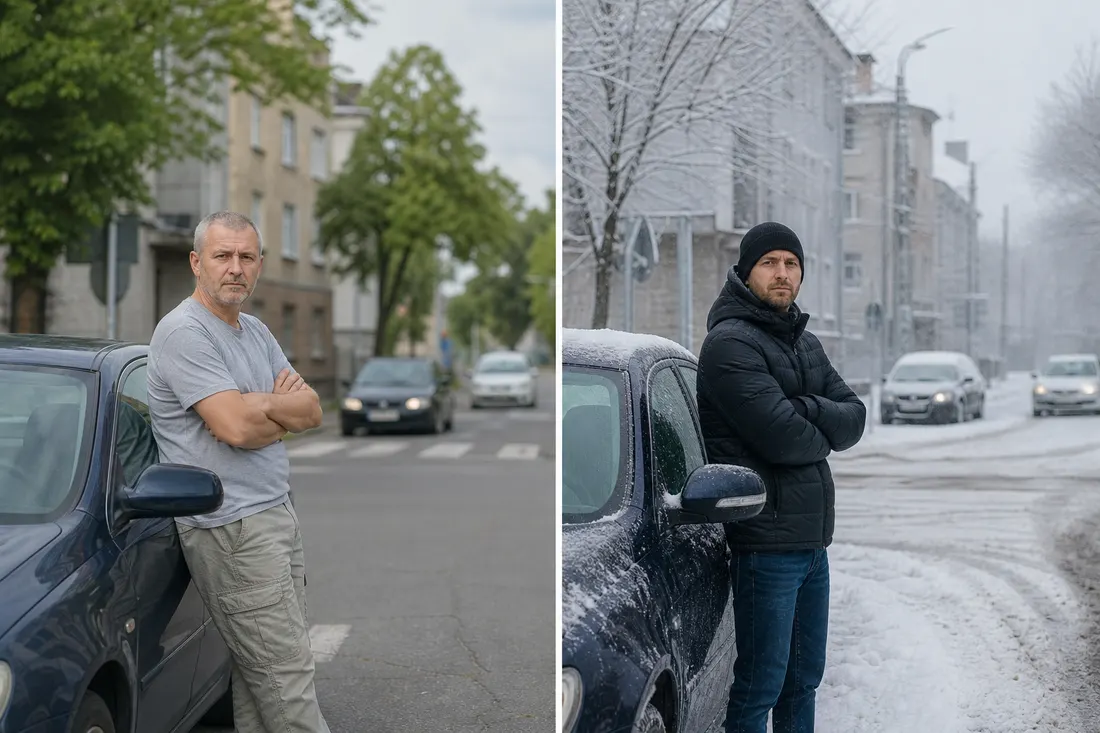
At 7:43, almost identical things happen on two different streets. Two drivers are traveling a little faster than they should. Both lower their eyes to their phones for a few seconds. In that moment, both knowingly trade attention for convenience. The first passes an empty crosswalk and remembers nothing that evening. A person steps into the second driver's lane from behind a parked van. The braking distance ends several metres too late.
One was irresponsible. The other killed someone.
This is a model scenario, not a description of a real case. The conditions are deliberately simplified: the same rule violation, a comparable risk, the same level of attention, and no difference in intent. The only variable is meant to be the outcome, which neither driver fully controlled at the moment of decision.
The intuitive judgment comes quickly. The first is a gambler, perhaps a fool. The second is the person who caused a death. There will be photographs, a case file, survivors, a courtroom, and a date that forever divides someone's life into before and after. There will probably be nothing about the first.
But the question is not whether two equally serious things happened. They did not. The question is whether both people made an equally blameworthy decision —and whether the chance difference between their outcomes may retroactively change the amount of their guilt.
Behind the wheel, they created the same danger. In the world, they did not leave the same mark.
At first glance, this looks like a dispute between common sense and oversensitive philosophy. In reality, it is one of the hardest problems in moral responsibility. Once we admit that an outcome changes guilt, we hand part of the moral judgment over to chance. But if we remove outcomes entirely, we risk erasing the victim, causation, and the real world from the moral picture.
The word “guilt” conceals at least six different questions
In everyday speech, guilt is a single word. In moral philosophy and criminal law, it is a bundle of different judgments that often move together—but need not. If we fail to distinguish them, the dispute is lost from the start: one side is talking about intent, the other about a dead person.
From intent to punishment: six layers of responsibility
Editorial modelIntent asks what a person wanted or accepted. Action describes what they did. Risk assesses danger from the standpoint of the moment of decision—not with knowledge of what has already happened. Causal responsibility connects an action to a specific outcome. Outcome captures actual harm. And response is the separate question of what morality, law, and society should do about it.
In Czech criminal law, “culpability” is not synonymous with all moral guilt. It is a legal category of intent or negligence under Sections 15 and 16 of the Criminal Code. Criminal liability also requires the other elements of a specific offence to be present. Moral condemnation, causal responsibility, and legal guilt may overlap, but they are not identical.[10]
This is where the first simple judgment falls apart. Two drivers may be equally negligent, yet only one may be the cause of a death. They may be equally blameworthy in the degree of their negligence and still be responsible for different ranges of facts.
When chance enters only after the decision—and still changes the judgment
There is a term for this problem: moral luck. In the second half of the 1970s, Thomas Nagel and Bernard Williams used it to name a conflict between two beliefs that sound reasonable but begin to destroy each other when applied together.[1][2][3]
Yet ordinary morality does exactly the opposite. We usually judge an unsuccessful murderer whose bullet happens to miss differently from a successful murderer. We judge a driver who neglected the brakes and arrived without an accident differently from a driver with the same neglect whose path a child crossed. The Stanford Encyclopedia of Philosophy calls this kind resultant luck —luck in how an action turns out.[1]
Four places where chance enters responsibility
Philosophical mapThe problem goes deeper than a pair of an unlucky and a lucky driver. Chance also determines which situations a person encounters, what character genes and upbringing helped create, and what chain of causes preceded a choice. Nagel's provocative conclusion was that if we apply the control principle without exception, the space left for a “pure” agent may shrink almost to nothing.[1]
That does not mean responsibility is an illusion. It means no judgment is formed in a laboratory vacuum. A person acts in a world they did not choose, with traits they did not create from nothing, and with consequences they can never fully control. The question is therefore not how to remove chance from morality. That cannot be done. The question is which parts of it we may allow to change our judgment.
We do not see the outcome only at the end. We project it back onto the beginning.
If people simply said “the decision was the same, but the harm was different,” the problem would at least be clear. Psychological experiments show something more troubling: once we know the outcome, we often begin to judge the quality of the original decision differently as well.
In their classic 1988 study, Jonathan Baron and John Hershey presented participants with decisions made under uncertainty. Although the choice itself and the information available to the decision-maker were the same, a favourable outcome led to a better evaluation of the decision than an unfavourable outcome. The authors called this phenomenon outcome bias.[4]
Francesca Gino, Don Moore, and Max Bazerman later showed a similar effect in ethical judgments in an influential working paper based on six experiments. The same problematic action was condemned more harshly when chance produced a bad outcome. In their sixth study, 142 participants rated the ethics of an action on a scale from 1 (unethical) to 7 (ethical); the mean rating was 3.74 for a positive outcome and 2.49 for a negative outcome.[5]
The same action, a different ethical evaluation
Actual dataA newer preregistered replication of the first two experiments refined the original picture. In a sample of 402 people, the difference appeared more convincingly in attributed guilt and deserved punishment; only some scenarios replicated for the judgment of unethicalness itself. The graph above is therefore not a universal law of the human mind. It is one result within a broader but variable pattern: outcomes especially affect how much guilt and punishment we are willing to assign, but do not always affect our judgment of the choice itself with the same force.[5]
This is not merely the conscious rule “greater harm, greater punishment.” An outcome can change our reconstruction of the past. Across ten preregistered experiments with 2,043 participants, Markus Kneer and Izabela Skoczeń found that a harmful outcome retrospectively increased perceived likelihood of harm. That, in turn, increased attributed negligence and culpability. In other words: once we know a catastrophe happened, the risk before it seems more foreseeable than it did beforehand.[7]
Yet even here it would be unfair to close the matter with the sentence “people are irrational.” In two experiments, Gavin Nobes, Georgia Panagiotaki, and Justin Martin showed that perceived negligence had a strong influence when people judged accidental harm. When outcomes differed substantially, the outcome had a direct effect mainly on punishment, while its influence on judgments of wrongness and guilt was largely mediated by people inferring greater negligence from the outcome.[8]
An outcome can be a bias. Sometimes it is also information.
In a clean experiment, all circumstances can be held constant while only the ending of the story is changed. In a real case, a serious outcome may reveal a speed, force, duration of exposure, procedural breach, or causal connection that was not previously known. The right approach is therefore not to ignore the outcome, but to prevent it from rewriting without evidence what was foreseeable ex ante.
The distinction is crucial. We may derive new evidence from an outcome. We must not automatically manufacture prior foreseeability from it.
An outcome is not merely noise. It creates a relationship with a victim that did not exist before.
Now the pendulum must swing back. If the difference between our drivers were merely an error of thinking, ideal morality would remove it. Both would receive the same moral bill because both accepted the same risk. But the second driver is not merely an unlucky person with an identical decision-making process. He is also the cause of a specific death.
In research on moral judgment, Fiery Cushman distinguished several types of evaluation. Judgments of whether an action was wrong or permissible rested mainly on the agent's mental state—beliefs and intentions. Judgments of guilt and punishment, however, responded both to intent and to the causal connection with a harmful outcome.[6] Human judgment therefore need not use a single measure. It can say at the same time: “The choice was equally wrong” and “you are the one behind this outcome.”
Bernard Williams used the idea of agent-regret — agent-regret. A driver who hits a person without negligence of their own may reasonably feel something different from a detached observer, even though they are not more morally guilty. It is not merely general sadness about a misfortune. It is the awareness: this happened through my action, through my car, in my story.[3]
For the negligent driver, this relationship is stronger. They must face the bereaved, compensate the harm, undergo an investigation, and explain why they accepted a risk that became a death. The lucky driver has no such duties toward a specific victim—because no specific victim came into existence.
This is not a magical transformation of past character. It is a change in the scope of responsibility.
One of the most precise ways out of the paradox therefore distinguishes the degree of guilt from its scope. A successful perpetrator may be responsible for more things—for example, a death—without being morally worse to the same degree than someone who attempted the same thing and failed only by chance. This possibility is explicitly discussed in contemporary philosophical literature.[1]
The law punishes chance. At the same time, it tries to tame it.
Criminal law cannot remain a pure moral theory. It must classify conduct, prove causation, protect those harmed, impose sanctions, and distinguish predictably between endangerment and actual harm. That is why an outcome sometimes forms an element of the offence itself.
The Czech Criminal Code does not use a single principle. It creates a system that treats intent, negligence, attempt, outcome, and punishment differently in different places. The current text verified on August 15, 2026 reveals several important layers.[10]
How Czech criminal law works with outcomes
A simplified legal mapAttempt shows an effort to punish choice, not merely luck
Under Section 21, an attempt is conduct that immediately aims at completing an offence, is driven by the intent to commit it, but does not reach completion. An attempt is punished within the sentencing range set for the completed offence. For murder under Section 140(1), the basic range is ten to eighteen years; the same statutory range is therefore the starting framework for attempted murder.[10]
That does not automatically mean the same sentence. Section 39 requires the court, in an attempt case, to consider how close the conduct came to completion and why completion did not occur. Section 58(8) also allows, under certain conditions, a sentence below the lower end of the range if applying it would be disproportionately harsh in light of the nature and seriousness of the attempt. The law therefore says on the one hand that a perpetrator's failure need not erase their intent; on the other, it leaves room to distinguish incomplete conduct from a completed tragedy.[10]
In negligence, an outcome can create an entirely different offence
Negligent homicide under Section 143 requires the perpetrator to cause death through negligence. Without a death, this specific offence does not arise. The law distinguishes a basic case from aggravated forms linked, for example, to a breach of an important duty or a gross violation of workplace or traffic safety rules.[10]
At the same time, endangerment offences make it possible to respond before a tragedy occurs. Section 274, for example, penalizes performing a dangerous activity while incapacitated by an addictive substance; causing an accident, bodily harm, or another serious consequence may then lead to a higher range. The same section thus places danger and actual outcome side by side—and the outcome changes the legal seriousness.[10]
Czech law therefore does not resolve moral luck with a single verdict. It neutralizes some of it by criminalizing attempts and endangerment offences. It accepts some of it by allowing an actual outcome to establish or aggravate responsibility. And when imposing a sentence under Section 39, it considers not only outcomes but also the degree of culpability, the manner of execution, the circumstances, motive, and aim.[10]
It is not pure philosophical consistency. It is a compromise between responsibility for a choice and responsibility for the world that choice actually created.
Two kinds of justice look at the same moment from opposite sides
The justice of choice
Both actors had the same information, accepted the same risk, and exercised the same degree of control. A harsher conviction for the unlucky actor therefore punishes something they did not choose. Moral evaluation should be frozen at the moment of decision.
The justice of outcome
One person actually entered the life of a victim and those close to them. Causation, harm, and a duty to repair are not illusions. A moral and legal response that ignored them entirely would be precise about the perpetrator but blind to what happened.
The strongest argument for equal guilt
Return to the moment just before the crosswalk. At this point there is neither a dead person nor a lucky return home. There are two drivers, two phone screens, and two equally unjustified wagers with someone else's safety. Each controlled the same things: whether to look, whether to slow down, whether to accept the risk. Neither controlled who would step out from behind the van one second later.
If we assign the second person greater blameworthiness of the choice merely because of the pedestrian, we are using the outcome as a moral lottery. Out of a million similar risky acts, we punish most harshly those in which the rare possibility occurred, while equally reckless people remain morally cheaper simply because their surroundings were lucky.
Sanford Kadish described this problem in criminal-law theory as “luck of the draw.” The criticism is not directed against recognizing harm. It is directed against letting a chance outcome determine desert of punishment in a way that obscures the equal blameworthiness of the original act.[9]
A preventive paradox also emerges. The lucky risk-taker receives a false lesson from reality: nothing happened, so it probably was not that dangerous. The unlucky one receives the fullest lesson only after it is too late. A system based mainly on outcomes punishes catastrophes but may fail to capture the creation of risk.
The strongest argument for a different response
Now move beyond the crosswalk. One branch of the world contains danger that has passed. The other contains death, trauma, financial losses, an investigation, and a relationship between the perpetrator and the people whose lives were affected. If we claim these worlds should provoke exactly the same response, we confuse a fair measure of guilt with the full shape of responsibility.
Cause has moral significance. Whoever breaks a window owes the repair, even if someone else threw the same stone and missed. Whoever injures someone has a duty to help and bear consequences that a person with an identical failed attempt does not. Compensation, protecting the victim, acknowledging harm, and repairing damaged relationships are not measurements of the perpetrator's inner character. They respond to a fact that came into being.
The same distinction may apply to part of a sentence. A sanction is not merely a mathematical expression of moral wrongness. It also serves protective, preventive, reparative, and publicly acknowledging functions. Society may legitimately treat a completed killing as a different object of legal response from equally dangerous conduct without a victim—without claiming that chance retroactively made the perpetrator's mind worse.
This is where the original question stops being enough. “Are they equally guilty?” is too crude. We must ask: guilty to the same degree in what respect, responsible for what and a different sentence for what reason?
A fair court needs two cameras: one before the act and one after it
The first camera stands before the decision. It does not know the outcome. It sees the information available to the person, the probability of harm, the alternatives, the reason for acting, the intent, and the degree of negligence. This camera protects against hindsight distortion. It forces us to ask whether the choice would be wrong even if everything had turned out well.
The second camera stands after the act. It sees the causal chain, actual harm, the victim, and the need for help, compensation, and protection. This camera protects against the opposite blindness: a theory in which a completed tragedy is merely the statistically unlucky version of the same abstract risk.
The error arises when we use one camera to do the work of the other. We infer from the image of a dead person that the risk must have been obvious. Or we infer from identical negligence that both actors have identical duties after the act.
Equal blameworthiness need not mean equal responsibility. Different responsibility need not prove a different character.
For the model pair, one can argue that the moral wrongness of the original choice and the degree of negligence are the same. At the same time, one can argue that only one person is responsible for the death, has special duties toward the victim, and may face a different legal response. The dispute is therefore not whether the outcome exists, but how much punitive severity it may justify on its own.
This view does not resolve every case. Real acts are not perfectly paired. An outcome often brings new evidence about risk, causation, and the actual degree of negligence. People also differ in whether they prevented the outcome by changing their conduct or merely because of chance. Voluntarily stopping an attack is not the same as a bullet stopped by a defective weapon. A driver who brakes immediately after a mistake and offers help is not the same as one who continues and flees.
That is why no universal equation can be written: “same intent = same sentence.” But we can formulate a discipline of judgment:
This matters more than choosing a single philosophical slogan. It reveals when a sentence truly expresses a difference in culpability—and when it merely converts bad luck into years of imprisonment without precise justification.
Two identical people did not remain on the road. But neither were they as different as they seem.
Return to 7:43. The first driver lifts his eyes from the phone, passes the empty crosswalk, and continues. His decision dissolves into thousands of events we will never know about. The second lifts his eyes the same fraction of a second too late. His decision receives a name, a case number, and the face of a person who will never get up again.
Before the crosswalk, they were morally closer than our first judgment admits. Beyond the crosswalk, they are farther apart than a pure control principle admits.
The first was lucky, but his luck does not make him a safer person. The second was unlucky, but his bad luck does not erase the cause, the victim, or the duty to bear the consequences. Justice must hold both sentences at once—and must not let one silence the other.
Chance does not change past intent. But it changes the world for which we ask a person to answer.