

Article contents
- The man who looks guilty
- Behavior is not an imprint of guilt
- Fifty-four percent
- A contradiction is not the same as a lie
- Anger that condemns the innocent
- There is no right emotion
- Silence and cooperation
- When our expectations fail
- Fleeing and other strong signals
- How an impression becomes evidence
- What behavior can honestly tell us
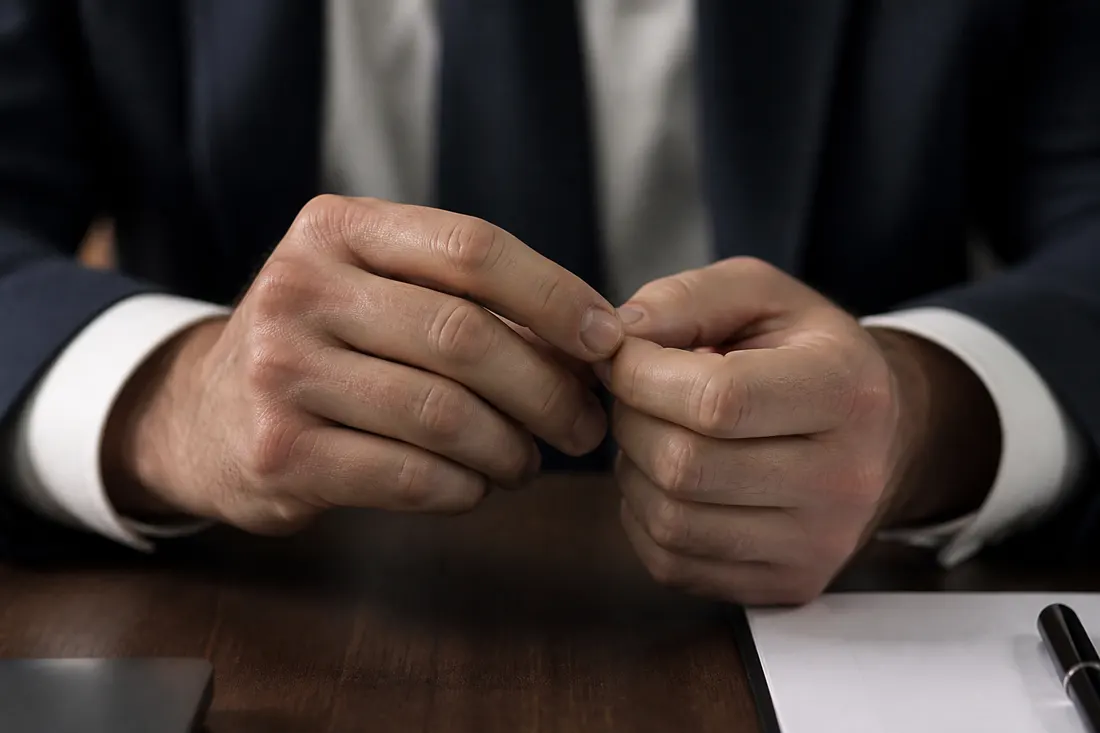
He sits opposite the investigator, avoids eye contact, and corrects his answer to a simple question twice. When the victim's name is mentioned, his jaw tightens. A moment later he bursts out: “This is absurd.” Then he refuses to continue without a lawyer. If we saw only a few minutes of the recording, many of us would be certain.
The man who looks guilty
Hypothetical situation · 02:17
The man first says he left the house around half past nine. Ten minutes later he says it may already have been after nine. When asked about his phone, he rubs his hands. He reacts to a crime-scene photograph with almost no expression.
When the investigator points out the contradiction, the man becomes angry. In the end, he stops answering. The separate images fall into place and create a story: he is hiding something, choosing his words carefully, merely performing emotion.
This story may be correct. A guilty person may be nervous, change their account, control their emotions, and refuse questions because they are trying to prevent discovery. The mistake does not begin when we allow for that possibility. It begins when we mistake it for the only explanation.
The same man may have misjudged the time because he never encoded an ordinary evening precisely. He may know nobody will believe him because he previously lied to the police about something entirely unrelated. He may feel ashamed of something unrelated to the crime. He may be sleep-deprived after several hours, frightened, traumatized, neurodivergent, or simply someone whose face under pressure does not look the way people imagine an innocent person should look.
Our intuition has a peculiar property: it does not tolerate the blank space between behavior and its cause very well. It fills that space. A lowered gaze acquires meaning. Silence acquires meaning. Anger acquires meaning. And because guilt provides a coherent story, every sign starts being read in the same direction.
Particularly deceptive is behaviour that can mean several things, but appears to the observer to mean only one.
Behavior is not an imprint of guilt
A fingerprint is created by direct contact. DNA has a biological mechanism. A phone-location record has a technically describable origin. Behavior works differently. It is the product of many systems converging in a single moment: memory, attention, physiological arousal, personality, social expectations, experience with authority, and the strategy a person chooses.
Nervousness is therefore not “guilt escaping the body.” It is a nonspecific response to threat. And an accusation is a threat even to an innocent person: they may lose their freedom, job, relationships, reputation, or even the chance to be heard. The organism does not distinguish whether the danger is fair. It responds to its intensity.
A review by Aldert Vrij, Marie Hartwig, and Pär Anders Granhag concludes that the nonverbal cues of deception found so far are weak and unreliable. This does not mean that there are no statistical relationships between lying and behavior. It means their overlap with the behavior of truthful people is too large for simple individual judgments: one glance away, one pause, or one restless movement does not move a person from “we do not know” to “guilty.”[2]
Causal map
One behavior, several paths
This is where the basic logical error arises. The question is not only: “Can a guilty person behave this way?” The answer is often yes. The diagnostic question is: “How often do innocent people also behave this way under the same circumstances?” Until we know the second part, we do not know how much weight to give the sign.
Fifty-four percent: how accurately do we read a lie?
A large meta-analysis by Charles Bond and Bella DePaulo combined the results of 206 documents and 24 483 observers. They distinguished truthful from deceptive statements without technical aids. The average success rate was 54 %—only slightly above fifty-percent chance. They correctly identified 47 % of lies, while 61 % of truthful statements were correctly classified as true.[1]
These figures are not a verdict on every experienced investigator and do not mean that no method can improve performance. The meta-analysis included different laboratory tasks, different kinds of lies, and different observers. Its value lies elsewhere: it shows that spontaneous “reading of a person” is not the precise biological sensor we often take it to be.
Actual data
Detecting lies without aids
The difference between truth and lies is also interesting. Observers more often accepted a statement as truthful than correctly detected a lie. That may help in ordinary life: society would fall apart if we tested every sentence as suspicious. But once we suspect someone, this default mode can reverse. We start looking for deviations and reading every deviation as confirmation.
Confidence does not necessarily grow with accuracy. The feeling “I can tell” is a psychological sensation, not a measurement protocol. A person may be rightly suspicious and still choose the wrong reason. They may detect a lie because of a verifiable contradiction, but attribute their success to the suspect “blinking strangely.” Next time they use blinking without a contradiction—and intuition convinces itself that it works.
A contradiction is not the same as a lie
A changed account feels more serious than a lowered gaze. It is observable, comparable, and sometimes genuinely important. But the simple equation still does not hold. Memory is not a camera, and stress does not have one single effect. A meta-analysis of 113 independent studies with 6 216 participants showed that the effect of acute stress depends on timing: stress can disrupt some phases of memory and under narrow conditions strengthen others. Across studies, however, it significantly impaired recall of information already stored.[4]

This matters for testimony. A person may experience an event but not have equally easy access to it when asked. They may first recall the outline and the detail later. They may correct a time estimate using a receipt or a phone message. They may confuse the order of two routine actions. A correction is then not proof of an original lie; sometimes it is evidence that recall is still taking shape. that recall is still taking shape.
Major contradiction
Changes the possibility of the event itself: the person first denies being at the scene, then admits it. Such a contradiction requires careful verification and may have high evidentiary value in the context of other findings.
Peripheral contradiction
Concerns a detail that was not the focus of attention: the exact minute, the order of routine actions, the color of a secondary object. Its significance depends on the conditions of perception, the time elapsed, and how the question was asked.
Paradoxically, even perfect consistency is not automatically a sign of truth. A person who has created a simple script may repeat it almost word for word. Research on repeated interviews starts from the problem that liars sometimes use a “repetition strategy” and are not generally less consistent than truth-tellers. In one experiment, the difference emerged only after a targeted procedure: an unexpected repeat interview a week later, separating central from peripheral questions, and increasing cognitive load. Only under those designed conditions were liars less accurate, less consistent, and more evasive.[3]
This is an important shift. A contradiction is not a magic word. It is a place for another question. Its meaning does not come from its mere existence, but from what it concerns, when it arose, how the question was asked, whether the person gained new information, and whether one version can be independently verified.
What the research does not show
We cannot claim that stress explains every contradiction, that trauma automatically confirms truth, or that every later memory is more accurate. These are alternative mechanisms that must be tested—not universal excuses.
Anger that condemns the innocent
The accused slams a palm on the table. Raises their voice. Starts attacking the investigator's fairness instead of calmly explaining the facts. The intuitive translation is: they lost control because a sensitive spot was hit.
A series of six studies published in Psychological Science described the opposite paradox. Thousands of online participants and a group of professionally experienced fraud investigators and auditors used an accused person's anger as a signal of guilt. In further experiments, however, people were angrier when they were falsely accused than when the accusation was justified. The authors therefore found no valid signal of guilt in anger in these tasks; instead, it was associated with innocence.[5]
Experimental paradox
What the observer thinks—and what the situation caused
Why should a false accusation provoke more anger? A sense of injustice and loss of control is one plausible explanation: the person is not only facing consequences but also knows that, in their view, the reason is untrue. That is a plausible mechanism, not the one proven cause of every outburst.
More important is something else. The observer assigned meaning to the emotion according to their own script, not according to its actual source. Anger looked to them like a leak of aggressive character or a defensive strategy. They did not see injustice because they had already assumed guilt. The same emotion thus arose from innocence and served as an argument against it.
There is no right emotion
If anger looks suspicious, calm may seem like a safer alternative. Yet excessive calm may be read as coldness, rehearsed behavior, or a lack of connection to the victim. Tears may increase credibility, but may also look theatrical. A person finds themselves in a narrow corridor of expected emotion whose boundaries nobody knows precisely.
A meta-analysis of twenty experimental studies with 3 128 participants examined ratings of adult women reporting rape. Distress—such as visible agitation—increased perceived credibility by a small to medium effect. Participants included laypeople, mock jurors, and justice professionals.[6]
The result matters precisely because of its limits. The studies measured an impression of credibility, not objective truth. They concerned a specific type of complainant and simulated decision-making situations. They cannot simply be applied to all victims, witnesses, or suspects. They do show, however, that emotion affects evaluators even when it is not independent evidence of an event.
Trauma also need not look like continuous despair. Some people may appear detached, matter-of-fact, or slow to respond; others may be overwhelmed. Neither image alone confirms that trauma occurred. An unusual reaction does not disprove trauma either. The honest conclusion is less dramatic: emotional style should be described, but its cause cannot be diagnosed by looking.
Silence and cooperation: a trap for both sides
“If you did nothing, you have nothing to hide.” The sentence sounds like common sense because it links innocence with openness. In reality, it creates a double trap. A person who speaks may make a mistake under stress, offer an incomplete alibi, or be misunderstood. A person who stays silent may look like someone afraid of the truth.
A 2024 study in an American legal context found that suspects who invoked their rights or remained silent were judged more negatively and as guiltier than those who waived their rights and spoke. Participants also assigned them more investigative time. The authors called this effect the “Miranda penalty”—a psychological penalty for using a right intended to protect a person.[7]
Two decades earlier, another experiment showed the mirror-image problem. In the mock situation, 81 % of innocent participants waived their rights, compared with only 36 % of guilty participants. Many innocent participants explained the choice by believing they had nothing to hide and the truth would protect them.[8] The authors linked this to the “phenomenology of innocence”: an innocent person may underestimate risk because they do not know the compromising fact they would need to explain strategically.
The legal context matters
Both cited studies come from the American system and Miranda rules. They say nothing directly about Czech procedural law or how a particular silence should be assessed legally. Psychologically, however, they illustrate a broader conflict: people may see the use of a protective right as a sign of guilt, while genuine innocence may lead a person to cooperate in a dangerously excessive way.
Cooperation is therefore not a certificate of innocence, and refusing to cooperate is not a confession. Either may be a guilty person's strategy, an innocent person's reaction, a lawyer's advice, an experience from earlier proceedings, distrust of the institution, or an attempt to regain control in a situation where a person has almost none.
When our expectations fail, not the person
When assessing behavior, we unconsciously use a template of “normal” presentation: adequate eye contact, fluent answers, appropriate facial expression, the right amount of emotion. But the template is not universal. It differs between people, cultures, diagnoses, and situations.
In a study with thirty autistic and twenty-nine neurotypical adults, 1 410 raters watched video recordings. When giving truthful accounts, autistic participants were perceived as more deceptive and less credible than neurotypical participants. The effect was not simply explained by individual observed behaviors—such as avoiding eye contact or flat affect— but by the person's overall presentation.[9]
This is an exceptionally important result, but again not a universal verdict. The sample of speakers was limited and the interviews simulated. It does not mean that every autistic person appears a certain way or that knowing a diagnosis automatically corrects evaluation. It shows something more precise: when an observer's expectations do not match another person's natural communication style, the difference may be mistaken for deception.
Similarly, direct eye contact may express sincerity in one culture and disrespect in another. A person speaking a second language may answer more slowly, monitor their grammar, and seem less spontaneous. An introvert may reduce speech under pressure, while an extrovert may fill the space. This is not a reason to discard behavioral observations. It is a reason not to treat one's own norm as a neutral measure.
Fleeing and other strong signals
Some signs intuitively carry more weight than nervous hands. A person runs away, deletes messages, lies about a secondary circumstance, or tries to avoid contact. It would be a mistake to pretend that such behavior cannot increase suspicion. It can. But it still contains no explanation of its own.
Fleeing may be a response to awareness of a specific guilt. But it may also relate to another offense, a wanted object, an old warrant, panic, intoxication, fear of the police, or the belief that the situation cannot be explained. Deleting messages may conceal a crime, an affair, an information source, a drug contact, or something entirely different. The alternatives are not equally likely, but until they are examined, none may be declared to be the meaning of the act itself.
A simple but often overlooked change in the question helps here. Do not ask only: “Is this behavior compatible with guilt?” It is almost always possible to find behaviour compatible with guilt — but that alone does not distinguish guilt from innocence. Also ask: “Which competing explanations predict the same thing, and what independent data would distinguish them?”
Decision framework
From a sign to a testable hypothesis
How an impression becomes evidence
A central risk does not come from one mistaken reading. It comes from a chain that reinforces itself. The investigator develops an initial suspicion. Because of it, they ask harsher and more accusatory questions. The suspect reacts more defensively, more curtly, or more angrily. That reaction then looks like confirmation of the original suspicion.
An experiment by Saul Kassin, Christine Goldstein, and Kenneth Savitsky tested this mechanism in mock interrogations. Interviewers were primed to believe that most suspects were guilty or innocent. The assumption of guilt affected interviewer behavior, suspects' subsequent behavior, and neutral observers' judgments. The authors described this process as behavioral confirmation: expectations do not merely sort information; they help create an interaction that begins to resemble them.[10]
This does not mean that a firm interrogation is automatically wrong or that a defensive reaction is never meaningful. It means that observed behavior is not always independent of the method that elicited it. If the tone, length, timing, level of accusation, or sense of safety changes, the person opposite may change too—without any change in actual guilt.
And this is where the whole problem changes. We are no longer examining only whether we can read a person. We are also examining whether we wrote some of what we are reading ourselves.
What behavior can honestly tell us
It would be convenient to end the article by saying that behavior means nothing. That would not be true. Behavior can reveal a change of subject, point to a detail that needs checking, show overload, suggest a strategy, or help decide how to conduct a conversation. Its value grows, however, when it stops functioning as a verdict and starts functioning as a question.
-
Separate observation from interpretation “He looked away for seven seconds” is an observation. “He was ashamed of a lie” is a hypothesis. Recording both sentences as the same thing destroys the ability to test the hypothesis.
-
Compare the person mainly with themselves A change from their usual presentation may be more informative than a deviation from a general idea of normality. Even a change does not by itself say why it occurred.
-
Look for competing explanations For every suspicious sign, formulate at least one innocent and one unrelated alternative. Not to minimize guilt, but to find what distinguishes the versions.
-
Prefer testability to impression A timeline, digital trace, physical finding, or independent witness is different in kind from facial expression. Behavior can show where to look; it should not replace what we find there.
-
Keep asking what would disprove the theory A hypothesis that explains nervousness, calm, anger, tears, and silence as evidence of guilt explains nothing. It has merely become unfalsifiable.
A more precise approach is therefore not softer. It is more demanding. It forces us to distinguish signal from noise, a major contradiction from ordinary imprecision, justified suspicion from a story that no longer wants to be disproved. It protects the innocent, but also the investigation: when too much energy is spent confirming an impression, the actual perpetrator may gain time.
Let us return to the room at two seventeen. The man still looks away. He still corrected the time. He still became angry and asked for a lawyer. After the entire article, we do not know that he is innocent.
We do know, however, that his behavior alone is not enough to know that he is guilty. The contradiction must be verified. Anger must be placed in context. Silence must be separated from its legal and strategic meaning. An unusual sign must be compared with the person, not with a film-made idea of innocence.
The original picture has not fallen apart. It has merely lost its monopoly. Beside the story of guilt, other possible stories have appeared and each must pay the same price: produce testable predictions.
The interrogation room does not show a person without a mask. It often shows only what an interrogation room does to a person.