

We tend to think that we simply move through a city, carrying our decisions within us. Yet a pavement can offer a route—or break it into a sequence of obstacles. A bench can invite someone to stay—or quietly determine how long they are allowed to remain. Streets, lighting, noise, public transport and even the absence of a toilet do not command us. But they alter the cost of each option. And in doing so, they subtly change what we are likely to do in the city.
One kilometre, two different decisions
It is Saturday morning. Someone needs to walk to a pharmacy roughly one kilometre away.
In the first city, a person leaves home onto an uninterrupted pavement. Along the way, they pass trees, several open shops and a transit stop. Crossings lie in the natural direction of travel, cars move slowly and the street can be crossed without a long wait. Before they have time to calculate whether walking is worth it, they are already on their way.
In the second city, the distance is identical. But after a few hundred metres, the pavement ends at a car park. A broad road cuts across the direct route, and the nearest safe crossing requires a detour. Parking outside the pharmacy is easy; walking there demands a series of small decisions: how to get around the slip road, where to cross, whether to squeeze past the crash barriers. The person reaches for the car keys.
At first glance, we have watched two personal choices. In one case, walking won; in the other, the car did. It would be easy to read a difference in character into this: the first person is more active, patient or environmentally conscious; the second more comfort-seeking or lazy.
Yet it may be the very same person.
Neither the person’s will nor the distance changed. What changed was the cost of the two options. One route made walking feel self-evident; the other turned it into a small project. In the second case, taking the car was not a moral failure. It was a response to the offer the built environment had assembled.
This is where the city’s second layer begins. A city is not only a place in which people make decisions. It is also a system that adds time, money, effort, risk, discomfort and social meaning to each of those decisions.
It does not tell us what we must do. But it creates a silent price list of what will be easy.
The city as a silent price list of choices
Urbanism is usually described in the language of buildings, streets, blocks, parks and transport networks. For the person moving through it, however, the same structure appears differently: as a set of possibilities.
A door offers passage. Stairs offer ascent to someone who can use them—and an obstacle to someone in a wheelchair or pushing a pram. A well-lit path offers an evening shortcut; a dark underpass can psychologically lengthen the same distance. A bench offers a pause. A public toilet makes a longer stay away from home possible. A stop with frequent service offers the freedom not to plan every journey in advance.
Environmental psychology uses the term “affordance”: an environment is not merely seen; it also suggests what can be done within it. This idea must not be allowed to slide into the notion that paving stones control the human mind. The same feature can offer different possibilities to different people, and people often use spaces in ways their designers never intended.
It is more accurate to speak in terms of probability.
Meta-analyses in transport research find associations between access to destinations, street-network connectivity, density or mixed land use and the way people travel. The effects are neither magical nor equally strong everywhere. But they show that a route to a shop, school or transit stop is not neutral geometry. Its design changes the relative attractiveness of walking, public transport and driving.[1]
That distinction matters. “The city causes behaviour” is too crude a claim. “The city changes the conditions under which a behaviour becomes worthwhile” is less dramatic, but more accurate.
A city is not a script that people perform without thought. It is a silent price list of possibilities.
Friction: small obstacles, a large cumulative effect
Each individual obstacle is almost negligible. A kerb. An extra minute of waiting. No shade. A crossing a hundred metres farther away. A timetable that thins out in the evening. A bench without a backrest. Noise that makes a phone call impossible. Rarely does any one of them decide the matter by itself.
But everyday behaviour does not arise from one great choice. It arises from repetition.
Friction is anything that raises the cost of a particular action. It need not be physical effort alone. Friction can be temporal, financial, informational, social or psychological. Confusing signage raises the cost of finding one’s way. An empty street raises the perceived risk for some people. A transfer without a lift increases the burden of travelling with a suitcase. Having to buy something in a café in order to use the toilet turns a public need into a private transaction.
The opposite of friction is not automatically convenience. It is a genuine ability to choose.
Walkability, or the ease with which an area can be navigated on foot, is therefore not an aesthetic score awarded to a street because it has a few trees. It depends on whether destinations are reachable, routes form a connected network, crossings are safe, pavements are continuous, the surroundings are legible and the journey is comfortable enough for different groups of people. Connections to public transport matter too: even the best service loses value if the final five hundred metres lead across a barrier.
A more recent study used people moving between US cities as a natural experiment. Among those who relocated to more walkable environments, the average daily step count increased; moving from roughly the lower to the upper quartile of walkability corresponded to about 1,100 additional steps per day. The effect worked in both directions and proved relatively persistent.[2] This is much stronger evidence than a one-off comparison of two neighbourhoods, but it is still not a random assignment of residents to cities. The authors worked with a particular sample of smartphone users, and walkability overlaps with other characteristics of urban life.
That caution is not a footnote. It is part of the point. A neighbourhood is not a laboratory, and a person is not a test animal. People have some choice over where they live, cities attract different groups, and architecture is entangled with income, age, culture, weather and politics.
Yet the underlying mechanism remains simple: when an environment repeatedly lowers the cost of one option and raises the cost of another, it need not control anyone in order to alter the aggregate behaviour of thousands.
Public space begins with the possibility of staying
Public space is often judged by how it looks in a photograph. For everyday life, a different question matters more: who can remain there, and under what conditions?
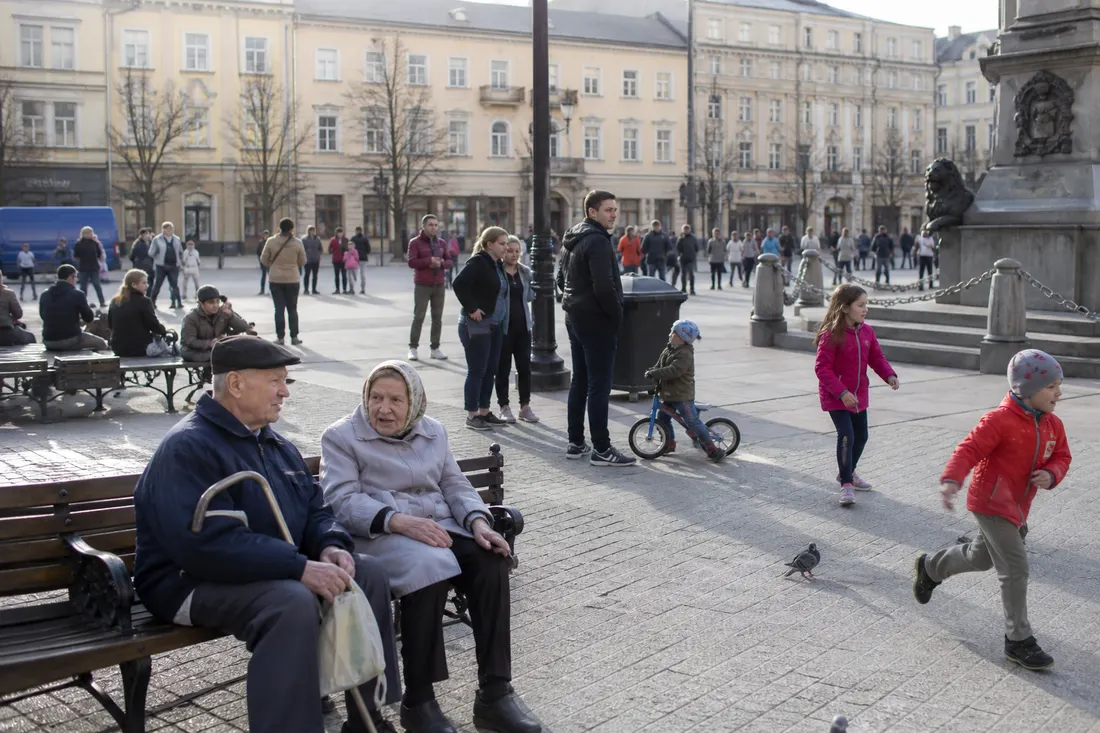
A bench appears to be a minor piece of street furniture. In reality, it extends the reach of the city. A person with limited mobility can travel only as far as the next place to rest. A pregnant woman, a parent with a child, someone recovering from surgery or anyone walking on a hot day does not read distance only in metres. They read it in available pauses.
Public toilets work in a similar way. Their absence is more than an inconvenience. For some residents, it imposes an invisible time limit on being away from home. A city may have a beautiful square, but if people cannot sit safely, drink water, find shade or reach a toilet there, it is public only in a limited sense. This is why the World Health Organization’s guidance for age-friendly cities addresses not only transport and health services, but also well-placed seating, toilets and accessibility.[3]
Green space is another example in which it is easy to overstate causality. A long-term panel study found an association between living in greener urban areas and better indicators of psychological well-being even after accounting for some stable differences between individuals.[4] That does not mean planting a tree will, by itself, “cure” stress. Greenery is often bound up with lower noise, shade, opportunities for movement, housing quality and socioeconomic status. It is a bundle of mechanisms, not a simple switch.
Noise, too, changes behaviour before it appears in health statistics. Loud environments shorten conversations, make concentration harder and can discourage people from staying. Long-term exposure to traffic noise is also associated in WHO guidance with sleep disturbance and other adverse effects, although the scale of risk depends on the intensity, duration and context of exposure.[5]
And then there is encounter. A square does not manufacture community, any more than a bench manufactures friendship. But it can make repeated presence possible: familiar faces, brief greetings, the chance to observe others, room for a market, protest, children’s play or a chance conversation. A systematic review of research on public space and social cohesion found numerous associations with accessibility, street furniture, mixed uses and the possibility of informal use. It also warned that much of the research is cross-sectional and that results are strongly conditioned by age, income, perceived safety and local culture.[6]
Public space therefore does not command social relationships. It allocates opportunities for them.
Transport Is Not Just Movement. It Is an Offer of Possibilities
Transport debates are often reduced to an argument over who receives how many metres of street. Yet allocating space also allocates time, risk and access.
A wide road may carry many vehicles, but for pedestrians it lengthens the crossing and increases the distance between the two sides of a neighbourhood. Vehicle speed is not determined by a sign alone. It is also shaped by what the street permits and visually suggests to the driver: lane width, sight lines, subdivision, the presence of pedestrians, parking, trees and the frequency of junctions. Research across different contexts repeatedly shows that design speed and the perceived character of a street matter to actual behaviour.
Speed is not an abstract parameter. The probability of a pedestrian suffering fatal injuries rises sharply with impact speed, even though precise estimates vary between studies depending on the data, the age of victims and the methodology used.[7] A street that presents itself as a through-route therefore changes not only objective risk, but also whether a parent is willing to let a child cross alone or whether someone chooses to walk there after dark.
Public transport works in much the same way. The mere existence of a route is not enough. Frequency, reliability, price, connections, accessibility, the quality of the stop and whether the service still runs when a shift ends all matter. Missing one tram on a five-minute service is an episode. Missing one bus on an hourly service changes the day’s plans. Formally, transport is “available” to both passengers; in practice, they have been offered something very different.
Road capacity is not neutral either. A well-known study of US metropolitan areas found that increases in highway capacity were accompanied over time by an almost proportional rise in vehicle miles travelled. Some of the new capacity was absorbed by changed routes, additional journeys, commercial traffic and shifts in settlement patterns.[8] This does not mean that every new lane is pointless, or that the result applies identically to every street. But it reveals a broader principle: infrastructure does not merely serve a fixed level of demand. It changes what becomes worthwhile for people and businesses to do.
Transport is therefore less like a pipe carrying a fixed volume of movement and more like a market of possibilities. Change the price of one form of mobility, and you also change the behaviour that depends on it.
Safety, light and the camera’s eye
Urban safety has at least two forms. One is the probability that something will happen. The other is the feeling that a space can be used without constant vigilance. The two may overlap, but they are not the same.

Lighting is a good example. It can improve visibility, orientation and the ability to recognise other people. For some, that lowers the psychological cost of an evening journey. But it is not true that every brightly lit space is automatically safe. Placement, glare, shadows, the presence of people, maintenance and surrounding routes all matter.
New York provided an unusually strong test: in a randomised experiment, temporary lighting towers were installed at selected public-housing developments. The study found a reduction in some forms of outdoor night-time crime at the treated sites.[9] This is important evidence because the finding was not based on correlation alone. At the same time, it is not a universal prescription for every neighbourhood. It concerned a particular intervention, in particular locations, over a particular period.
Cameras require similar caution. A meta-analysis spanning four decades of research into CCTV found a modest average reduction in crime, with the strongest and most consistent effects in car parks. Outcomes depended on the setting, active monitoring, coverage and whether cameras were combined with other measures.[10] A camera, then, is not synonymous with safety. It may deter, assist an investigation or increase the sense of control. But it can also displace behaviour beyond its field of view, create a false expectation of immediate help, or tell some people that they are first and foremost objects of suspicion.
Surveillance also changes the social acceptability of behaviour. A space filled with cameras, prohibition signs and physical barriers may be objectively well managed, yet subjectively communicate that people are only meant to pass through. Public gathering, protest, street music or simply lingering then acquire a different cost, even if none is forbidden.
Safety is therefore not produced by a single feature. It emerges from the relationship between design, management, people, institutions and trust. A camera can observe a space. On its own, it cannot create a public.
A camera can monitor a space. It cannot create a public on its own.
When a bench issues a wordless prohibition
Some urban features expand possibilities. Others are designed to do precisely the opposite.
Dividing armrests in the middle of a bench may help an older person stand up. They may also be positioned so that lying down is impossible. Metal studs on a ledge may protect the surface from skateboards—but also prevent anyone from sitting there. Sloping surfaces, stones in sheltered corners, locked recesses, timed sprinklers or seats too short for rest belong to the broader family of features known as defensive or hostile architecture.
The term “hostile architecture” gained currency above all in debates about displacing people experiencing homelessness. A study of the London controversy over metal spikes showed that the issue is not merely the design of an individual object, but the way a city translates a social conflict into the physical arrangement of space.[11]
The power of such architecture lies in the fact that it needs neither a police officer nor a sign. The rule is embedded in the material. The bench does not say, “Do not sleep here.” It simply creates a shape that a body cannot fit onto.
That raises an uncomfortable question: when a city makes a particular behaviour physically impossible, has it solved the problem—or merely moved it elsewhere?
For a person without a home, the answer is especially clear. Removing the possibility of lying down does not remove the need for sleep. It moves that need into a less visible passageway, a more distant stop or a more dangerous place. In an administrative report, the problem may disappear from one address; in the person’s life, friction has simply increased.
The impact is rarely precisely targeted. An uncomfortable bench does not deter only the person the design was intended to displace. It shortens the rest available to an older person, someone with back pain, a night worker and teenagers who cannot afford commercial space. Architecture can exclude without checking identity—and for that very reason, it excludes crudely.
None of this means that public space should have no rules. Cities must manage conflicts involving sleep, movement, noise, hygiene, safety and maintenance. The difference lies between addressing a cause and managing visibility. A defensive feature can work exactly as specified in one location and still leave the overall problem untouched.
In this sense, a bench is a small piece of social policy. It simply is not voted on like a law.
A person is not a product of the pavement
There is a fundamental objection to this entire argument: people are not passive products of their environment.
And that objection is correct.
People overcome barriers, create desire paths, move chairs, organise neighbourhood festivals in car parks and turn inhospitable corners into meeting places. Cultural practices can change the meaning of the same square. Someone who loves walking will walk even through an unfriendly environment; someone else will drive through a perfectly connected neighbourhood. Work, health, family, weather and personal preference can outweigh any design.
Causality also runs in the opposite direction. People do not merely adapt their behaviour to a city; through their behaviour and political decisions, they shape the city itself. Demand for parking produces more parking, improved public transport may attract new residents, and a lively street creates a market for additional businesses. Cause and effect circle back into one another.
Urban research therefore faces the problem of self-selection. Are people more active because they live in a walkable neighbourhood, or did they choose that neighbourhood because they were already more active? Is crime lower because of the area’s design, or because it has more resources for maintenance, services and surveillance? Does greenery improve mental well-being, or is greener housing associated with other advantages the data failed to capture?
Longitudinal studies, natural experiments and randomised interventions sometimes help. But they can never turn a city into a perfectly controlled laboratory. An honest conclusion will therefore often read: “there is an association,” “the result is consistent with this mechanism,” or “in this context, the intervention changed the outcome.” That is not a weakness of science. It is a precise boundary around what we know.
Rejecting determinism does not, however, mean returning to an image of completely free choice. Freedom is not merely the absence of prohibition. It is also the availability of feasible options.
The infrastructure of probable behaviour
As we move through a city, we can try a different kind of attention.
Look not only at façades, but at the moments when space makes something cheaper or more expensive. Where does the pavement continue, and where does it suddenly yield to a driveway? How long does a pedestrian wait compared with a car? Where can someone sit without paying? Who can reach the crossing button? Does a tree shade the route, or merely decorate the rendering? Where is the nearest toilet? Where is the camera pointing? Does the bench invite people to stay, or permit only a brief, obedient pause?
This way of looking does not divide cities neatly into good and bad. Every space must reconcile competing needs, and every design has side effects. A wider pavement may reduce space for deliveries. More light can disturb residents and nocturnal wildlife. Trees need room, maintenance and water. Public toilets require operation. Fewer barriers may mean more demanding management. Real urbanism is not a cost-free picture.
What changes is the question.
Instead of asking, “Why don’t people behave better?”, we can ask, “What price have we set for their choices?” Why does a parent drive a child a few hundred metres? Perhaps it is not merely habit, but a fast road with no safe crossing. Why is the square empty? Perhaps what is missing is not a cultural programme, but shade, a seat and permission to remain. Why do people from the urban fringe attend fewer evening events? Perhaps the last service takes them home before the event is over.
The city does not tell us what to do.
But every day it quietly tells us which decision will be easy, which uncomfortable, which expensive and which nearly impossible. It does not take away our agency. It becomes part of the conditions under which we exercise it.
And that is precisely why architecture is not merely a matter of appearance.
It is infrastructure for probable human behaviour.
The same map, a different city
On a map, distance is measured equally for everyone. In practice, there is no single kilometre, no single transit stop and no single park.
For someone with a car, a supermarket on the edge of town may be easy to reach. For someone without one, it means two bus routes and a walk along a busy road. A park may be five hundred metres from home, but on the far side of railway tracks with no nearby crossing. A doctor’s surgery may be in the same district, yet upstairs in a building without a lift. A night service may exist—just not in the direction used by people returning to cheaper outer neighbourhoods.
Urban access to services is therefore not the same as the number of services present. What matters is how much time, money, physical ability and planning a particular person needs to reach them. Theories of transport justice consequently propose judging a system by access to essential destinations and genuine opportunities, rather than speed or total volume of movement alone.[12]
This is where space meets social inequality. A wealthier household can buy back part of a badly designed city: through a car, taxis, a private garden, air conditioning, a paid toilet, a gym membership or housing closer to services. Someone on a lower income depends far more heavily on what public infrastructure actually provides.
Spatial segregation then distributes not only addresses unevenly, but also schools, social connections, green space, noise, commuting time and access to work. The Moving to Opportunity experiment, in which some families were given the opportunity to move to lower-poverty neighbourhoods, found long-term benefits for children who moved at a younger age.[13] Even this strong study design does not tell us that the results were caused by a particular street width or the presence of a park. A “neighbourhood” is a package of schools, institutions, peer networks, safety, labour markets, burdens and expectations.
This is precisely why it is dangerous to mistake urbanism for an all-powerful cure. It is equally dangerous to treat space as mere scenery. When opportunities are distributed unevenly and the routes to them carry different costs for different people, the city is already participating in social outcomes—even if it does not explain them in full.