
First impressionOne object, three possible rooms
The silver Boeing B‑29 bomber bears the name Enola Gay. On 6 August 1945, the atomic bomb dropped on Hiroshima was released from this aircraft. The metal fuselage, engines, rivets and traces of operation are material facts. This is not a replica of an opinion or a metaphor for history. It is a real machine that formed part of a real event.
Now imagine three galleries. In the first, the aircraft hangs among blueprints, engine cutaways and production statistics. Visitors read about long-range bombing, the pressurised fuselage, industrial capacity and the technological leap represented by the B‑29. Here, the exhibit tells a story of engineering.
In the second gallery, it stands beside maps of the Pacific War, documents on decision-making by the US leadership, casualty estimates and testimony from crew members. The same machine becomes a node of military strategy and political choice. In the third, it is surrounded by personal belongings from residents of Hiroshima, survivor testimony, data on the effects of the explosion and a timeline of nuclear armament. The technical artefact suddenly becomes a threshold into the history of human consequences.
The aircraft has not changed. None of these rooms need be lying. Each, however, asks a different question, gives different weight to the surrounding facts and guides the visitor towards a different conclusion.
A dispute of exactly this kind did, in fact, unfold around this aircraft. For the fiftieth anniversary of the bombing, the Smithsonian prepared a script of more than three hundred pages linking the end of the war, the decision to use the bomb, the experience of the crews, conditions in the affected cities and the beginning of the nuclear age. After a fierce public and political conflict, the concept was cancelled in January 1995. A markedly reduced presentation opened several months later: the fuselage, basic facts and information about the restoration were displayed without the broader interpretation and without images of the consequences.2
That does not prove that one version was true and the other propaganda. It is a particularly clear example of a different mechanism: the dispute was not about whether the aircraft was authentic. It was about what this genuine object should mean.
The second layerAn object is evidence. It is not a finished sentence.
A museum object can establish material, technique, dimensions, wear, style, original function or the fact that something physically existed. Its surface may preserve traces of use and its construction information no later text can replace. In that sense, authenticity is fundamental.
But an object has no verbs or conjunctions. It cannot say for itself: “therefore”, “despite this”, “as a result”, “it was inevitable” or “another option existed”. It does not determine whether we should understand it as a masterpiece, an everyday tool, evidence of oppression, a technological breakthrough, a personal memorial or some combination of all these roles.
An exhibit can be genuine down to its last scratch. The causal story connecting one exhibit to another, however, is not a discovered object. It is a sentence assembled by curators.Jiný Kontext
The word argument does not imply an accusation of manipulation here. In the scholarly sense, an argument is an organised claim supported by reasons and evidence. A good exhibition does exactly that: it selects material, arranges it and proposes which relationships among its parts deserve attention.
The International Council of Museums, after all, does not define a museum merely as an institution that collects and conserves. Alongside research, collecting and care, it explicitly includes the interpretation and exhibition of tangible and intangible heritage.1 Interpretation is therefore not a defect that enters the museum once the “pure” scholarly work is complete. It is one of the museum’s basic functions.
- The past was larger than everything that survived it.
- Only a fraction survived—physically, socially and politically.
- A particular collection was formed from that surviving fraction.
- A particular exhibition was selected from the collection.
- The exhibition was arranged into a legible story.
The third layerA museum preserves a fragment—and displays a fragment of that fragment.
The intuitive image of a museum is simple: the important things from the past were rescued and now stand in display cases. But several consecutive filters lie between the past and the case.
First, the object had to survive at all. Paper burns, textiles disintegrate, wood rots, metal is melted down, and everyday objects are discarded precisely because they do not appear exceptional while in use. Someone then had to recognise the object as worth preserving. It had to reach an institution, fit its collecting policy, be legally and ethically acceptable, documented, conservable and sufficiently significant in relation to what the collection already held.
Even acceptance into a collection does not automatically begin the journey into a gallery. London’s Natural History Museum says it cares for around eighty million objects, of which only a tiny fraction can be displayed.3 That imbalance is not a failure. It is intrinsic to large collecting institutions.
A store, therefore, is not a rubbish bin for unimportant things. It contains research series, comparative material, objects too fragile for long-term exposure to light, items awaiting processing, things displayed in rotation and objects whose importance will emerge only when a new question is asked. A single butterfly may be an aesthetic exhibit. Thousands of specimens of the same species from different places and decades, however, may form a dataset for studying changes in distribution, habitat or climate.
What remains in storage is therefore not simply the opposite of what matters. Often it is material whose value lies precisely in quantity, context and the possibility of repeated examination—not in attracting a visitor’s gaze on its own.
From the past to the icon: a series of narrowing selections
Each layer can be professionally justified. At the same time, each narrows what the visitor will ultimately see.
The fourth layerWho decides what will be displayed?
In the popular imagination, a single curator stands behind an exhibition, selecting favourite objects according to personal taste and writing an authoritative text about them. In reality, the decision is distributed across several professions and constraints.
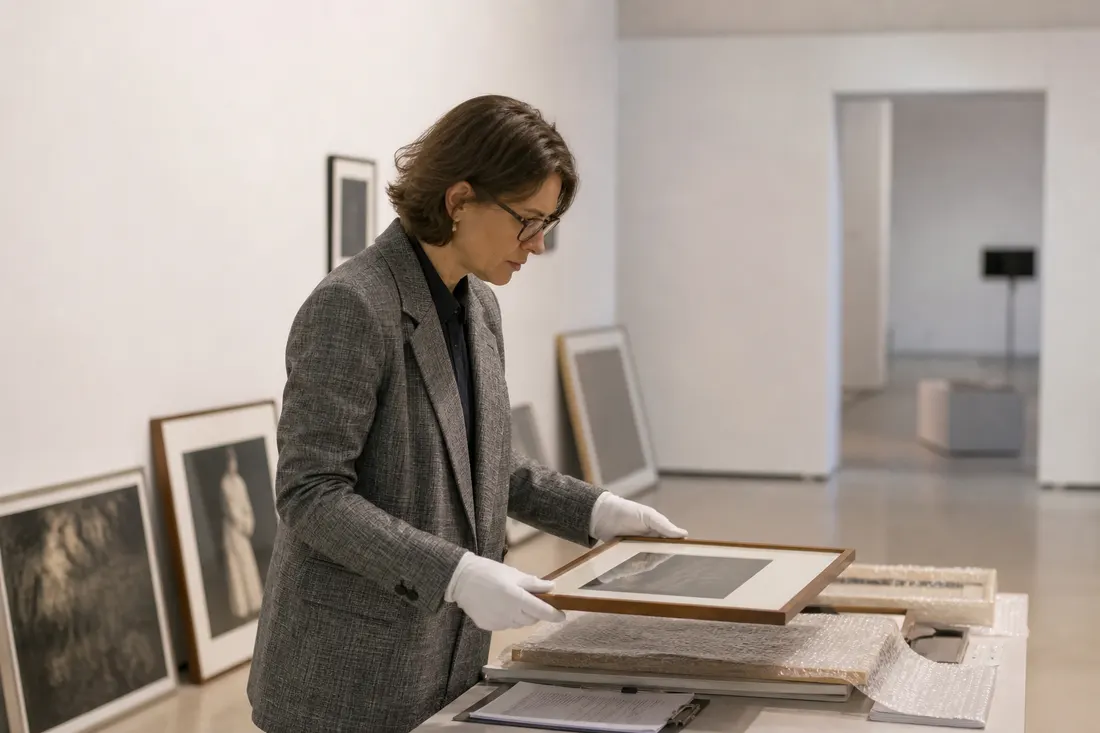
The curator formulates the scholarly question and selects material. A conservator assesses whether an object can withstand light, vibration, changing humidity or a particular form of installation. A registrar tracks records, movement and insurance. An exhibition designer translates the concept into physical space. Educators and interpretation specialists consider what visitors without prior knowledge will actually understand. Lawyers and provenance experts may address title, sensitive material, loan conditions or claims by source communities. Budgets, security and the dimensions of doorways can intervene in the story as forcefully as a historiographical dispute.
Selection is therefore not a single moment. It occurs at least three times. First, when building the collection: what will the institution accept at all? Second, when designing the exhibition: what will leave storage and enter the public gallery? Third, during installation: what receives the central plinth, its own light, the longest label and a place on the poster?
It is the final step that creates iconic objects. Sometimes an object becomes famous because it was historically pivotal. At other times, its public importance grows because the institution repeatedly chooses it to stand for an entire period. From among thousands of surviving objects, one becomes the image through which society remembers an era.
This does not mean scholarly criteria are an illusion. It means that even a well-justified selection remains a selection. A transparent museum therefore shows not only the conclusion but, where possible, the rules by which it arrived there.
The fifth layerA label is a compressed argument
The small card beside an object appears modest. It gives a title, maker, date, material, place of origin and inventory number. This matter-of-fact form creates the impression that the text merely transcribes what is already present in the object.
But after the basic data, only a few sentences remain. They must answer why the object is in the room at all. In describing its own practice, the V&A shows that writing gallery text involves both standardised identifying information and the demanding compression of scholarly research without losing its essence.4 The word limit is not a minor technical detail. It forces a decision about what will be said and what will remain outside the label.
All three sentences may be true. Yet each chooses a different grammatical subject, a different degree of human presence and a different scale for the event. Language can also move almost imperceptibly from description to causation. “The event was followed by surrender”, “the event contributed to surrender” and “the event ended the war” are not stylistic variants of one sentence. They are three historical claims of very different strength.
A good label is therefore not one that pretends to have no perspective. It is a text that distinguishes established facts from scholarly interpretation, does not burden the evidence with stronger causal claims than it can sustain, and gives visitors a route to a deeper layer—in a catalogue, digital documentation or a later section of the exhibition.
One exhibit in three contexts
The object remains the same. The neighbouring evidence, the exhibition’s question and the expected mode of reading change.
The sixth layerSequence is the grammar of space
An exhibition communicates through more than text. It speaks through distance, height, light, sound, direction of movement and the size of rooms. A display case is a sentence, a gallery a paragraph, and the visitor route can function like a plot.
If we begin with the invention of the steam engine, move to factory production, then to urban growth and finally to workers’ housing, the physical sequence almost automatically invites a causal reading: technological change led to social transformation. If we instead begin with living conditions, continue with conflict over labour and only then introduce the machines, the same material can tell a history of pressure from below, regulation and institutional response. Neither route need deny the facts. Each, however, determines what the visitor experiences as cause and what as consequence.
Architecture also distributes authority. An isolated object in an empty room appears more singular than the same object in a dense row. A monumental staircase prepares the body for a ceremonial entrance. A dark corridor slows the pace and changes the emotional register before a visitor reads the first word. An object placed at eye level enters into a relationship; one suspended high overhead acquires dominance.
The art historian Carol Duncan described the public museum as an environment in which visitors pass through a particular ritual script and where the building is not a neutral container for art.7 We need not accept every strong interpretation of that theory to recognise the basic fact: the visitor’s body reads the space before the conscious mind begins evaluating its argument.
The curatorial story therefore emerges not only from what is displayed. It also emerges from what the visitor sees first, cannot avoid, is allowed to pause beside and encounters immediately before leaving. The final room often functions as the conclusion of an essay.
The seventh layerWhen a perspective is missing, the facts need not be missing. The question may be.
An exhibition may give the correct date, material and maker yet still miss an important part of the meaning. Most often this is not because a curator consciously concealed evidence, but because both the collection and the scholarly tradition grew from a particular position.
A colonial collection may long be organised around European expeditions, collectors and stylistic development. From the perspective of the source community, however, other questions may be equally important: Who was allowed to use the object? Under what circumstances did it leave its place? Was it sold, given, removed under duress or looted? What does its absence mean where it came from? May it be displayed publicly at all?
The absence of this perspective does not automatically make every existing sentence false. It changes the scope of the explanation. A history of European collecting may be accurate, but it is not identical to the history of the object.
The Benin Bronzes at the Smithsonian offer a concrete example. The museum transferred ownership of twenty-nine objects removed during the British attack on Benin City in 1897 to Nigeria’s National Commission for Museums and Monuments. Nine are now at the US museum on long-term loan with the consent of the Kingdom of Benin; the remaining twenty were returned to Nigeria.10
This case disrupts the simple model in which restitution and public access must be opposites. An object may remain on display while its owner, the authority behind its label and the relationship between institution and source community all change. The case looks much the same; the argument it presents is different. It no longer says only, “we own this and show it”. It can say, “this has been entrusted to us, and we display it within an agreed relationship”.
The eighth layerProvenance: the object’s second life
The origin of a collection object is sometimes reduced to a line such as “gift of Mr X” or “purchased in year Y”. Provenance research, however, studies the history of an object’s ownership and movement. The Metropolitan Museum of Art describes it as central to responsible museum practice and as a basis for contextualisation, acquisition, interpretation and possible repatriation or restitution.8
Every object has at least two biographies. The first is the history of its original use: who made it, what it was for, who touched it and what event it entered. The second begins when the thing becomes a collectable or museum object: who found, bought, inherited, exported, sold, donated, seized, catalogued and displayed it.
The second biography can transform the first. Missing decades in a chain of ownership are not an empty field without meaning. They may conceal a forced sale, wartime confiscation or illegal export—or a perfectly legitimate transfer that has not yet been documented. A newly opened archive, scientific material analysis, a dealer’s record or information from a source community can change what a museum knows about an object decades later. The Met therefore stresses that provenance records are continually updated and that curators, archivists, conservators, scientists, legal experts, authorities and source communities collaborate in the research.8
Provenance is not an automatic verdict on every old collection. It is a method for distinguishing assumption from a documented route and legal possession from responsible title. The ICOM Code of Ethics therefore links acquisition to due diligence on origin, documentation and a willingness to discuss the return of cultural property where substantiated reasons exist.9
In an exhibition, all this work may appear in a single sentence. But if a label gives only the place of manufacture and skips the route into the collection, the object looks as though it arrived in the case naturally. Provenance restores the human decisions, power, trade, violence, care and cooperation that lie between the object’s creation and the way we see it today.
The object’s journey: from use to display case
Museum status is not a property with which an object is born. It emerges through a documented chain of events and institutional decisions.
The strongest counterargumentWithout selection, a museum would not be a museum. It would be a warehouse.
At this point, an easy but mistaken conclusion presents itself: if every exhibition selects and frames, then everything is merely a subjective story and museums cannot be trusted. Such cynicism would confuse the inevitability of interpretation with arbitrariness.
A visitor cannot walk past eighty million objects. Nor can they read a complete catalogue, archival file, conservation report and every scholarly dispute for each one. If an institution displayed everything without hierarchy, most objects would become indistinguishable noise. A warehouse maximises storage; an exhibition must create the possibility of understanding.
Curating is therefore a form of expert reduction. It requires knowledge of the collection, the ability to compare evidence, identify representative and exceptional objects, verify dates, construct an intelligible structure and respect the material’s physical limits. Twenty well-chosen objects may illuminate a particular question better than two thousand unrelated and unexplained things.
Selection need not weaken truth. It can make truth accessible. A model of DNA, a timeline of archaeological layers or a group of objects from one household creates an abstraction that reveals a relationship hidden in the individual pieces. Eilean Hooper‑Greenhill described museums as institutions that have actively helped shape modes of knowledge throughout history; Mieke Bal, in turn, showed that collecting itself can be understood as a narrative activity rather than neutral accumulation.56
The question, then, is not how to eliminate interpretation. It can be eliminated only by hiding its decisions and allowing them to appear as the natural order of things. A more meaningful question is: by what rules was the selection made, how well is it supported by evidence, and how open is it to correction?
The ninth layerCan an exhibition be neutral?
Not in an absolute sense. The decision to establish a particular kind of museum, divide history into periods, devote a large gallery to one subject and a single case to another, begin with a particular date or use chronology instead of thematic organisation already creates a perspective.
That does not mean there is no difference between an honest exhibition and propaganda. Neutrality can be understood not as the absence of choices, but as a discipline that constrains those choices and makes them available for scrutiny.
Six features of a transparent exhibition
- The selection follows a recognisable criterion. Visitors know which question the gallery investigates and why these particular objects are present.
- Fact is separated from interpretation. Date, material and a documented event are not conflated with motive or disputed causality.
- Uncertainty is not disguised. Gaps in provenance, disputed authorship or competing scholarly interpretations are acknowledged in proportion to their importance.
- Strong counterevidence is not hidden in storage. The exhibition addresses relevant facts that complicate its central story.
- Source communities are not merely objects of description. Where materially relevant, their knowledge and views also enter the research and interpretation.
- The story is corrigible. Labels, catalogues and installations change when better evidence appears; the museum’s authority does not rest on pretending to be infallible.
Such an exhibition need not be without a point of view. It may even advance a strong thesis. The difference is whether visitors receive only the conclusion or also enough traces to understand how it was assembled.
In the case of the Enola Gay, the claim that the limited 1995 display contained no interpretation is itself instructive. Factually, it did omit the broader script and retain basic information about the aircraft and its restoration.2 Analytically, however, omitting context also creates a frame: the aircraft as a technical and historical artefact takes precedence, while the human, strategic and political layers move outside the room. In practice, “without interpretation” can mean “with an interpretation enacted through the choice of what will not be discussed”.
Visitor protocolHow to read a museum without cynicism
Reading a museum critically does not mean looking for a conspiracy behind every plinth. It means perceiving two layers at once: the past that the exhibition makes accessible, and the present-day decisions that determine its form.
- What is at the centre of the room? Which object receives the most space, light and text—and what does it stand for?
- What is the central question? Does the exhibition ask how an object was made, whom it served, what it caused, or how it was later remembered?
- What does the object itself establish, and what does the label add? A material trace, a documented date and an interpretation of motive carry different evidential weight.
- How does the sequence work? What is introduced as a cause, what as a response, and which event is given the final word?
- Who is the agent in the sentences? Active verbs reveal responsibility; the passive voice can unintentionally dissolve it.
- Is the route into the collection visible? Provenance information often reveals a story as important as the object’s original use.
- Where is the rest? A digital catalogue, storage, a research database and rotation can show how narrow the slice currently on view really is.
None of this robs the museum of its magic. Quite the opposite. An object becomes more interesting when, alongside its age, we see the history of all the decisions that allowed it to survive, receive an inventory number and stand here. The display case ceases to be a transparent window into the past and reveals itself as a precise interface between past and present.
A museum visitor is therefore looking not only at the past, but also at the way the present has chosen to arrange it.
They see genuine objects, but never all of them. They read documented facts, but in an order someone composed. They move among real traces, but through an architecture that strengthens some relationships and leaves others in shadow. None of this is, in itself, a museum’s failure. It is a condition of the museum’s existence.
The most honest museum, then, is not one that claims to have no argument. It is one that lets visitors glimpse the evidence from which the argument was built, what had to be omitted, where uncertainty remains and what might change the story.
The past inside the case is no less real. It is simply no longer alone. Beside it stands the selection made by our own era—and that selection, too, is a historical document.