

Among the ruins of the royal palace at Nineveh, more than thirty thousand clay tablets and fragments were found after centuries. They preserve epics, medical texts, omen lists, dictionaries, letters and administrative records. We consequently know the world of the Assyrian king Ashurbanipal in detail that can feel almost intimate. We know what knowledge he wanted to gather, what his court feared and in what language the empire described itself.[1]
Of most people who carried water, baked bread, built walls, gave birth and died in the same city, there may not be a single sentence written in their own hand. Some flicker into view on a ration list. Others appear as a debtor, soldier, servant or item in a property inventory. Many left not even a name.
A single royal archive can therefore speak louder than an entire city.
Whom are we actually seeing when we look into the past?
The familiar phrase says that history is written by the victors. It is compelling because it offers an intelligible culprit: the victor controls the state, monuments, schools and the account of what happened. There is much truth in that intuition. Power really does determine whose deeds are celebrated, whose violence is named order and whose defeat becomes an inevitable ending.
But before anyone interprets the past in their own interest, a much quieter and deeper selection has already taken place. Someone had to be able to record the event. The record had to be made on a material that endured. It could not burn, rot, tear, disappear or be deliberately destroyed. Someone had to consider it worth keeping. An archivist had to acquire, describe and make it available. A researcher had to find, read, translate and place it in context.
The past is not the archive. The archive is only a fragment of the past that has passed through a system of physical, political, social and cultural filters.
The funnel of the past
Each successive layer works with a smaller and differently distorted set of traces.
The first filter: who could leave a sentence at all
For most of human history, writing was not an ordinary part of every person’s life. Nor is literacy a simple switch between “can” and “cannot”. Someone might read a familiar prayer but be unable to write a letter. Another might sign their name but not compose a longer text. A merchant understood accounts and marks, while a scholar worked in several languages. Someone else could dictate a story to a scribe, gaining access to writing but not full control over the final wording.
Writing was a skill, but also an infrastructure. It required instruction, time, materials, a socially recognised language and often a connection to temple, court, church, army or office. The earliest cuneiform records emerged in part as tools for recording rations and managing resources. A scribe was therefore not merely someone with the technical ability to capture words. The scribe belonged to a system that decided what mattered enough to become an entry in the record.
That radically changes the perspective. An ancient or medieval text does not automatically show us a society. It shows society as institutions capable of producing writing were able to capture it.
An office needed to know who owned land, who had paid tax, who owed grain, who entered service and who broke a rule. That is why charters, verdicts, accounts, registers, military lists and property transfers survive. There was much less reason to record how a person experienced a long winter, why they feared marriage, what they thought of local authority or how they understood their own place in the world.
Poor and marginalised people therefore often enter the record only when they come into contact with an institution. They appear as defendants, witnesses, welfare recipients, patients, recruits, enslaved people listed in an inventory, refugees in an official report or labour in an account book. The archive may contain many sentences about them and not a single sentence in which they themselves determine who they are.
Historical visibility is not the same as historical importance. Often it is merely the by-product of someone needing to tax, judge, employ, own or control you.
An archive does not begin in the stacks. It begins at the event.
It is easy to imagine an archive as a neutral room into which the past gradually deposits its documents. In reality, sources are not produced to satisfy future historians. They arise from a specific activity: to levy tax, validate a contract, defend a decision, transmit an order, establish a claim or monitor a person.
What an institution records is connected to what it needs to govern. Archives are therefore not only repositories of memory; they are also remnants of administrative power. Archival theorists Joan M. Schwartz and Terry Cook point out that archives and records do not arise outside relations of power. The values and information needs of governments, organisations, companies and individuals influence which records are created and preserved.[3]
The same is true of family and private archives. A wealthy family had reason to protect purchase contracts, wills, correspondence, genealogies and evidence of privilege. It had a house, a chest, legal continuity and heirs to whom the documents could be passed. A poor household moved more often, reused paper and lacked both secure space and an institution that would take over a box of letters after the owner’s death. The difference between a surviving aristocratic archive and a servant’s vanished correspondence need not tell us whose life was more complex. It tells us about unequal conditions of preservation.
The historian Michel-Rolph Trouillot described how silence enters history not only when a textbook is written. It arises during the creation of sources, their assembly into archives, their later retrieval and the decision about which events will be assigned significance.[4] In other words, some voices are not removed from the story at the end. They never enter its material in the first place.
Material has its own politics of survival
Sometimes the shape of history is decided not by a king or censor, but by damp.
A clay tablet, stone inscription, wax tablet, papyrus, parchment and paper do not have the same chance of survival. Each material responds differently to water, fire, insects, mould, pressure from the soil and the human desire to reuse it. Differences in durability do more than create more or fewer sources. They change the kinds of information that remain available.
When Nineveh fell in 612 BCE and fire swept through the palace, the flames paradoxically fired and hardened many clay tablets. A paper library would have been destroyed. Part of the clay library survived because of the fire. Organic writing tablets and other media probably used in the palace disappeared. The surviving Library of Ashurbanipal is therefore not a simple list of what the Assyrians knew. It is a list of what part of their knowledge was written on material capable of surviving a particular catastrophe.[1]
Oxyrhynchus in Egypt is similarly revealing. The dry climate preserved papyri that would long ago have rotted in wetter regions. Today, the Oxyrhynchus collection contains more than half a million fragments dating roughly from the third century BCE to the seventh century CE. Alongside literature, it includes contracts, accounts, tax receipts, court records, lists and private letters. The town’s rubbish heaps became one of the richest archives of everyday life in the ancient world.[2]
We must not infer from this that people in Egypt wrote ordinary letters while people in rainy parts of Europe did not. We can say only that Egyptian conditions preserved a particular kind of trace in quantities that had no chance of surviving elsewhere. A geography of preservation can easily disguise itself as a geography of human activity.
What survives most often need not have been what occurred most often in the past. It may simply have been the most durable, best stored or most fortunately buried.
Fire, war and deliberate silence
The selective survival of sources is not always slow. Centuries of memory can sometimes disappear in a single afternoon.
On 30 June 1922, a fire from fighting around Dublin’s Four Courts complex spread to the repository of Ireland’s Public Record Office. Virtually the entire central store was destroyed, and vast groups of documents covering roughly seven centuries vanished within hours. Historians now reconstruct some losses from transcripts and copies dispersed across other institutions, but the original whole no longer exists.[5]
In Warsaw, archives were destroyed along with the city during the Second World War and after the suppression of the uprising. Estimates speak of tens of kilometres of lost records. This was not merely collateral damage from combat. Destroying cultural memory can form part of an attack on a society’s ability to prove its own continuity, property relations, institutions and experience.[5]
Sometimes the institution that created records destroys them itself. At the end of the German Democratic Republic, Stasi employees tried to eliminate the secret police files. Material torn by hand filled around sixteen thousand sacks. Germany’s Federal Archives says approximately 1.7 million pages from six hundred sacks were reconstructed manually; an enormous quantity of fragments remains unassembled.[5]
This is no longer a random sample. If a perpetrator destroys precisely the records that might establish responsibility, the absence is not neutral. The surviving archive may have been systematically stripped of its most sensitive part. What remains then looks not merely smaller. It may look more innocent.
State censorship creates silence even earlier. Prohibited subjects are not recorded openly. People use allusion, self-censorship or safer language. A document may be created but classified, sealed, falsified, rewritten or discarded before transfer to a public archive. Sometimes the machinery of censorship survives—a list of banned books, a censor’s report, an interrogation record—while the original voice of the person targeted disappears.
Inequality of traces
Different groups enter the archive by different routes and in different voices.
An archivist is not transparent glass either
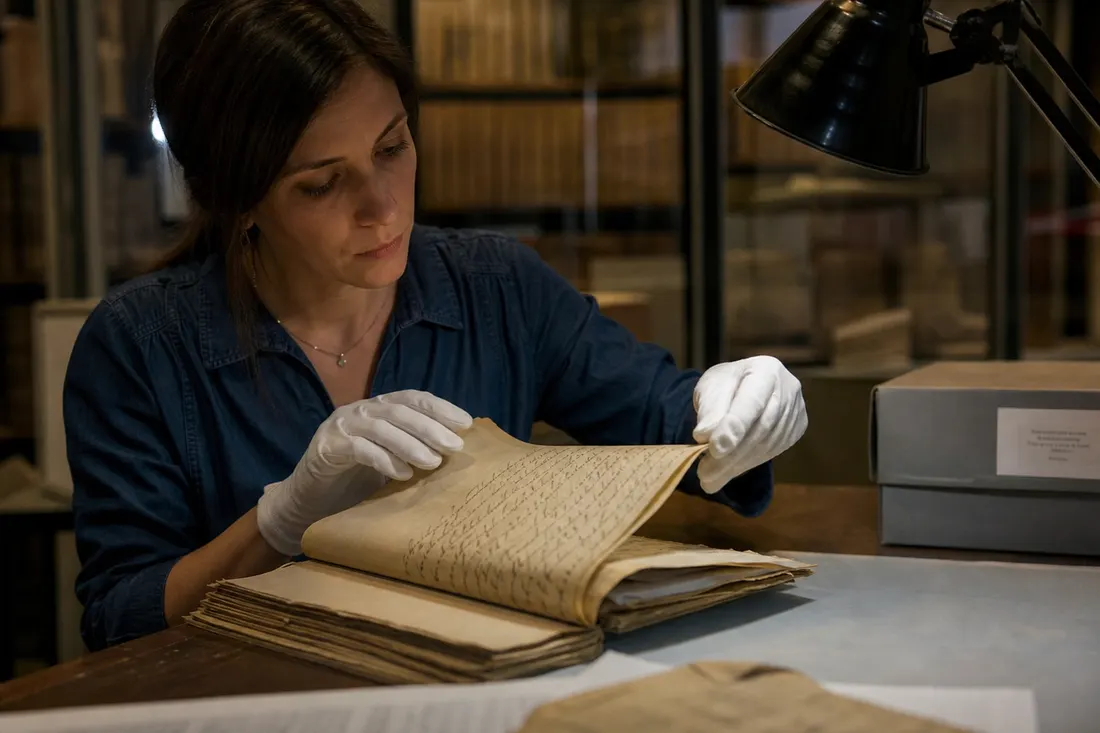
Even if a document outlives its author, it is not guaranteed a place in history. Modern institutions produce a volume of records that cannot all be preserved permanently, professionally processed and made accessible. Archivists therefore conduct appraisal: they decide which groups of records have lasting legal, administrative, evidential or research value, and which may be destroyed once their retention period expires.[6]
That is not secret manipulation but an unavoidable part of archival practice. Precisely for that reason, however, an archive should not be imagined as everything that ever existed. It is the product of rules, budgets, capacity, collecting policy and professional judgement. Another archive might choose a different documentation strategy in the same situation.
Selection does not end with acquisition. A collection must be arranged, described and catalogued. A box no one knows about is almost as invisible to most researchers as a box that did not survive. The name of a collection, its keywords and its structure influence what a search engine returns. Digitisation expands access, but creates another layer of selection: only part of a collection is usually online, while machine recognition favours clean print, widely used languages and clearly legible scripts.
The searchable past is therefore not the same as the surviving past. It is the technologically privileged part of it.
What was never written down may sometimes emerge from the ground
Written sources are not the only route to the past. Archaeology can capture what officials did not consider worth recording: the ground plan of a house, wear on a tool, the composition of a diet, a child’s grave, a rubbish pit, pollen in sediment, traces of violence on bones or human movement legible in dental isotopes.
But the archaeological record is not the complete past stored underground either. The discipline studies formation processes and taphonomy—how human activity, decay, water, soil, animals, erosion, later construction, looting and excavation itself alter the assemblage of remains. Pottery survives differently from wood. A buried object differently from one left on the surface. A dry cave differently from acidic soil. What archaeologists find is the remainder of a long chain of transformations, not a frozen scene.[7]
Yet material evidence often disrupts the one-sidedness of text. An official document may describe a prosperous province while skeletal remains reveal malnutrition. A chronicle celebrates a monumental building, but settlement analysis shows who supplied it, where the labourers lived and what they ate. A tax register lists households; archaeology reveals extensions, workshops and informal life that did not fit the administrator’s categories.
Evidence is particularly strong when different kinds of traces agree not because one copied another, but because they arose independently. A text, a coin, tree-ring dating, a fire layer and human remains can together support a conclusion far more robust than any single source could.
A voice that survived in a person
Oral history also arose from the need to move beyond the official archive. Interviews can capture the experience of workers, migrants, women, minorities, politically persecuted people or those whose everyday lives left no private papers. In societies with a living oral tradition, spoken transmission is not a substitute for the “real” written source. It is a medium of memory in its own right.
Oral testimony is not a tape recorder stored in the brain. Memory is reconstructive and changes with later experience, public narratives, trauma and the interviewer’s questions. The historian Alessandro Portelli pointed out that factual inaccuracy in testimony need not make it worthless: it may reveal how a person understood events, what meaning they assigned them and how a community later arranged them into a story.[8]
That does not mean subjective meaning replaces factual verification. If we want to know whether a train left at eight or ten, we look for a timetable, reports, other witnesses and material traces. If we want to know why people remember the departure as betrayal, fear or liberation, the way they tell it may itself be a crucial source.
Oral history therefore does not dissolve the difference between an event and a memory. It makes both available for study.
Translation is the final invisible filter
Even a perfectly preserved document may remain silent until someone reads it. And reading an old text is not the same as transferring individual words into modern English.
Historical languages use categories with no exact modern equivalent. Depending on context, one word may mean a subject, servant, enslaved person or someone in another form of dependency. A term translated as “state”, “nation”, “religion” or “citizen” may project a modern institutional concept into a past in which it functioned differently. With a damaged manuscript, a scholar must also supply missing characters, decide among variants and work with a grammar known only from a limited corpus.
A scholarly edition displays uncertainty through square brackets, dots, alternative readings and commentary. Popular narrative often removes those marks and offers the reader a smooth modern sentence. Between the fragment and the confident-sounding translation, the information that part of the text is reconstructed can disappear.
Translation is not a betrayal of the original. Without it, much of the archive would remain closed. But translation is interpretation and part of the production of knowledge—not an invisible transport service between two languages.[10]
The life of a single source
The model journey of a sheet from a Stasi file shows that a source acquires meaning in several different periods.
“We have no evidence” is not the same as “it did not happen”
Here lies one of the most important boundaries of historical reasoning.
The absence of a source can mean several different things: the event did not happen; no one recorded it; a record was made but did not survive; it survived but has not yet been found; it was found but is inaccessible; it is accessible but we cannot correctly recognise or read it.
Silence alone therefore does not prove that the past was silent.
Absence becomes stronger evidence only when a particular trace would be expected under the circumstances and we have good reason to think the relevant series of records is sufficiently complete. If the law required every land transfer to be registered, the register survives continuously and the transaction in question is absent, that absence means something. If only a few random sheets from the entire region survive, a missing entry tells us very little.
The trace would almost certainly have been created
A complete mandatory record survives. The absence of an expected entry may be relevant evidence against a claim.
The trace may or may not have been created
A private act, unequal access to writing or an incomplete collection. Absence weakens a conclusion only slightly.
The trace was created by a hostile institution
The document may be detailed, but its language and categories reflect the interests of whoever monitored or controlled the person.
The opposite error is equally dangerous. The silence of an archive is not a licence to insert any story we please. The missing voice of a poor woman does not entitle a historian to place unsupported opinions in her mouth. A destroyed file may explain why something cannot be ruled out, but it does not by itself prove a particular alternative version.
An archival gap weakens some negative conclusions. It does not automatically manufacture evidence for our preferred story.
An honest historian therefore distinguishes among what is documented, what is highly probable, what is merely possible and what remains unknown. Uncertainty is not an embarrassment to research. It is information about the quality and reach of the sources.
That Still Does Not Make History Free-Form Literature
Recognising that archives are fragmentary and shaped by power can tempt us into a postmodern shortcut: if every source is incomplete and every interpretation arises in a particular context, then supposedly the truth about the past cannot be known and all stories are equally valuable.
They are not.
Historical methodology exists precisely to build from limited traces conclusions that are testable, corrigible and differently weighted. Source criticism asks about a document’s origin, authenticity, date, author, audience, purpose, earlier models and route of transmission. It then examines whether the author could know what they claim, had reason to deceive, what they reveal unintentionally and whether independent sources corroborate their account.[9]
Independence is crucial. Ten chronicles copying a single earlier chronicle are not ten confirmations. By contrast, a brief account, an archaeological layer and a letter from someone on the opposite side of a conflict may converge powerfully precisely because they arose for different reasons.
Historians use palaeography, ink and material analysis, radiocarbon dating, dendrochronology, stratigraphy, numismatics, spatial methods and statistics. Large series can reveal trends, seasonality or demographic change. At the same time, researchers must examine who is missing from the data and whether recording practices changed over time. Precise calculations performed on a selective register may be mathematically correct and historically misleading.
A strong historical conclusion therefore does not look like a flawless story without gaps. It looks like a network of evidence in which it is clear which nodes are firm, which depend on interpretation and what might change the conclusion.
A calibrated language of knowledge
There is a direct, verified source or agreement among several independent traces.
This explanation best fits the surviving traces, while alternatives require more unsupported assumptions.
The sources permit this version but do not distinguish it from other possibilities.
The story is conceivable, but its support is weak or indirect.
The surviving evidence is insufficient. Precision requires leaving the space blank.
That is not a weakness of history. It is its intellectual discipline.
What, then, writes history?
Victors influence it. They can hire chroniclers, mint coins, build monuments, open or close archives and name the defeat of others in their own language. But they are not enough.
History is also written by scribes who decided what would fit on a form. Officials who created a category. Families that preserved a chest of letters. Materials that resisted damp. Fires that destroyed some things and paradoxically fired others. Wars that scattered collections. People who tore documents apart. Citizens who saved them. Archivists who selected, described and made them accessible. Archaeologists who recognised rubbish as a source. Witnesses who spoke. Translators who chose one word rather than another. And historians who build from fragments a conclusion strong enough to be criticised.
None of this means that the past is inaccessible or that truth does not exist. It means access to it is uneven. Some events are illuminated by hundreds of independent traces. Others appear only as a shadow at the edge of someone else’s document. And some lives disappeared so completely that we cannot frame even a precise question about the individuals who lived them.
The greatest distortion of history need not be a lie written by a victor.
It may be the silence of a person from whom nothing at all survived.
When we look into the past, we do not see the past itself. We see traces that defeated time. The historian’s task is not to fill silence with an arbitrary voice, but to recognise its shape, acknowledge its limits and still seek the truest possible picture from what remains.