
1. A ballot paper and thirty-one years
On 1 December 1991 Ukrainians were asked to confirm the Act of Independence adopted by parliament on 24 August. Nationwide, 90.32 per cent of participating voters chose independence. Majorities also existed in Crimea, Sevastopol, Donetsk and Luhansk, although their size differed substantially. The vote therefore established an electoral mandate for a sovereign Ukrainian state; it did not prove that all regions shared the same identity, language policy or geopolitical outlook.
The distinction is essential. A Russian-speaking citizen could favour close economic ties with Moscow and still regard Ukraine as his or her state. A voter could support independence while opposing NATO. Later political categories cannot simply be projected backward onto the 1991 ballot.
Within weeks the Soviet Union ceased to exist. During the following years Russia dealt with Kyiv as the capital of a separate state and repeatedly recognised Ukraine's sovereignty and borders. The central historical question is therefore not whether Ukraine existed in 1991, but how a relationship based on formal recognition developed into the full-scale invasion of 2022.
2. Statehood, borders and historical diversity
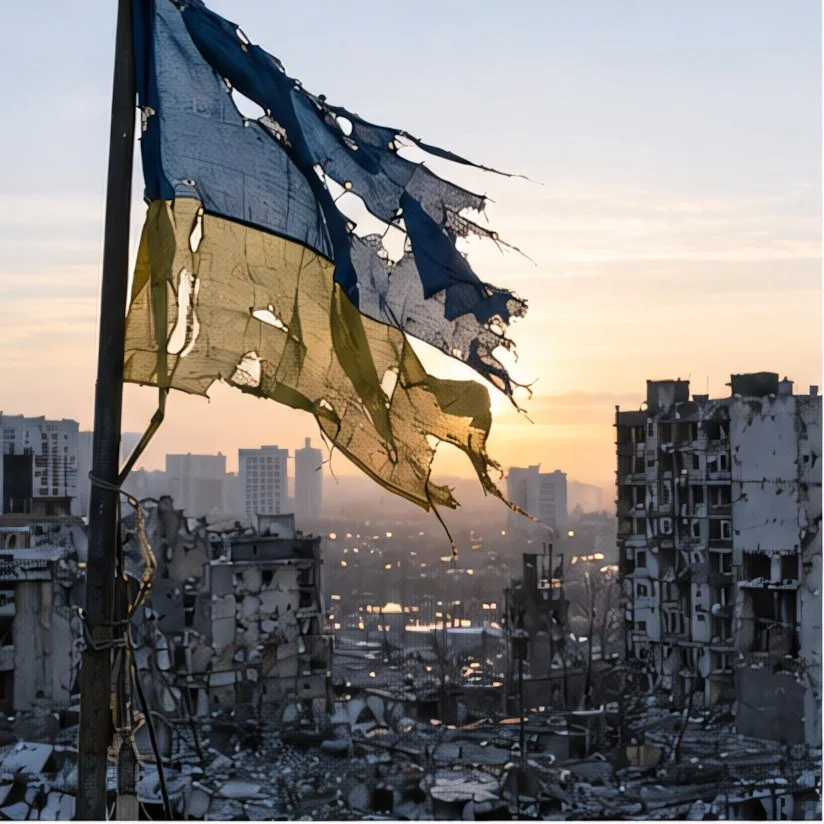
Ukraine's borders incorporated territories with different imperial, Soviet and Central European histories. Crimea had been transferred from the Russian SFSR to the Ukrainian SSR in 1954; Sevastopol had exceptional naval importance; the Donbas was industrial and deeply connected with Russia; western regions had different historical trajectories. These facts mattered politically. They did not automatically transfer sovereign title after the Soviet collapse.
Modern statehood cannot be tested by asking whether every border is ethnically pure or historically ancient. Most European borders are products of layered history. What matters in the legal order is political existence, recognition, institutions and the rules governing territorial change.
3. The nuclear inheritance
When the USSR collapsed, roughly 1,900 strategic nuclear warheads and their delivery systems were located on Ukrainian territory. Calling this the world's third-largest nuclear arsenal captures the scale of the physical inheritance but can conceal the question of operational control. Key authorisation systems and command structures remained connected to Moscow.
Ukraine nevertheless possessed substantial technical capacity and bargaining leverage. Retaining or creating an independent nuclear deterrent was not physically inconceivable, but it would have required major technical work, money, time and a confrontation with the international disarmament framework. The real choice was more complicated than either “Ukraine simply owned the weapons” or “Ukraine had no meaningful leverage at all.”
Tactical nuclear weapons were transferred earlier; the Lisbon Protocol, START arrangements and subsequent negotiations set the path toward a non-nuclear status. By 1996 the warheads had been removed. The later Russian violation of Ukraine's borders inevitably transformed the political meaning of that disarmament decision, but it cannot retroactively prove a single counterfactual outcome in which retaining nuclear weapons certainly would have prevented war.
4. Budapest 1994: what was actually promised
The Budapest Memorandum of 5 December 1994 reaffirmed commitments to respect Ukraine's independence, sovereignty and existing borders, to refrain from the threat or use of force, and to consult when questions arose concerning the commitments. It also contained provisions related to nuclear aggression and economic coercion.
It did not contain an automatic obligation for the United States or the United Kingdom to send troops if Ukraine were attacked. For that reason, the common sentence “Ukraine gave up nuclear weapons in exchange for a Western military guarantee” overstates the text. The opposite claim—that the memorandum meant nothing—is equally misleading. Russia itself signed assurances regarding the borders and non-use of force that its later conduct breached.
5. The 1997 friendship treaty and the Black Sea Fleet
In 1997 Russia and Ukraine signed a Treaty on Friendship, Cooperation and Partnership affirming territorial integrity and existing borders. Parallel agreements regulated the division and basing of the Black Sea Fleet. The legal architecture matters: Russian forces in Sevastopol were present under Ukrainian consent and treaty rules, not because Russia possessed sovereignty over the city.
The 2010 Kharkiv agreements later extended basing arrangements in exchange for economic concessions linked to gas. This was characteristic of Ukraine's long strategy of balancing: maintaining extensive ties with Russia while preserving room for relationships with the European Union.
6. NATO and Russia were not always formal enemies
The NATO–Russia Founding Act of 1997 declared that the parties did not consider one another adversaries and reaffirmed principles including sovereignty, territorial integrity and the right of states to choose their means of ensuring security. Cooperation later included Bosnia, counterterrorism and Afghanistan.
This did not remove Moscow's opposition to NATO enlargement. It does, however, warn against reading the entire post-Cold War period backward from 2022. Enlargement was contentious, but conflict was not mechanically inevitable after each round.
7. “Not one inch eastward”
Declassified diplomatic records demonstrate that Western officials discussed formulations in 1990 that reassured Soviet leaders about the military consequences of German reunification. James Baker's famous phrase belongs to that record. It is therefore too simple to say that no such assurance was ever uttered.
The final Two Plus Four settlement, however, did not contain a general legal ban on future NATO enlargement into Poland, Czechoslovakia, Hungary or the Baltic states. The serious historical dispute concerns expectations, political assurances and alternative security architectures—not a secret treaty clause granting Moscow a permanent legal veto.
8. Why Central and Eastern European states wanted NATO
The enlargement story is incomplete if only Washington and Moscow are treated as actors. Poland, the Czech Republic, Hungary and later the Baltic states actively pursued membership. Their governments drew on experiences of Soviet domination and feared that a post-Cold War security vacuum would leave them exposed.
The same step could therefore improve the security of one country and worsen another's threat perception. That is the security dilemma in practice. A rigorous analysis must recognise Russian fears without erasing the agency and fears of Russia's neighbours.
9. Ukraine's shifting relationship with NATO
Ukraine joined Partnership for Peace in 1994 and developed a special partnership with NATO in 1997. Under Leonid Kuchma, cooperation grew, but domestic consensus for membership did not. After the Orange Revolution, President Viktor Yushchenko pushed harder for Euro-Atlantic integration.
Bucharest in 2008 produced the commitment that Ukraine and Georgia “will become members,” but no Membership Action Plan or timetable. In 2010 Yanukovych restored a non-aligned policy. The chronology therefore contradicts both a story of uninterrupted Western absorption and a story in which NATO had no relevance at all.
After 2014 the calculation changed. Crimea and the Donbas demonstrated that non-alignment had not prevented Russian military action. Ukraine abandoned the non-bloc policy, increased cooperation with NATO and later constitutionally affirmed a Euro-Atlantic trajectory.
10. Bucharest 2008: promise without protection
The Bucharest compromise can be read as strategically ambiguous. It told Moscow that the door remained open and told Kyiv that membership was a future objective, while providing neither the immediate process nor the protection of membership.
Critics later described this as the worst of both worlds: a political commitment that could intensify Russian opposition while leaving Ukraine exposed. That assessment is plausible but remains an interpretation. The subsequent Yanukovych period demonstrates that accession was not administratively imminent.
11. Georgia 2008
The Russo-Georgian war occurred in a different conflict, but it affected the security expectations of every actor. The EU-sponsored investigation described both the Georgian attack on Tskhinvali that opened the large-scale phase and the longer escalation involving Russian support for separatist regions and a Russian response that extended far beyond the immediate battlefield.
For Moscow, the war could suggest that force could block an unwanted geopolitical trend. For Kyiv and Eastern European governments, it could suggest that insecure post-Soviet states were especially vulnerable. The same event thus reinforced opposite strategic lessons.
12. Ukraine was internally divided, but not by one clean line
Election maps from 2004 and 2010 showed striking regional differences. They were real, but they were not ethnic ownership maps. Language was not nationality; nationality was not geopolitical loyalty; electoral preference was not a mandate to change borders.
In the spring of 2014, surveys in the south and east showed stronger support for decentralisation, federalisation and, among a minority, separation or joining Russia. The Donbas genuinely differed from much of the country. It still did not contain a single unanimous political will that could be inferred from language alone.
13. Yanukovych and the politics of balancing
Yanukovych improved relations with Moscow and adopted non-alignment, yet his government continued negotiations on an EU Association Agreement. This was not necessarily incoherent. Ukrainian elites had long tried to benefit from relationships with both Russia and Europe without surrendering freedom of manoeuvre.
Energy dependence, oligarchic politics and growing authoritarian tendencies weakened that balancing model. The prosecution of Yulia Tymoshenko damaged relations with the EU, but the association process continued until late 2013.
14. November 2013: why the EU agreement was suspended
Ukraine entered late 2013 with serious macroeconomic weaknesses. Reserves were falling, growth had stalled, Naftogaz and fiscal policy imposed heavy burdens, and access to external financing was difficult. Russia simultaneously increased economic pressure and warned that an EU free-trade arrangement would alter the conditions of Russian-Ukrainian commerce.
The IMF and European path involved reforms with domestic political costs. Russia offered a large bond-purchase programme and a gas discount. Yanukovych's decision to suspend the EU agreement can therefore be understood as a choice made under financial and geopolitical pressure, not necessarily as a settled plan to subordinate Ukraine permanently to Russia.
What his government underestimated was the domestic political meaning of Europe. For many Ukrainians, the EU stood for more than tariffs; it symbolised rule-bound governance and escape from a corrupt post-Soviet model.
15. Maidan: protest, revolution, uprising or coup?
The protests began over the EU agreement and expanded sharply after the violent police dispersal of demonstrators on the night of 29–30 November 2013. Demands broadened from the agreement itself to government accountability and eventually to Yanukovych's departure.
The movement was heterogeneous. Liberal and civic groups, opposition parties, nationalist organisations and far-right actors all participated. Far-right groups sometimes played a disproportionately visible role in confrontation and self-defence structures, but they were not the numerical majority of the movement or of Ukrainian society.
The February 2014 violence, the collapse of the 21 February compromise and Yanukovych's departure created an extraordinary constitutional situation. Parliament did not complete the full ordinary impeachment procedure. Describing that defect precisely is more useful than assuming that a single label—revolution or coup—settles every question about legitimacy and foreign involvement.
16. The role of the West on Maidan
US and European officials supported Ukraine's European orientation, met opposition leaders and funded civil-society, media and reform programmes over many years. The leaked Nuland–Pyatt conversation shows American diplomats discussing preferred political outcomes and personalities. This is direct evidence of attempted influence.
It is not, without additional evidence, proof that Washington operationally commanded the protest movement, armed groups or every parliamentary decision. Domestic mass mobilisation and foreign political support can coexist. An analysis does not need to deny one in order to recognise the other.
17. Crimea: operation, referendum, annexation
After Yanukovych's fall, armed unmarked personnel seized key Crimean institutions. A new regional leadership organised a referendum while Ukraine had lost normal control of the peninsula. Putin initially denied that the unmarked personnel were Russian troops but later acknowledged that Russian soldiers had supported the operation and created conditions for the vote.
The referendum did not offer a simple option to preserve the immediate status quo. The Venice Commission judged the referendum decision incompatible with the Ukrainian constitution and the circumstances inconsistent with European democratic standards. Russia formally incorporated Crimea after the vote. The UN General Assembly maintained Ukraine's territorial integrity and rejected the referendum as a basis for changing the peninsula's status.
Russia thereafter exercised de facto control. De facto control and internationally recognised sovereignty are analytically distinct.
18. Donbas: civil war, Russian aggression, or both?
The Donbas conflict had domestic roots: political alienation, regional identity, anger at Kyiv and genuine support for decentralisation or, among some people, separation. But in April 2014 armed seizures transformed the crisis. Igor Girkin's group in Sloviansk illustrates the direct role of Russian citizens with security backgrounds in moving the conflict toward organised war.
The conflict then included Ukrainian forces, local separatists, Russian volunteers, Russian-linked personnel and later regular Russian units. Calling it a civil war captures the fact that citizens of the same state fought one another. Using that label to erase Russian military involvement is misleading.
By late summer 2014, the balance shifted as Russian regular forces entered in greater scale, including around Ilovaisk. Later judicial findings, including European Court of Human Rights assessments, documented the depth of Russian military, political and economic control over separatist-held areas.
The most accurate description must carry both layers: domestic conflict existed, and its transformation into a sustained war cannot be explained without Russian intervention.
19. MH17 and the evidentiary problem
Malaysia Airlines flight MH17 was destroyed over eastern Ukraine on 17 July 2014, killing all 298 people aboard. Years of investigation concluded that a Buk missile system linked to Russia's 53rd Anti-Aircraft Missile Brigade was used from separatist-controlled territory. A Dutch court convicted three men and acquitted a fourth for lack of evidence of his personal participation.
The case matters beyond the tragedy itself because it shows how forensic, investigative and judicial evidence can clarify claims initially buried beneath wartime propaganda.
20. Minsk I and Minsk II
The September 2014 Minsk Protocol attempted to create a ceasefire and political framework. It failed to stop fighting. The February 2015 Package of Measures, Minsk II, linked ceasefire, heavy-weapons withdrawal, OSCE verification, detainee exchanges, political dialogue, special status, local elections, border control and withdrawal of foreign formations.
The provisions created a sequencing problem. Kyiv asked how free elections could be held before security was restored and foreign or irregular armed formations removed. Moscow insisted on political steps that the text connected to later restoration of Ukrainian border control. The agreement therefore contained enough interdependence and ambiguity to support sharply competing implementation narratives.
21. Who failed Minsk?
Ukraine did not implement the full constitutional and special-status arrangement demanded by Moscow, and the envisaged local elections did not occur. At the same time the security provisions were repeatedly violated. Heavy weapons returned, ceasefires collapsed and the OSCE mission faced significant access restrictions, especially in separatist-controlled territory.
Minsk also required the withdrawal of foreign armed formations. Russia denied being a party to the war in the sense asserted by Ukraine and Western states, even as evidence documented extensive Russian support and military involvement. This contradiction made implementation structurally difficult.
The correct answer therefore depends on the obligation under discussion. “Ukraine failed Minsk” and “Russia failed Minsk” can each refer to real failures, but neither phrase by itself captures the architecture of the agreement or the asymmetry of control over the armed actors.
22. Zelenskyy and the attempt to make peace
Zelenskyy won the 2019 presidential election with 73.22 per cent in the second round and a broad geographical mandate. His campaign included a promise to seek an end to the Donbas war. Early initiatives included disengagement at selected points, exchanges of detainees, acceptance of the Steinmeier formula and a Normandy-format meeting with Putin.
Domestic opposition limited the space for concessions perceived as institutionalising Russian influence before security was restored. Moscow continued to insist on its preferred sequencing. The process ultimately failed, but it is evidence that diplomatic engagement was real rather than entirely fictitious.
23. NATO after 2014
Western military assistance and training expanded after Crimea and the Donbas. Ukraine's armed forces became far more capable than in 2014. Cooperation with NATO standards and member states grew, and lethal aid including Javelin anti-tank systems followed.
Yet institutional categories matter. Ukraine was not a NATO member; Article 5 did not apply. Training, weapons, exercises and advisers are not identical to alliance membership. For Moscow, however, the growth of practical integration increasingly mattered even without the legal title of membership.
24. 2021: troops gather, but war is not yet inevitable
Russia conducted a major build-up in spring 2021 and later reduced parts of it. This earlier episode is important because it shows that a large troop concentration can serve coercion without automatically producing invasion.
From the autumn, however, new deployments, logistics, command infrastructure, forces from distant military districts and the later move into Belarus made the force increasingly suitable for a large operation. US intelligence publicised estimates of a potential multi-axis campaign. Publicly, Washington still distinguished capability and planning from certainty about a final political decision.
The precise moment at which Putin decided on the full invasion remains unknown from open sources.
25. Putin's conception of Ukraine
Putin's July 2021 essay argued for the historical unity of Russians and Ukrainians and portrayed important aspects of modern Ukrainian statehood as the product of Soviet decisions and external anti-Russian influence. His 21 February 2022 speech returned to Lenin, Soviet borders and the legitimacy of Ukraine's historical trajectory.
Ideology and security calculation need not compete as explanations. A leader can simultaneously regard NATO as a strategic problem, Ukraine's Western alignment as a geopolitical loss and separate Ukrainian nationhood as historically artificial. Ideology helps define what is perceived as loss; strategy shapes the perceived costs of acting against it.
26. December 2021: Russia's security demands
Russia's draft treaties demanded more than Ukrainian neutrality. They sought a halt to NATO enlargement and restrictions on military activity and deployments across parts of Eastern Europe, the South Caucasus and Central Asia. Some proposals addressed missiles, exercises, bombers and ships.
The US and NATO rejected a Russian veto over other states' future membership, but signalled willingness to discuss arms control, transparency, reciprocal inspections and risk reduction. The unresolved conflict was therefore partly technical and partly principled: the sovereign right of states to choose alliances collided with a great power's claim that a neighbour's alliance choice could fundamentally damage its security.
27. January–February 2022: the last diplomatic window
Talks took place in Geneva, in the NATO–Russia Council and through the OSCE. Blinken and Lavrov met; Macron and Scholz travelled between capitals; Biden spoke with Putin. Written US and NATO responses offered negotiations on several security issues while refusing to close NATO's open door.
At the same time the military picture deteriorated. Russian forces deployed in Belarus, units moved closer to Ukraine and the posture increasingly resembled attack preparation rather than a temporary exercise. Diplomacy existed; no agreement bridged the central security dispute.
28. 21 February 2022
Putin recognised the self-proclaimed Donetsk and Luhansk republics and delivered a long speech that combined NATO-related security claims with a sweeping historical argument about the origins and legitimacy of Ukrainian statehood. Russia thereby abandoned the previous formal Minsk framework, under which the separatist territories were to be reintegrated into Ukraine under a special arrangement.
Russian forces were then ordered to perform “peacekeeping” functions in the recognised entities. The terminology did not change the fact that Russian forces were entering internationally recognised Ukrainian territory without the consent of Kyiv.
29. 24 February 2022
The invasion opened with strikes and ground advances from Russia, Belarus and occupied Crimea. Its geography immediately exceeded the claimed defence of the Donbas entities. Attacks toward Kyiv and across the country demonstrated that the operation's aims were broader.
Russia invoked collective self-defence of the newly recognised entities, alleged genocide, NATO expansion, “demilitarisation” and “denazification.” These arguments differed in type and evidentiary strength. A real Donbas conflict and a real long-term NATO dispute did not validate the genocide claim or transform Ukraine into a Nazi regime. Nor did unilateral Russian recognition automatically make the collective-self-defence argument accepted internationally.
30. A matrix of causes
NATO enlargement: strong evidence as long-term background and a component of Russian threat perception; insufficient as a sole cause.
The prospect of Ukrainian NATO membership: important for Moscow's strategic outlook, but formal accession was not imminent in February 2022.
Ukraine's broader Western orientation: highly relevant because political, economic and military integration with the West could reduce Russian influence even without formal NATO membership.
Loss of Russian political leverage: plausible and strongly connected to the post-2014 trajectory, though difficult to quantify as a private motive.
Crimea and Donbas: direct unresolved conflicts and central public justifications, but unable by themselves to explain the nationwide geography of the invasion.
Failure of Minsk: an important condition of the pre-war crisis, not a legal entitlement to enforce a preferred settlement militarily.
Russian security fears: real as a matter of perception and strategic capability, but explanatory significance is not equivalent to legal permission.
Great-power and sphere-of-influence politics: useful for understanding the contest over the post-Soviet space, but too broad unless tied to concrete mechanisms.
Putin's ideological conception of Ukraine: strongly supported as an existing belief by primary sources, though its precise weight relative to security calculations remains unknowable.
Domestic Russian politics: potentially relevant through regime structure, information filtering and concentration of decision-making, but weaker as a directly documented primary motive.
Miscalculation about a quick victory: consistent with the initial campaign design and subsequent evidence, though still inferred rather than proven by a public pre-war decision memorandum.
A closing strategic window: a powerful explanation for timing if Moscow believed Ukraine was getting stronger and more Western while direct Western intervention remained unlikely; evidence is convergent but indirect.
31. Counterfactual: what if NATO had not enlarged?
A Europe without eastward NATO enlargement would probably have removed one major source of Russian resentment and reduced part of the security conflict. It does not follow that war would have been impossible. Questions about Ukraine's independent foreign-policy orientation, Crimea, Sevastopol, Russian views of Ukrainian nationhood and the broader post-Soviet sphere would still have existed.
The opposite counterfactual is equally useful: keep NATO enlargement but imagine a Russian leadership that accepts Ukraine's political separation and responds to security concerns through arms control, defence and diplomacy. Enlargement by itself does not mechanically produce invasion.
Counterfactual reasoning therefore sets limits on absolute claims. NATO can be a significant cause without being the complete cause. Putin's decision can be decisive without erasing the preceding security environment.
32. Conclusion: cause is not justification
Between the 1991 referendum and the morning of 24 February 2022 lie the dissolution of an empire and a union, nuclear disarmament, border treaties, NATO enlargement, Eastern European security choices, Ukraine's unstable balancing policy, Maidan, Crimea, the Donbas war, Minsk, a strengthening Ukrainian military, changes inside the Russian regime and Putin's increasingly explicit ideas about what Ukraine was and should be.
Some Western policies can reasonably be criticised as strategically shortsighted. Some Ukrainian decisions were constitutionally or politically problematic. Russian security fears cannot be analysed away simply by calling them irrational. Minsk contained genuine contradictions and was not implemented.
None of those propositions automatically authorises the seizure of Crimea, military intervention in the Donbas or a full-scale invasion of a neighbouring state. Explaining a fear is not the same as accepting the scale of the alleged threat. Describing mistakes by Ukraine or the West is not the same as transferring authorship of the invasion order to them.
The broad environment of conflict was systemic. The final act of launching the full-scale invasion was an exercise of agency by the Russian leadership. Both statements are necessary if the history is to be explanatory rather than propagandistic.
Causes can be multiple. The order was not.