
Map Is Not the War

How the war in Ukraine is actually fought, and why a kilometre of territory says little without the price paid for it.

Map Is Not the War
Editorial illustration created with AI assistance.How the war in Ukraine is actually fought, and why a kilometre of territory says little without the price paid for it.
Evidence record

Sources and article details

Sources and article details100 citations
Sources and checks
100 citationsSources checked: Not stated
Publication and updates
Published: Updated: Not stated
Correction history
0 corrections
Method
Described
Role of AI
Disclosed
Listen
00:0000:00
Advanced controls
1.00 ×
Ready
Evidence record

Conclusion at a glance

What is established

How the war in Ukraine is actually fought, and why a kilometre of territory says little without the price paid for it.

What remains uncertain · What would change the conclusion

What remains uncertain

The sources alone do not isolate every cause of the observed pattern or determine how it will develop when conditions change.

What would change the conclusion

Newer comparable data, stronger causal identification or documented results of an implemented measure would change the conclusion.

Article contents
  1. Prologue — one red pixel
  2. A war that changed several times
  3. Kyiv 2022 — superiority that could not add itself up

Prologue — one red pixel

Open two front maps a month apart. A few coloured folds have changed. The map may be correct and still explain almost nothing about what happened between the two images. It does not by itself show the resistance overcome, the losses sustained, the logistics strained, or the forces preserved.

Territory matters because it contains people, roads, industry, resources and defensive depth. The analytical error begins when a spatial result is treated as a complete measure of military performance.

A map measures space. War consumes the ability to keep fighting.

1. A war that changed several times
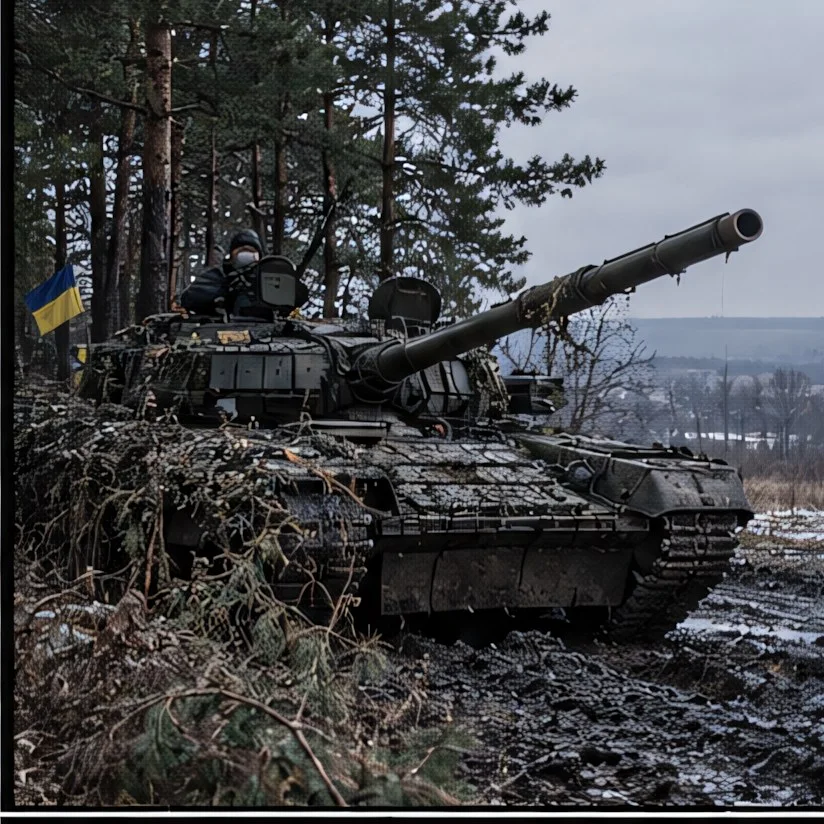
AI-generated illustration — A camouflaged tank in woodland near the front line.

The war of March 2022 is not the same operational environment as the war of 2026. The failed Russian attempt at a rapid political-military break around Kyiv, the artillery-heavy fighting in Donbas, Ukraine's autumn 2022 offensives, Bakhmut, the prepared defences confronted in 2023, and the later expansion of drone warfare all emphasised different constraints.

The phases overlap. Different sectors can simultaneously show urban attrition, infiltration, positional defence and long-range strike. The essential lesson is that organisations must keep learning while fighting.

2. Kyiv 2022 — superiority that could not add itself up

Russia possessed major advantages in equipment and firepower, but the northern operation depended on speed, political assumptions, logistics and coordinated follow-on action. Hostomel showed that capturing a point does not automatically create the air bridge, ground access and sustainment needed to exploit it.

A long vehicle column was a visible symptom, not the whole explanation. Combat power is constrained by the weakest links connecting movement, information, fuel, command and resistance. Ukraine's surviving air defence, dispersed forces and functioning command denied Russia the kind of permissive air environment familiar from some Western campaigns.

3. Charkiv and Kherson — the same colour, a different mechanism

Around Charkiv in September 2022, Ukraine exploited surprise, uneven Russian dispositions and a tempo that outran the defender's ability to recreate a coherent line. Around Kherson, the crucial process was also sustainability: the Russian grouping west of the Dnipro depended on vulnerable crossings and a supply system under growing pressure.

An organised withdrawal can preserve forces while conceding important terrain. A collapse and a deliberate withdrawal may look similar on a simplified map and represent very different conditions inside the force.

4. The 2023 offensive — passing through is not breaking through

Prepared defence consists of mines, observation, fire, reserve positions, obstacles and forces capable of reacting. Mines become especially powerful when they slow movement in areas that can be observed and struck. A breaching vehicle by itself cannot solve that system.

Successful breaching requires engineers, suppression, protection, communications, command and forces able to exploit a temporary opening. Concentration creates strength but increases detectability. Passing the first obstacle is therefore not synonymous with achieving an operational breakthrough.

5. The battlefield is more transparent, not transparent

Reconnaissance drones, thermal sensors, radar, satellites and electronic surveillance increase the probability that activity will leave a detectable signature. They do not give every soldier a live omniscient picture.

Visibility depends on terrain, weather, sensor survival, connectivity, attention and deception. Published footage is also a selected sample: we see successful or narratively useful clips more often than failed sorties, ambiguous observations or lost links.

6. From image to effect

A useful analytical chain runs from detection through identification, location, tracking and decision to strike and assessment. Each step has its own uncertainty and latency. Correct coordinates can arrive too late. A hit can fail to produce a durable loss of function.

The final step, assessment, is especially important. Explosion is an event; loss of capability is an outcome. A repairable interruption and a durable deficit are not the same military result.

7. A drone is not one weapon

Reconnaissance multicopters primarily produce information. FPV systems bring guided effects to individual observed targets. Bomber multicopters can return and be reused. Loitering munitions combine waiting, sensing and one-way effect. Long-range one-way attack drones stress rear-area defence and industrial endurance.

Fibre-optic systems trade radio vulnerability for physical and weight constraints. Interceptor drones add another layer to air defence. Naval unmanned craft contributed to sea denial in the Black Sea. Ground robots can move supplies, assist evacuation and take on dangerous tasks. Partial autonomy can affect navigation, tracking or image processing without making an entire system autonomous.

Cost comparisons must include the whole system: failed launches, operators, reconnaissance, communications, maintenance and the number of attempts required for a verified effect.

8. What FPV can do better than a shell — and what it cannot

FPV drones can act against individual observed objects while the operator sees a changing scene. Artillery can deliver suppression, area effects and concentrated fire whose value is not captured by a single destroyed vehicle.

Destruction and suppression are different. A force that is temporarily unable to observe, move or fire may be operationally constrained even if much of its equipment survives. Camera-equipped weapons also produce more visible evidence of their own use, creating a publication bias in public debate.

9. Fibre optic — when the countermeasure changes the problem

A physical fibre link avoids the particular vulnerability of a radio control channel to ordinary jamming. It does not abolish mechanical limitations, weather, detection, physical interception or the need for correct target identification.

The important pattern is adaptation. A countermeasure can force the attacker to redesign a system; the redesign then creates new compromises. Defence can remain useful even when it is not absolute.

10. Electronic warfare — the invisible spectrum contest

Jamming interferes with reception. Spoofing attempts to make a receiver accept false information. Electronic surveillance detects and interprets emissions. Protection seeks to preserve one's own functions under hostile interference.

Navigation and communications are not identical functions, and friendly jamming can harm friendly systems if not coordinated. Electronic warfare is therefore as much an organisational problem as a technical one.

11. Software as part of the munition

Some contemporary systems can change behaviour through software updates: image processing, navigation, stabilisation or data handling. Code does not repeal physics; a small battery remains a small energy store and a poor sensor does not become perfect through software.

What matters is the feedback chain from battlefield problem to diagnosis, development, testing, distribution and operator understanding. Rapid iteration can be an advantage, but untested updates and fragmented versions can also create new failures.

12. Ground robots — a machine that is supposed to replace somebody
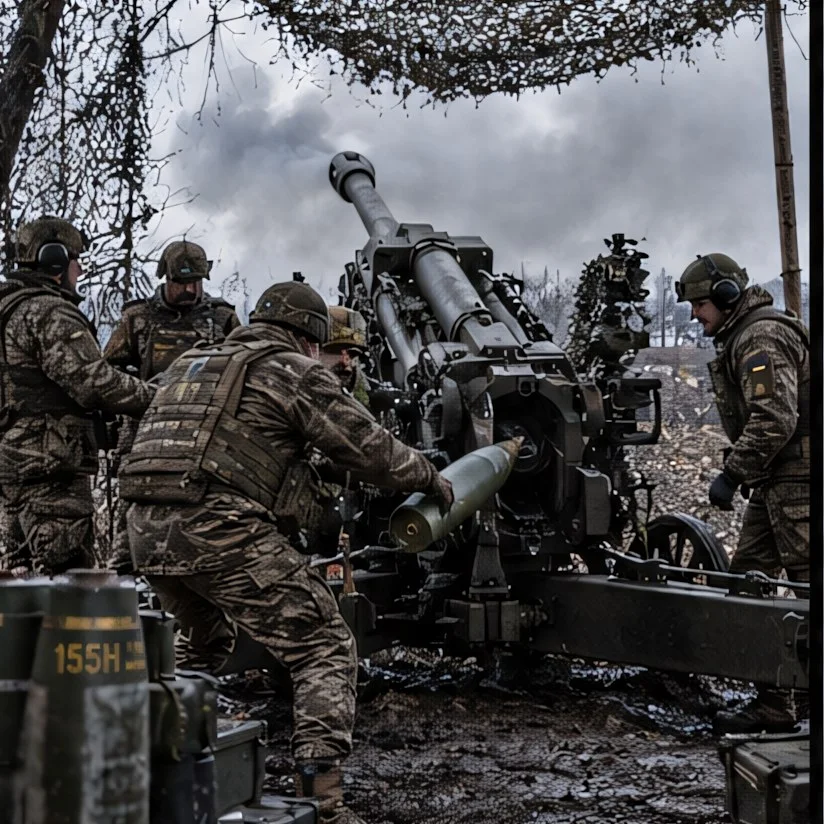
AI-generated illustration — An artillery crew loads a howitzer in winter terrain.

Uncrewed ground vehicles can carry supplies, help evacuate casualties, scout or perform dangerous engineering tasks. Their value is measured not by how futuristic they look but by how many risky human journeys or tasks they reliably replace.

Terrain, connection, recovery, repair and the possibility of the robot itself becoming a new rescue problem remain practical constraints.

13. Infantry did not disappear

New technology did not remove the need for people to hold ground, clear positions, move through buildings, repair systems and make decisions in uncertain conditions. In many places, technology changed how infantry survives and moves rather than eliminating infantry.

The density of observation and strike creates pressure for dispersion, concealment and smaller movements, but terrain is still ultimately controlled by people and organisations.

14. What makes a good soldier

Individual courage matters, but modern combat also rewards routine, discipline, technical literacy, small-unit leadership and the ability to operate when communications or plans fail. Experienced non-commissioned officers, medics, drone operators, engineers and maintainers can be harder to replace than the equipment they use.

Human capital accumulates slowly and can disappear quickly.

15. Mobilisation — population is not a reservoir of soldiers

Demographic size is only the first layer. A mobilised person needs screening, equipment, training, leaders, integration and eventually rotation. States also need workers for energy, transport, defence industry, health care and the tax base.

Mobilisation is therefore a competition between military manpower needs and the continued functioning of society. The maximum theoretical pool is not the same as sustainable force generation.

16. Losses — the number everybody wants

Casualty figures are among the most politically charged and methodologically difficult numbers in war. Killed, wounded, missing and captured must be separated, and “casualties” may combine categories that readers assume to mean deaths.

Different sources have different incentives and access. A precise-looking number can still be uncertain if its method, period or category is unclear.

17. How the dead are counted

Named lists built from obituaries, graves, official notices and family reports can establish documented cases and useful lower bounds. They inevitably lag and miss cases that are not public. Statistical excess-mortality methods answer different questions and have their own confounders.

No responsible estimate should silently mix a documented minimum with a modelled total and call them the same thing.

18. Equipment on video — what is actually confirmed

Visual confirmation is powerful because it anchors a claim to observable evidence. It is also incomplete. Some losses are never photographed; the same object can be recorded multiple times; a damaged vehicle can later return to service.

Destroyed, damaged, abandoned and captured should remain separate categories unless evidence justifies a change. Visual databases are valuable samples, not omniscient inventories.

19. Artillery — a weapon that is really a chain

A gun requires target information, fire control, ammunition, crews, transport, maintenance and barrel life. Shortages at any point can reduce the value of the entire chain. A shell in a warehouse and a shell available to the correct gun at the correct time are not the same military resource.

Artillery remains important even in a drone-rich war because suppression, area effects and sustained fire perform jobs individual FPV attacks cannot always reproduce.

20. Barrels, tyres and repair crews

High-intensity warfare consumes components that rarely appear in headlines: barrels, tyres, tracks, engines, batteries and tools. Repair capacity determines whether a damaged platform becomes a permanent loss or a temporary absence.

A military that can recover and return equipment may preserve combat power even while public imagery shows many damaged vehicles.

21. Logistics — the war that begins far behind the trench

Fuel, ammunition, food, medical supplies, spare parts and replacements have to move through a network. Railheads, depots, bridges, trucks and roads create capacity and vulnerability. A route does not have to be completely destroyed to become militarily less useful; reduced throughput and greater uncertainty can be enough.

Logistics turns geography into usable combat power.

22. The mine, the engineer and the second trench

Mines shape movement even when they do not detonate. They channel forces, slow them and expose engineers and vehicles to observation and fire. Defensive depth matters because clearing the first belt may reveal another obstacle or allow reserves to intervene.

Engineering is therefore inseparable from protection, suppression, reconnaissance and tempo.

23. The tank — dead, or simply less forgiving?

Tanks became easier to observe and attack from above, but they retained firepower, mobility and protection that infantry still finds useful. The correct conclusion is not that the tank died, but that unprotected and predictable tank employment became more costly.

Survivability increasingly depends on combined use with infantry, electronic protection, reconnaissance, camouflage, engineering and recovery.

24. Aviation and glide bombs — why this is not Iraq
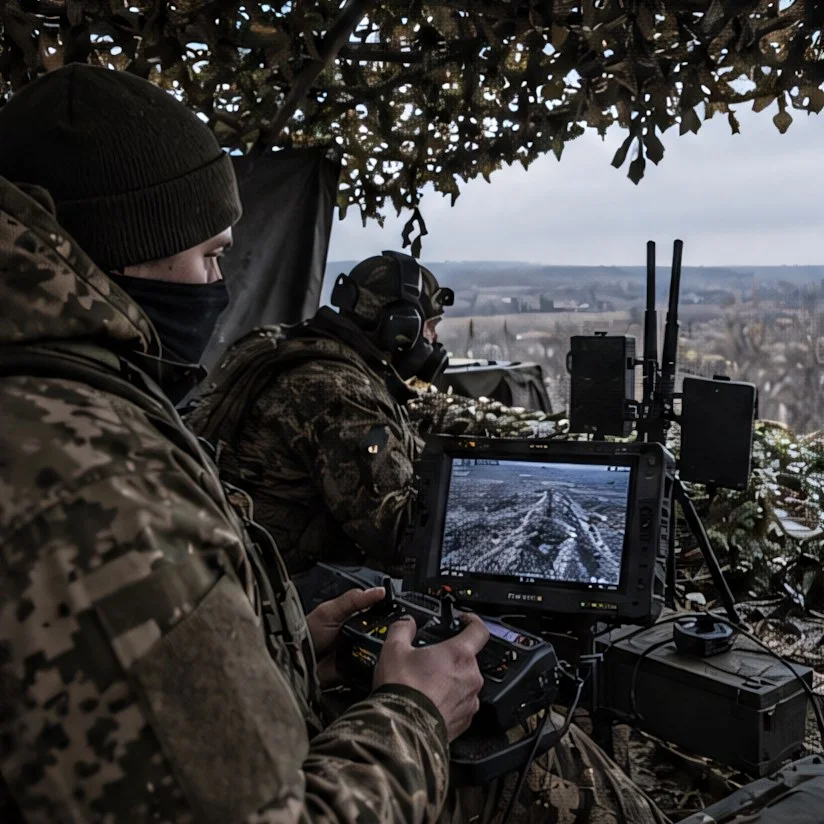
AI-generated illustration — An operator watches a reconnaissance drone feed on a screen.

Neither side enjoyed the permissive air environment seen in some post-Cold War Western campaigns. Surviving air defence constrained manned aircraft and shaped flight profiles. Russia's use of stand-off and glide bombs expanded the ability to deliver heavy effects without routinely flying directly over the most defended front-line areas.

Air power here is a contest between aircraft, stand-off weapons, sensors, air defence and the industrial ability to replace munitions.

25. Air defence — with what do you shoot it down?

Air defence is layered because different threats demand different interceptors, sensors and engagement ranges. Using a scarce, expensive interceptor against a cheap threat may still be rational if it protects a much more valuable target, but repeated exchanges create an economic problem.

Interceptor drones and cheaper layers seek to improve this equation. No single layer can efficiently defeat every missile, drone and aircraft.

26. War far behind the front

Long-range attacks aim at headquarters, logistics, airfields, industry, energy and transport. The relevant measure is not only whether something was hit, but how long the function was lost and what resources were required to restore it.

Strategic strike is therefore a contest between repeated damage and recovery.

27. Energy — a transformer is not just a budget line

Electrical systems depend on generation, transmission, substations, transformers, protection and repair crews. Large specialised components can be difficult to replace quickly. Redundancy and emergency repair can reduce the strategic effect of physical destruction.

Energy attacks reach directly into civilian life while also affecting industry, transport and military support.

28. The Black Sea — sea denial is not the same as sea control

Ukraine, despite lacking a symmetrical surface fleet, increased risks for Russian naval operations through coastal missiles, intelligence, strikes and unmanned maritime systems. This contributed to changes in deployment and behaviour.

Forcing a stronger navy to operate more cautiously is sea denial. It is not identical to owning the sea, and the distinction matters.

Commercial satellite imagery and private communications services became important parts of wartime infrastructure. That creates advantages in scale and innovation but also dependencies on corporate policy, contracts, terminals, spectrum and external supply.

A military capability can therefore depend on a private actor whose decisions are not governed exactly like those of a defence ministry.

30. Command and combined arms

Combined arms is not a collection of weapon types standing nearby. It is the coordination of functions so that one compensates for another's vulnerability: engineers open routes, fires suppress, air defence protects, reconnaissance informs and logistics sustains.

The harder the battlefield is to move through, the more valuable coordination becomes — and the more costly organisational failure can be.

31. Advance, breakthrough and tempo

Advance is movement. Breakthrough means disrupting a defensive system sufficiently to create wider opportunities. Tempo is the rate at which one side can keep presenting problems before the other restores coherence.

Kilometres per day do not by themselves tell us which of these is occurring.

32. The city — objective, symbol and trap

Cities concentrate people, roads, industry, political meaning and defensible structures. Fighting in them can consume infantry and ammunition at extraordinary rates while turning civilian protection into an immediate operational constraint.

A city can matter because of transport, terrain or symbolism; these values should not be silently merged.

33. War is manufactured

High-intensity war consumes ammunition, drones, vehicles, air-defence missiles, explosives and spare parts faster than peacetime procurement systems were designed to replace them. Industrial capacity therefore becomes a strategic variable.

Production numbers still need context: quality, delivery, repair, component availability and the rate of battlefield consumption determine the usable result.

34. The Ukrainian factory is not one place

Ukraine's defence production is dispersed across state firms, private companies, workshops, software teams and foreign partnerships. Dispersion can improve resilience but complicates standardisation, security and logistics.

Rapid adaptation is valuable only if successful designs can move from experiment to reliable production and field support.

35. Aid — money that is not yet a weapon

Appropriated, allocated, contracted, produced, delivered and operational are different statuses. Headlines often mix them. A large financial commitment can be strategically decisive while still not solving a shortage today.

The calendar of foreign legislatures, budgets, manufacturers and training programmes can be as important as the nominal total.

36. Economics — how many resources become power
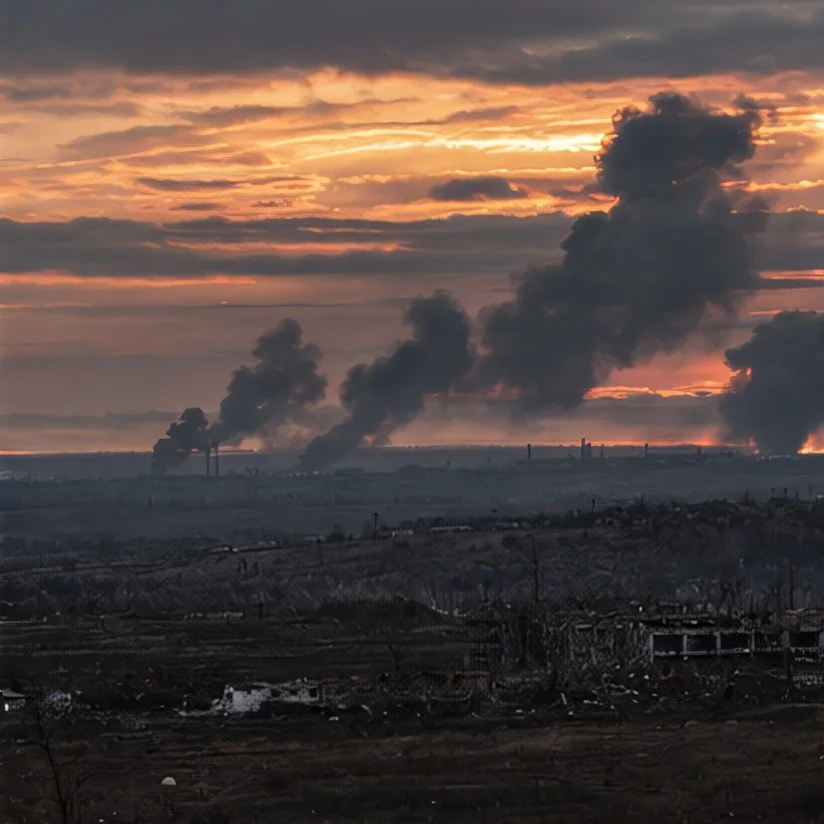
AI-generated illustration — Columns of smoke over the front line at sunset.

A larger economy creates more potential resources but must convert them into military output. The Czech master cites SIPRI estimates for 2025 of roughly 190 billion US dollars in Russian military spending and 84.1 billion for Ukraine, alongside very different shares of GDP. Such dollar comparisons do not imply equal domestic purchasing power or equal efficiency.

Economic endurance includes labour, taxation, inflation, energy, imports, sanctions, external finance and the opportunity costs imposed on civilian society.

37. The civilian is not a side chapter

Civilian deaths and injuries are not merely humanitarian footnotes. Population displacement changes labour markets and local services. Destroyed housing and infrastructure shift public spending. Fear and insecurity alter political behaviour and long-term demographic prospects.

A military analysis that removes civilians misunderstands the society sustaining the military.

38. A wounded person is not a closed record

Survival does not end the human and strategic cost. Rehabilitation, prosthetics, mental health, chronic disability and family care can last years. The ability to return personnel to civilian life or duty also affects military manpower and public finance.

Wounded figures therefore do not translate mechanically into permanent military loss, but neither do they disappear after evacuation.

39. Time is not neutral

Time can benefit the side that adapts, replenishes and sustains political support faster. It can harm the side whose experienced personnel, infrastructure or external alliances erode. Both processes can happen simultaneously in different domains.

There is no universal rule that a long war automatically favours the larger state or the defender.

40. Five races without a final lap

The conflict can be understood as overlapping races: sensors against concealment; strike systems against protection; production against consumption; innovation against countermeasure; and force generation against human attrition.

Winning one race temporarily does not finish the others. A technological advantage can be copied, jammed, dispersed against or outproduced.

41. No miracle weapon

Every celebrated system enters an ecosystem of countermeasures and constraints. A weapon can be genuinely excellent and still fail to transform the strategic balance because there are too few of them, because the enemy adapts, or because another bottleneck remains.

The relevant question is therefore not whether a system is “game-changing” in isolation, but what function it changes, at what scale and for how long.

42. Telegram is not a general staff. A general staff is not an independent source

Open-source reporting, social media, official military statements, commercial imagery and specialist analysis each provide different evidence. None should automatically inherit the authority of another.

A claim becomes stronger through corroboration, clear methodology and acknowledgement of uncertainty. War rewards propaganda; analysis must reward evidence instead.

43. What would the war look like without drones?

Without the mass proliferation of drones, artillery, mines, infantry and aviation would still exist, but observation would often be slower and less granular, movement somewhat easier to conceal, and some precision effects more expensive or less available at unit level.

This counterfactual shows why drones matter without pretending they replaced traditional warfare. They changed the connections between old functions.

44. Where is the war now?

The Czech master uses a cut-off of 13 September 2026 and distinguishes a dated map from certainty about every metre of front. The essential methodological point survives every update: a map should state its time, source, definition of control and treatment of grey zones or infiltrations.

A current front line is an estimate of control, not a legal border and not a forecast of the next month.

45. Who is winning?

There is no single metric that closes the question. Territory, force preservation, casualty replacement, industrial output, air defence, the Black Sea, long-range strike, foreign support and political endurance can point in different directions.

Any answer should define the time horizon and level. “Winning today” can mean a local tactical advantage and still coexist with a strategic problem.

46. Back to the map

The map is most useful when its limits are visible. It is excellent at showing space. It is poor at showing training, repair capacity, ammunition stocks, morale, hospital load, industrial learning or the political reliability of future aid.

Instead of discarding the map, we should surround it with the variables it cannot carry.

47. Final evidentiary summary

Well supported: the war changed its operational character repeatedly; drones and sensors increased battlefield visibility without creating omniscience; logistics, repair, air defence, engineering, infantry and industrial production remain central; a local territorial gain does not by itself demonstrate an operational breakthrough.

Strongly supported interpretation: the conflict is best understood as a system of interacting military, technological, economic and human processes rather than a competition between individual weapons.

Still uncertain: exact comparative losses, hidden stockpiles, the durability of some industrial rates and the internal assessments by which both governments evaluate acceptable cost.

What public data cannot provide in real time is a perfect balance sheet of remaining combat power. That is precisely why humility about the map is not evasiveness. It is method.

Territory is the result. War is the system that produces, pays for and tries to sustain that result.

Evidence record

How this article was made

Method, the role of AI, corrections and source details in one place.

Methodological note

Each article starts with a question and traceable sources. Findings, estimates and interpretation remain distinct even when this makes the conclusion more cautious. Readers should see both the strength of the material and where the evidence stops.

Use of AI

AI may assist with technical processing, language review or illustrations. A human remains responsible for factual conclusions and editorial decisions.

Sources and further reading100 citations

The count is the number of cited entries. More than one entry can describe the same study or document.

  1. Official statisticsRUSI · 2022-11-30 Bibliographic record; the number of references is not the number of independent datasets.
    Preliminary Lessons in Conventional Warfighting: February–July · 2022
  2. Official statistics-05-19 Bibliographic record; the number of references is not the number of independent datasets.
    Meatgrinder: Russian Tactics in the Second Year of Its Invasion of Ukraine RUSI · · 2023
  3. Official statisticsOffensive RUSI · 2023-09-04 Bibliographic record; the number of references is not the number of independent datasets.
    Stormbreak: Fighting Through Russian Defences in Ukraine’s · 2023
  4. Official statistics–23 RUSI · 2024-07 Bibliographic record; the number of references is not the number of independent datasets.
    Preliminary Lessons from Ukraine’s Offensive Operations · 2022
  5. Official statistics-03-18 Bibliographic record; the number of references is not the number of independent datasets.
    The Attritional Art of War: Lessons from the Russian War on Ukraine RUSI · · 2024
  6. Official statistics-02-14 Bibliographic record; the number of references is not the number of independent datasets.
    Tactical Developments During the Third Year of the Russo–Ukrainian War RUSI · · 2025
  7. Official statistics-10-23 Bibliographic record; the number of references is not the number of independent datasets.
    Emergent Approaches to Combined Arms Manoeuvre in Ukraine RUSI · · 2025
  8. Official statistics-07-28 Bibliographic record; the number of references is not the number of independent datasets.
    Four Years On: An Update on the Air War Over Ukraine RUSI · · 2026
  9. Official statistics-09-07 Bibliographic record; the number of references is not the number of independent datasets.
    Russia’s Most Dangerous Military Adaptation Is Recovery RUSI · · 2026
  10. Official statistics-04-11 Bibliographic record; the number of references is not the number of independent datasets.
    Mass Precision Strike: Designing UAV Complexes for Land Forces RUSI · · 2024
  11. Official statistics-08-25 Bibliographic record; the number of references is not the number of independent datasets.
    The Evolution of Russia’s Precision Strike: Adopting Mass Precision RUSI · · 2026
  12. Official statistics-08-08 Bibliographic record; the number of references is not the number of independent datasets.
    Silicon Lifeline: Western Electronics at the Heart of Russia’s War Machine RUSI · · 2022
  13. Official statistics-11-07 Bibliographic record; the number of references is not the number of independent datasets.
    The Russian Air War and Ukrainian Requirements for Air Defence RUSI · · 2022
  14. Official statistics-06-17 Bibliographic record; the number of references is not the number of independent datasets.
    The Return of Industrial Warfare RUSI · · 2022
  15. Official statisticsBibliographic record; the number of references is not the number of independent datasets.
    Dispersed, Disguised, and Degradable: Implications of the Fighting in Ukraine RAND · · 2025
  16. Official statistics-09-04 Bibliographic record; the number of references is not the number of independent datasets.
    From Shahed to Geran: How Russia Continues to Reinvent the One-Way Attack Drone CSIS · · 2026
  17. Official statistics-08-31 Bibliographic record; the number of references is not the number of independent datasets.
    Winning the Salvo Competition: How to Rebuild the Air and Missile Defense Industrial Base CSIS · · 2026
  18. Official statisticsISW · 2026-09-01 Bibliographic record; the number of references is not the number of independent datasets.
    Russian Offensive Campaign Assessment, September 1 · 2026
  19. Other sourceISW · 2026-09-12 Current analytical source; claims of the parties and timing errors cannot be adopted automatically.
    Russian Offensive Campaign Assessment, September 12 · 2026
  20. Official statistics-08-11 Bibliographic record; the number of references is not the number of independent datasets.
    How ISW Maps Russian Infiltrations in Ukraine: Breaking Down the Grey Zone ISW · · 2026
  21. Official statisticsAttack On Europe: Documenting Russian Equipment Losses Oryx · Continuously updated Bibliographic record; the number of references is not the number of independent datasets.
  22. Official statistics-09-11 Bibliographic record; the number of references is not the number of independent datasets.
    Russian losses in the war with Ukraine: Mediazona count Mediazona / BBC Russian · · 2026
  23. Official statistics-02-24 Bibliographic record; the number of references is not the number of independent datasets.
    Estimating Russian military deaths using the Probate Registry Mediazona / Meduza · · 2024
  24. Official statisticsOHCHR / HRMMU · 2026-08-12 Bibliographic record; the number of references is not the number of independent datasets.
    Protection of Civilians in Armed Conflict: July · 2026
  25. Other source-08-13 Same verification system as S024; a different edition or revision.
    Highest monthly number of civilian deaths and injuries in Ukraine OSN Ukrajina · · 2026
  26. Other sourceOHCHR / HRMMU · 2026-07-14 Same verification system as S024; a different edition or revision.
    Protection of Civilians in Armed Conflict: June · 2026
  27. Official statisticsSIPRI · 2026-04 Bibliographic record; the number of references is not the number of independent datasets.
    Trends in World Military Expenditure · 2025
  28. Official statisticsSIPRI · 2026-03 Bibliographic record; the number of references is not the number of independent datasets.
    A Budget for a Fifth Year of War: Military Spending in Russia’s Budget for · 2026
  29. Other source-08-13; data do 2026-06 Same tracker family; date and methodological version must be kept distinct.
    Ukraine Support Tracker Kiel Institute · · 2026
  30. Official statisticsUkraine Support Tracker: Dataset Documentation Kiel Institute · Metodika; verze dostupná při uzávěrce Same tracker family; date and methodological version must be kept distinct.
  31. Other source-08-13 Same tracker family; date and methodological version must be kept distinct.
    Ukraine Support Tracker: Europe leads on aid, US weapons remain key Kiel Institute · · 2026
  32. Official statistics-02-23; as of do 2025-12-31 Bibliographic record; the number of references is not the number of independent datasets.
    Updated Ukraine Recovery and Reconstruction Needs Assessment Released: RDNA5 World Bank / EU / OSN / Ukrajina · · 2026
  33. Official statisticsArticle IV Consultation and First Review of the EFF IMF · 2026-07 Bibliographic record; the number of references is not the number of independent datasets.
    Ukraine: · 2026
  34. Official statistics-07-20 Bibliographic record; the number of references is not the number of independent datasets.
    IMF completes First Review of Ukraine’s EFF IMF · · 2026
  35. Official statistics-04-23 Bibliographic record; the number of references is not the number of independent datasets.
    Council finalises €90 billion support loan to Ukraine Rada EU · · 2026
  36. Official statistics-07-22 Bibliographic record; the number of references is not the number of independent datasets.
    Actions Needed to Properly Value Defense Articles Provided under Presidential Drawdown Authority US GAO · · 2024
  37. Official statisticsWHO · 2026-02-23 Bibliographic record; the number of references is not the number of independent datasets.
    Attacks on Ukraine’s health care increased by 20% in · 2025
  38. Official statistics-02-24 Bibliographic record; the number of references is not the number of independent datasets.
    Three years of war: rising demand for mental health support, trauma care and rehabilitation WHO · · 2025
  39. Official statistics-03-25 Bibliographic record; the number of references is not the number of independent datasets.
    Strengthening the Rehabilitation System in Ukraine Public Health Reviews / Boichuk et al. · · 2026
  40. Official statistics-09-13 Bibliographic record; the number of references is not the number of independent datasets.
    Frequently Asked Questions: IHL and the escalating conflict in the Middle East ICRC · Výklad právního rámce; přístup · 2026
  41. Official statistics–2026 UNHCR · 2025-01 Bibliographic record; the number of references is not the number of independent datasets.
    Regional Refugee Response Plan · 2025
  42. Official statisticsIOM · 2026 Bibliographic record; the number of references is not the number of independent datasets.
    Ukraine Crisis Response Plan · 2026
  43. Official statisticsUNICEF · 2026-02-13 Bibliographic record; the number of references is not the number of independent datasets.
    Ukraine and Refugee Response: Humanitarian Action for Children · 2026
  44. Official statistics-09-05 Bibliographic record; the number of references is not the number of independent datasets.
    Update 365: Director General Statement on Situation in Ukraine IAEA · · 2026
  45. Official statistics-09-11 Bibliographic record; the number of references is not the number of independent datasets.
    Behind the killer robots of Ukraine’s new warfare revolution Reuters · · 2026
  46. Official statistics-09-12 Bibliographic record; the number of references is not the number of independent datasets.
    Russian attacks kill civilians; Ukraine and Russia report deep strikes Reuters · · 2026
  47. Official statistics-09-12 Bibliographic record; the number of references is not the number of independent datasets.
    Ukraine braces for harsh winter as Russian attacks hit economy Reuters · · 2026
  48. Official statistics-09-11 Bibliographic record; the number of references is not the number of independent datasets.
    IEA further cuts Russian oil output forecasts on Ukrainian attacks Reuters · · 2026
  49. Official statistics-07-28 Bibliographic record; the number of references is not the number of independent datasets.
    How Russia spread a secret web of agents across Ukraine Reuters Investigates · · 2022
  50. Official statistics-02-17 Bibliographic record; the number of references is not the number of independent datasets.
    A year of war in Ukraine Reuters Investigates · · 2023
  51. Official statistics-09-13 Bibliographic record; the number of references is not the number of independent datasets.
    How Russia’s new drones are changing the air war Financial Times · · 2026
  52. Official statistics-09-13, ranní zpráva Bibliographic record; the number of references is not the number of independent datasets.
    Russian drone attack injures five in Ukraine’s Odesa, officials say Reuters · · 2026
  53. Official statistics-09-08 Bibliographic record; the number of references is not the number of independent datasets.
    Ukraine contracting around 1,000 Patriot missiles from allies, defence chief says Reuters · · 2026
  54. Other source-06 Same tracker family; date and methodological version must be kept distinct.
    Ukraine Support Tracker Data Kiel Institute · Data do · 2026
  55. Official statisticsISW / CTP · 2023-06-04 Bibliographic record; the number of references is not the number of independent datasets.
    Russian Offensive Campaign Assessment, June 4 · 2023
  56. Official statisticsISW / CTP · 2023-11-01 Bibliographic record; the number of references is not the number of independent datasets.
    Russian Offensive Campaign Assessment, November 1 · 2023
  57. Official statisticsISW · 2024-12-31 Bibliographic record; the number of references is not the number of independent datasets.
    Russian Offensive Campaign Assessment, December 31 · 2024
  58. Official statisticsISW · 2025-12-31 Bibliographic record; the number of references is not the number of independent datasets.
    Russian Offensive Campaign Assessment, December 31 · 2025
  59. Official statisticsBibliographic record; the number of references is not the number of independent datasets.
    Ukraine Aid Is Important. So Is Oversight of Funding and Assistance US GAO · · 2024
  60. Official statisticsfinancing needs and continued budget support Ministerstvo financí Ukrajiny · 2026-06 Bibliographic record; the number of references is not the number of independent datasets.
    Ukraine’s · 2026
  61. Official statistics-02-12 Bibliographic record; the number of references is not the number of independent datasets.
    Mapping the MilTech War: Eight Lessons from Ukraine’s Battlefield Ifri · · 2026
  62. Official statistics-07-07 Bibliographic record; the number of references is not the number of independent datasets.
    Ukraine’s Logistics Targeting Raises Questions for Russia’s Rear Defences RUSI · · 2026
  63. Official statisticsCounter-Offensive US Army / Armor · 2025-07-08 Bibliographic record; the number of references is not the number of independent datasets.
    Blocked and Bloodied: Lessons from the Combined Arms Breach during the · 2023
  64. Official statisticsBibliographic record; the number of references is not the number of independent datasets.
    Has Russian Electronic Warfare Underperformed in the Ukrainian Conflict? Journal of Strategic Security · · 2025
  65. Official statisticsBibliographic record; the number of references is not the number of independent datasets.
    The Future of War: Kill-Chain Supremacy and Ukraine’s Lessons Journal of Strategic Security · · 2025
  66. Official statisticsBibliographic record; the number of references is not the number of independent datasets.
    Artificial Intelligence in Warfare: The Case of the Russia-Ukraine War Journal of Strategic Security · · 2025
  67. Official statisticsBibliographic record; the number of references is not the number of independent datasets.
    Sea Denial: The Ukrainian Case Study and the Future of Naval Warfare Journal of Strategic Security · · 2025
  68. Official statisticsBibliographic record; the number of references is not the number of independent datasets.
    Millions of Tons, Billions in Dollars: Unexploded Ordnance in Ukraine Journal of Strategic Security · · 2025
  69. Official statisticsBibliographic record; the number of references is not the number of independent datasets.
    Energy Weaponization in the Ukraine–Russia War Journal of Strategic Security · · 2025
  70. Official statisticsBibliographic record; the number of references is not the number of independent datasets.
    Russian Resilience: Sanction Elusion Mechanisms Journal of Strategic Security · · 2025
  71. Official statistics-12-15 Bibliographic record; the number of references is not the number of independent datasets.
    Historical Armor Losses: Shifting Tactics and Strategic Paralysis US Army / Armor · · 2025
  72. Official statistics-12-15 Bibliographic record; the number of references is not the number of independent datasets.
    The Orlan Complex: Tracking the Supply Chains of Russia’s Most Successful UAV RUSI / Reuters / iStories · · 2022
  73. Official statistics-09-13 Bibliographic record; the number of references is not the number of independent datasets.
    SIPRI Definition of Military Expenditure SIPRI · Metodika; přístup · 2026
  74. Institutional source-06-30 Inconsistent tranche amount; excluded from quantitative claims.
    First defence tranche under the Ukraine Support Loan Ministerstvo financí Ukrajiny · · 2026
  75. Official statistics-02-08 Bibliographic record; the number of references is not the number of independent datasets.
    Our City Was Gone: Russia’s Devastation of Mariupol Human Rights Watch / Truth Hounds / SITU · · 2024
  76. Official statistics-03-23 Bibliographic record; the number of references is not the number of independent datasets.
    On tour in hell: Wounded Ukrainian soldiers are evacuated Associated Press · · 2023
  77. Official statistics-09-21 Bibliographic record; the number of references is not the number of independent datasets.
    Fighting through hell to reclaim a Ukrainian village Associated Press · · 2023
  78. Official statistics-04-23 Bibliographic record; the number of references is not the number of independent datasets.
    They cannot be jammed: fibre-optic drones pose new threat in Ukraine The Guardian · · 2025
  79. Official statistics-12-05 Bibliographic record; the number of references is not the number of independent datasets.
    War in Ukraine: the complicated evacuation of the wounded from the frontline Le Monde · · 2023
  80. Official statistics-06-07 Bibliographic record; the number of references is not the number of independent datasets.
    The Fight to Survive Russia’s Onslaught in Eastern Ukraine The New Yorker · · 2022
  81. Official statistics-03-24 Bibliographic record; the number of references is not the number of independent datasets.
    Just a Typical Day: Rescuing Wounded Soldiers on Ukraine Front AFP / Voice of America · · 2023
  82. Official statistics-09-25 Bibliographic record; the number of references is not the number of independent datasets.
    Russia has secret war drones project in China, intel sources say Reuters · · 2024
  83. Official statistics-04-23 Bibliographic record; the number of references is not the number of independent datasets.
    Ukraine launches military charm offensive as conscription flags Reuters · · 2024
  84. Official statistics-12-13 Bibliographic record; the number of references is not the number of independent datasets.
    Ukrainian general to overhaul training and management amid manpower woes Reuters · · 2024
  85. Official statistics-07-31 Bibliographic record; the number of references is not the number of independent datasets.
    Putin doubles signing bonuses for volunteers to fight in Ukraine Reuters · · 2024
  86. Official statistics-06-21 Bibliographic record; the number of references is not the number of independent datasets.
    Photo of memorial shared as showing new Ukrainian military recruits Reuters Fact Check · · 2024
  87. Official statistics-03-17 Bibliographic record; the number of references is not the number of independent datasets.
    Armed conflict in Ukraine: a recap of basic IHL rules ICRC · · 2022
  88. Official statistics-03-30 Bibliographic record; the number of references is not the number of independent datasets.
    KA-SAT Network cyber attack overview Viasat · · 2022
  89. Other source-02 Same tracker family; date and methodological version must be kept distinct.
    Europe Steps Up: Ukraine Support After Four Years of War Kiel Institute · · 2026
  90. Official statisticsRussia Matters / Belfer Center · 2026-09-09; mapa 2026-09-08 Bibliographic record; the number of references is not the number of independent datasets.
    Russia-Ukraine War Report Card, September 9 · 2026
  91. Other source-01-08 Attribution and usage rules; not a military data analysis.
    Fair Use and Attribution Policy ISW · · 2026
  92. Official statisticsRussia Matters / Belfer Center · 2024-12-18 Bibliographic record; the number of references is not the number of independent datasets.
    Russia-Ukraine War Report Card, December 18 · 2024
  93. Official statisticsRussia Matters / Belfer Center · 2025-12-23 Bibliographic record; the number of references is not the number of independent datasets.
    Russia-Ukraine War Report Card, December 23 · 2025
  94. Official statistics-01-15 Bibliographic record; the number of references is not the number of independent datasets.
    The effect of conflict on damage to medical facilities in Mariupol: A quasi-experimental study PLOS Global Public Health · · 2025
  95. Official statisticsRussia Matters / Belfer Center · 2023-10-10 Bibliographic record; the number of references is not the number of independent datasets.
    Russia-Ukraine War Report Card, October 10 · 2023
  96. Official statistics-09-13 Bibliographic record; the number of references is not the number of independent datasets.
    Brave1: obranně-technologický klastr Brave1 · Přístup · 2026
  97. Official statistics-09-13 Bibliographic record; the number of references is not the number of independent datasets.
    Methodology: documentation and tracing of weapons Conflict Armament Research · Přístup · 2026
  98. Other source-06 Same tracker family; date and methodological version must be kept distinct.
    Ukraine Support Tracker: Methodological Update and New Results on Aid Allocation Kiel Institute · · 2024
  99. Other source-02 Same tracker family; date and methodological version must be kept distinct.
    Ukraine Support Tracker: Third Anniversary Report Kiel Institute · · 2025
  100. Official statistics-09-13 Bibliographic record; the number of references is not the number of independent datasets.
    Ukraine Conflict Monitor ACLED · Přístup · 2026
Discussion

Comments

Have an additional source or a factual correction? Add a comment.

0 comments

Add a comment