

The question is: what is pervitin in the Czech Republic — from production through use to the ends of people on it? It sounds simple only until we notice that we are not comparing one thing. A brand from a pharmacy of the thirties is not today’s detected clandestine lab. The lifetime experience of four to five percent of adults is not thirty-eight thousand people in the estimate of high-risk use. One hundred and eighty-four clandestine labs is not a map of production. Twenty-seven deaths in which a special register in 2024 found pervitin or amphetamine is not an annual account of addiction. Only when these four things are separated can one read what the National Monitoring Centre, the National Drug Headquarters and the courts actually measure for 2024 and 2025 — and what still does not follow about an “end”.
1. The epidemiologist, the police officer and the field see the same substance in three statistics
Imagine a table on which five files lie and no substance to photograph. An epidemiologist from the National Monitoring Centre for Drugs and Addiction puts down an estimate: in the Czech Republic there are 47.5 thousand people who use drugs in a high-risk way, of whom 38.2 thousand use pervitin. He says this is a multiplication from service clients, not a count of bodies in the street. He is right about the unit his report can carry [1][2].
Beside him sits a criminal investigator from the National Drug Headquarters. He says that among stimulants in the Czech Republic pervitin has the greatest health, social and criminogenic effects, that production and distribution are changing, and that the price in the regions runs in the order of thousands of crowns per gram. He is right about the market he sees in files and seizures. He does not measure the same thing as the epidemiologist’s estimate of 38.2 thousand [4].
A field worker from a low-threshold programme puts down a third file. In 2024, 41.0 thousand drug users were in contact with low-threshold services, of whom 30 thousand with pervitin and 36 thousand by injection. That is contact with a service. It is not prevalence in the population and it is not the number of detected clandestine labs [1][2].
A psychiatrist adds an outpatient return: among patients with illicit drugs, “other stimulants” — pervitin and amphetamines — are a strong group, but polydrug use is larger. A public prosecutor sees § 283. A family sees a person who does not sleep, loses weight and loses work. Each is a little right. No one, however, is adding the same unit.
At first glance this is a dispute about “how bad pervitin is in the Czech Republic”. In fact each is defending a different object: an estimate of high-risk use, a police picture of the market, the clientele of services, a diagnosis, the elements of an offence, a household. They can therefore all be partly right and the shared sentence “pervitin will destroy the Czech Republic” still wrong. The first rule is therefore not: believe the worst figure. It reads: write one sentence that the figure is supposed to prove.
A brand from a pharmacy is not a Czech clandestine lab.
— Jiný Kontext
2. Pervitin has at least six layers

The word pervitin looks like one object. In a file, at school, on television and at the family table it is used for a substance, a person, a criminal offence and a death. In fact it is a bundle of layers that do not add up.
The first layer is the name and the chemical identity. The active substance is methamphetamine. In vernacular: pervitin, piko, perník. The pharmaceutical brand Pervitin from Berlin in the thirties is the history of a medicine. Today’s illicit market is a different regime [16][4].
The second layer is supply. For 2024 the NMS records 184 detected clandestine labs, seizures of powder and of tablets with (pseudo)ephedrine, and the coincidence of domestic production with imports. That is a police and monitoring picture. It is not a recipe, and this text does not supply one [1][4].
The third layer is use in the population. Lifetime experience, use in the past twelve months, school ESPAD, the estimate of people who use drugs in a high-risk way, injecting and a metabolite in wastewater measure four to five different things [1][8][6].
The fourth layer is harm to the body. Infection, non-fatal intoxication, injury, a traffic accident, dual diagnosis, the special mortality register. Each series has a different denominator [1][2].
The fifth layer is law. Manufacture and other handling under § 283 of the Criminal Code is not possession for one’s own use under § 284 and is not a misdemeanour under the Addictive Substances Act. A quantity greater than small is case-law, not an impression of the weight on a kitchen scale [10][12][13].
The sixth layer is care and what people call an end: contact with a low-threshold service, psychiatry, a therapeutic community, prison, debt, loss of housing, death. An end is several accounts. It is not one fate that can be read from one statistic.
This layering is not an academic detail. It decides whether a figure belongs in a sentence at all. If we are talking about a brand, we cannot make it a map of Czech clandestine labs. If we are talking about ESPAD, we cannot make it the estimate of 38.2 thousand. If we are talking about a death in the register, we cannot make it a biography of everyone who has ever taken the substance.
3. The best reading is the one whose swap you can bear
An article about pervitin usually breaks into one of five errors. Either pharmaceutical history is made into an explanation of today. Or a lifetime “sometime” is made into a youth epidemic. Or a detected clandestine lab is made into proof that “everyone cooks it”. Or injecting is made into HIV. Or a death with the substance in the toxicology is made into a verdict that pervitin kills more than opioids because it is Czech.
The table is not a ranking of horror. It is a map of swaps that the text has to bear before it builds a conclusion from them.
| Type of failure | What it looks like | How to test it | What limits the harm |
|---|---|---|---|
| Brand as today | Temmler and the Wehrmacht as a guide to a Czech clandestine lab | Separate the history of the medicine from the police picture of 2024 | Do not cite a wartime tablet as epidemiology |
| Experience as addiction | 4–5% of adults = 38.2 thousand high-risk users | Ask about the period, the threshold and the method | Do not add “sometime in life” to a multiplier |
| Lab as production | 184 = how much is produced | Detected sites vs. the unknown remainder | Do not convert a count of labs into kilograms of consumption |
| Seizure as consumption | 164 kg = the annual market | The share of small seizures; one piece of 93 kg | Do not leave the weight to one case |
| Injection as HIV | 89% of high-risk users inject, therefore an HIV epidemic | 6 new injecting HIV vs. 668 VHC | Name the infection by name |
| Death as a mono-account | 27 = “they die of pervitin” | Combinations; opioids 30 of the same 52 | Read the register as toxicology, not as biography |
| Low-threshold as treatment | 30 thousand clients = 30 thousand cured | Contact ≠ abstinence | Do not read a service as the conclusion of therapy |
Illustrative scheme: Six columns — name, supply, prevalence, body, file, care — can, for the same word pervitin, move up and down independently. The stamp “the end of people on it” is an attempt to add what cannot be added.
It does not follow that the harm is small. It follows that the harm a sentence can carry must sit on the layer the sentence names.
4. A brand from a pharmacy is not a Czech clandestine lab
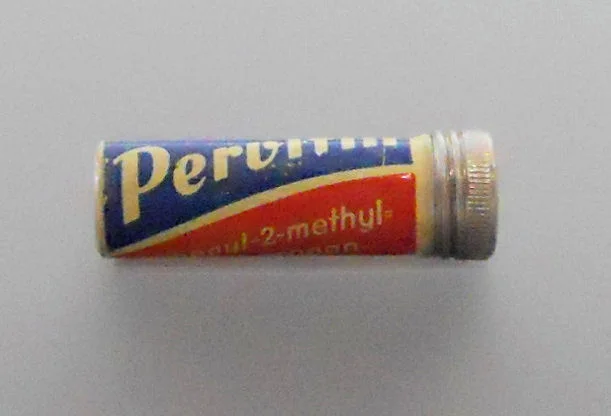
Jan Wellen, Wikimedia Commons, CC BY-SA 3.0. A historic Temmler medicine case. It is not today’s market and it is not a method.
Pervitin is so settled a word in Czech that it looks like a domestic invention. Chemically it is methamphetamine. The brand Pervitin was put on the market in 1938 as a stimulant by the Berlin firm Temmler-Werke after a patent of 1937. In Germany the preparation later became prescription-only; the Deutschlandmuseum records availability on prescription until 1988 [16]. The military issuing of tablets to the Wehrmacht is a historical file about another country, another regime and another legality. TIME cites the historian Steinkamp in connection with blitzkrieg; that is a debate about wartime pharmacology, not about Czech low-threshold services in 2024 [17].
In 2025 the NPC says expressly that methamphetamine is traditionally called pervitin in the Czech Republic and that the Czech market is specific in Europe by a historically rooted model of community production and a high share of high-risk users [4]. That is a description of a market. It is not proof that today’s illicit methamphetamine is a Temmler tablet. Nor is it a method for making the substance.
It does not follow that the name is an accident. It follows that the name has survived regimes and that today’s reader lumps a medicine, a wartime tablet, a kitchen clandestine lab and imported industrial methamphetamine into one word. The first distinction of the article is therefore not moral. It is nominal: when you say pervitin, say which of these four things you mean.
5. A lifetime four to five percent is not thirty-eight thousand high-risk users
The summary of the Report on Illicit Drugs 2025 states that 4–5 percent of persons over 15 report experience with pervitin in their lifetime. Ecstasy 5–7 percent, cocaine 5 percent. Cannabis sometime in life 29–34 percent. That is the general population and the threshold “at least once” [2].
The 2023 national survey in the face-to-face part showed a lower point: pervitin sometime in life 2.3 percent. Another wave of the same research year gave 3.8 percent. The NMS therefore works in the summary with a band of 2024 studies, not with one magic percentage [1]. Neither of these values is the estimate of 38.2 thousand people who use pervitin in a high-risk way.
The NMS defines high-risk use in the European tradition: injecting and/or long-term or regular use of pervitin and opioids. That is a different threshold from “I tried it at a party in 2011” [1].
The rate of pervitin use in the general population is, according to the NMS, stable over the long term. For cocaine, by contrast, prevalence in the past twelve months is rising. Stability in the general population and growth in the high-risk estimate for pervitin can hold at the same time, because they do not measure the same density of use [2].
It does not follow that an experiment is without risk. It follows that the sentence “every other person takes it” does not follow from a lifetime four percent. And the sentence “we have 38 thousand addicts” does not follow from the same four percent either. Addiction as a diagnosis is a further threshold that these two series do not open by themselves.
6. ESPAD among sixteen-year-olds is not a map of adult clandestine labs
The European school study ESPAD 2024 in the Czech Republic worked with 6,845 questionnaires, of which 2,977 were from students born in 2008. At least once in their life 25.1 percent of sixteen-year-olds had used an illicit drug, most often cannabis (23.9 percent). Pervitin and amphetamines alike 1.4 percent lifetime. Cocaine 1.9 percent. In the past twelve months, use of pervitin, amphetamines, cocaine and heroin moved at about 0.8 to 1.3 percent [1][8][9].
The NMS states that the rate of pervitin use among Czech sixteen-year-olds in 2024 was the same as the European average. Hallucinogens and ecstasy were above average. That is an inconvenient sentence for a headline that wants to make the Czech Republic a country where pervitin begins at secondary school [1].
The NMS dates the decline in lifetime prevalence of pervitin among students already from 1999; in the past ten years the series has been stable. That is not proof that the adult high-risk market is disappearing. A sixteen-year-old at school and a twenty-eight-year-old in the high-risk estimate are two populations [1][9].
It does not follow that a school needs no prevention. It follows that ESPAD does not measure clandestine labs in the Moravian-Silesian Region and does not measure 30 thousand low-threshold clients. Anyone who makes a map of Czech production out of 1.4 percent is adding a school questionnaire to a police site.
7. A multiplier from low-threshold work is not a count of people in the street
The estimate of 47.5 thousand people who use drugs in a high-risk way and 38.2 thousand for pervitin stands on a multiplication method from data on clients of harm-reduction services. Injecting 42.5 thousand, about 90 percent of high-risk users. For opioids and pervitin, injecting about 89 percent [1][2].
That is a strong figure and it already has a reservation in the method. We do not see everyone who uses. We see those who pass through the network, and from them the whole is estimated. When the network thickens, the estimate can rise without the hidden market rising by the same share. When the network thins, the estimate can fall without the harm falling.
In low-threshold programmes in 2024 41.0 thousand users, 30 thousand for pervitin, 9 thousand for opioids, 36 thousand by injection. The NMS notes a long-term rise in the number of pervitin users in this clientele [2]. Contact of 30 thousand and an estimate of 38.2 thousand are related series. They are not the same. The first is recorded contact. The second is a model.
In prison in 2024, 62 percent of sentenced persons in the survey reported experience with an illicit drug before entry; pervitin lifetime 47 percent, in the last thirty days before entry 31 percent. In prison 27 percent had ever used a drug, most often pervitin (16 percent). The share of people who use drugs in a high-risk way in the prison population of the survey rose to 44 percent, an estimate of 7,900 persons [1]. That is a prison layer. It is not the estimate of 38.2 thousand carried behind the wall.
8. A detected clandestine lab is not a map of production
In 2024, 184 pervitin clandestine labs were detected in the Czech Republic, in 2023 189. Small domestic labs predominate: 57 percent with a capacity usually lower than 50 grams per cycle. The number of labs in the order of hundreds of grams up to half a kilogram per cycle is rising. Large-volume production intended mainly for export was, according to the NMS, found most often in the north-western borderland and in the Central Bohemian Region. The most detections: Moravian-Silesian Region 35, South Moravian 32 [1].
In its annual report for 2024 the NPC gives around two hundred laboratories and for 2024 specifically 192. That is not proof that the NMS is counting wrongly. They are two outputs of two records. They do not merge into one “true” count unless a report says they are the same set [5][1].
The text may say what detections measure: sites the police found. It must not make 184 into a sentence about how many labs in the country are running. It must not make the cycle capacity of those detected into a method. The main precursors remain, according to the NMS, ephedrine and pseudoephedrine from medicines imported chiefly from Poland and Serbia; in 2024, 97.6 thousand tablets and 80.4 kg of powder were seized. That is a seizure of raw material, not a recipe [1].
Pervitin production in the Czech Republic, according to the NMS, supplies the domestic market to a considerable extent. At the same time large-volume production is moving abroad — Poland, Germany, the Netherlands, Belgium [1][4]. Both sentences can hold. The first describes where part of domestic production goes. The second describes where a more industrial grade moves when criminal pressure at home rises.
9. Domestic production is not the same as imported industrial methamphetamine
In 2025 the NPC describes a coincidence that a headline likes to erase. Traditional community production in small laboratories, often in flats and farm buildings, with an output in the order of tens of grams per cycle, stands beside the import of large-volume methamphetamine made in Western Europe and beside cases in which the imported substance is further processed at home or mixed with domestic production [4].
The European drug agency and UNODC both point to a shift of synthetic stimulants into industrial laboratories. The NPC mentions the Netherlands, Belgium and the Baltic states. A global branch toward Afghan ephedra is the context of the world market. It is not a description of a Czech kitchen clandestine lab, and this article does not make it a domestic scenario [4][21][15].
It does not follow that the “Czech path” has disappeared. The 184 detected clandestine labs in 2024 contradict that. It follows that the user at the end of the chain does not measure which of these supplies arrived in the bag, and that purity and adulterants are therefore not one property of “Czech pervitin”. Mixing of domestic and imported product, according to the NPC, on the contrary increases the variability of composition [4].
Distribution, according to both the NMS and the NPC, is moving from the street into online groups, parcel services and dead drops. That changes the trail for the police. It does not change the definition of the substance and it does not authorise the article to make an encrypted group into a buying guide [1][4].
The environmental burden — toxic waste and the risk of fire — is a repeated layer of supply in police reports. It is harm at the site and in the water, not proof of the number of users [4].
10. One hundred and sixty-four kilograms of seizures is not the country’s consumption
In criminal proceedings in 2024, 884 seizures of pervitin amounting to 163.8 kg of powder were recorded. In total the NMS gives 164.9 kg. In misdemeanour proceedings, 1,542 seizures of 1.1 kg. Most criminal cases, 72 percent, were seizures weighing less than 10 grams. The largest seizure was 93.0 kg [1].

That is important geometry. The median seizure and the sum of kilograms tell two stories. The sum is pulled by one large piece. The number of cases is pulled by small gram amounts. Anyone who makes 164 kg into “the Czech Republic’s annual consumption” ignores that a seizure is what was found, not what was consumed, and that one case can weigh more than hundreds of small ones.
Cannabis remained the most frequently seized drug (1,022 seizures of herbal material, 609 kg in criminal proceedings). Pervitin was second in the order of seizures. The order of seizures is not the order of harms. The NMS and the NPC alike place the greatest health and social weight of a stimulant precisely on pervitin, while the seizure statistic in kilograms can look different [1][4][2].
11. The purity of a sample is not the safety of a dose
In 987 analysed samples of pervitin in 2024 the average share of the active substance was 68.8 percent, the minimum 0.1 percent, the maximum 81.8 percent. The ten-year average moves between 64 and 70 percent and the NMS records a rising trend. The price was known in 387 cases: most often CZK 2,000 per gram, a range of 500 to 5,000 CZK [1].
In its 2025 annual report the NPC gives the purity of seized methamphetamine as a rule between 70 and 80 percent and a price by region most often CZK 1,000 to 2,500 per gram, approaching cocaine [4]. That is not proof that one of the figures is lying. They are two outputs on different sets and in a different language of rounding. The article must not average them into a “true purity”.
High purity in a police laboratory does not say that a particular dose on a table is predictable. The minimum of 0.1 percent in the same set of 987 samples is a reservation against the sentence that “Czech pervitin is always pure”. The maximum of 81.8 percent is a reservation against the sentence that adulterants protect the user. Neither is a method of use. Both are an argument why the eye and a dealer’s reputation are not toxicology.
The NPC links the closing of the price with cocaine to polydrug use. That is a market observation. It is not proof that every low-threshold client alternates the two substances [4].
12. Injecting is not an HIV epidemic
About 89 percent of people who use opioids or pervitin in a high-risk way inject. That is the main route of transmission of infections in this population. It is not automatically a Czech HIV epidemic [1][2].
In 2024, 269 new HIV cases were reported, of which 6 by transmission through injecting drug use and in a further 15 injecting was in the history. Since 1985 the NMS records 179 cases of HIV transmission by the injecting route. The share has long been low [2].
Viral hepatitis C is another account: 1,445 new cases, 668 (46 percent) among people who inject drugs. Hepatitis B: 40 cases, of which 6 in PWID. Hepatitis A in 2024: 634, of which 20 in PWID; by 5 October 2025 already 1,842 VHA cases in the general epidemiology, which the NMS gives as context for a rise, not as a pervitin series [2].
In 2024, 9.1 million syringes were issued, 213 pieces per injecting user. The NMS reads this as the WHO high-coverage band for HIV prevention [1][19]. That measures harm-reduction material. It does not measure whether a particular person used a syringe once.
The NMS reports psychiatric comorbidity in 30–60 percent of clients of addictology services; among patients in opioid-agonist treatment a dual diagnosis of 57 percent. Toxic psychosis is present in the clinical description of services. It is not a national register of “madness from pervitin” with one percentage [1][2].
Naloxone (Nyxoid) in 31 programmes: 982 doses, 218 reported uses that averted opioid overdoses. That is an opioid safeguard. It does not transfer to a stimulant [2]. Anyone who makes a low-threshold success with opioids into proof that a pervitin overdose is solved has confused the substances.
13. Twenty-seven deaths with pervitin in the register are not an annual account of addiction
The special mortality register recorded in 2024 a total of 73 fatal overdoses of illicit drugs, volatile substances and benzodiazepines. Illicit drugs and volatile substances were identified in 52 cases: opioids 30 (including 6 heroin/morphine), pervitin or amphetamine 27, benzodiazepines 21 — the most in a decade. Combinations of substances are rising [1][2].
Twenty-seven is therefore not the sentence “twenty-seven people died of pervitin”. It is the sentence: in 27 of 52 cases with an identified illicit drug or volatile substance, the toxicology found pervitin or amphetamine, often in a landscape where substances add up. Opioids in the same denominator of 52 cases have 30. Anyone who wants to make pervitin the Czech number-one killer must first bear that the register in this year shows opioid traces more strongly, and that benzodiazepines are rising.
Non-fatal intoxications: 675 cases, 380 in connection with illicit drugs; among them stimulants including pervitin and unspecified drugs. Hospitalisations for injuries with an illicit drug: 467 (3 percent of injuries under the influence of addictive substances). Traffic: 415 accidents under the influence of illicit drugs (0.45 percent of all accidents), 12 dead; 101 cases of a combination of alcohol and drugs in the person at fault [2].
These are ends that healthcare and transport record. They are not all the ends a family calls an end: loss of children, housing, teeth, work, a relationship. The NMS captures those in part in the social chapter — unstable housing, debts in the order of hundreds of thousands among low-threshold clients, an estimate of the social costs of illicit drugs of CZK 5.6–6.7 billion against tens to hundreds of billions for alcohol and tobacco, household spending on illicit drugs around CZK 10 billion (0.3–0.5 percent of spending) [2]. Billions are a macro-account. They are not a biography.
Twenty-seven deaths with a substance in the register are not a map of all ends.
— Jiný Kontext
14. Paragraph 283 is not paragraph 284 and is not a misdemeanour

In 2024, 4.2 thousand primary drug offences were registered, two percent of all detected criminal offences. Most often manufacture and distribution of pervitin under § 283. Of those detained for a primary drug offence, about 47 percent had a link to pervitin, about 35 percent to cannabis. The share of those detained for possession for their own use under § 284 rose to 21 percent [1][2][10].
Convicted of a primary drug offence were 2,545 persons, most often for manufacture and distribution of pervitin or cannabis. Main sanction: a suspended sentence 53 percent, unsuspended 26 percent. Under the influence of illicit drugs, 5,628 criminal offences (36 percent of offences under the influence of addictive substances), most often endangerment under the influence (§ 274) and intoxication (§ 360) [2][10].
Misdemeanours in connection with illicit substances: 10,369. The NPC records 9,644 persons in misdemeanours of unlawful handling; 76 percent cannabis, 17 percent pervitin, a year-on-year fall for pervitin of 403 persons [1].
As a quantity greater than small for pervitin, the criminal division of the Supreme Court treats more than 1.5 grams of the drug, which must contain at least 0.5 g of methamphetamine as base or 0.6 g of the hydrochloride. Below this threshold, without signs of distribution, it is as a rule not § 284 but a misdemeanour under the Addictive Substances Act. Indicative values are in the annex to opinion Tpjn 301/2013; a particular case may need toxicology [12][13][11].
An amendment effective from 1 January 2026 releases cannabis within statutory bounds for persons over 21. Methamphetamine does not become lawful by this amendment. Mixing “partial legalisation of cannabis” with pervitin is another layer of law [4][10].
It does not follow that possession under 1.5 grams is without consequence. It follows that the sentence “for pervitin one goes to prison” without the offence and without the quantity is a map without a scale.
15. Contact with a low-threshold service is not a cure
The NMS divides addictology services into prevention, harm reduction, outpatient care, short-term stabilisation, residential care and aftercare. In 2024 there were 15,059 persons with dependence on illicit drugs in outpatient psychiatric care. Return A013: 13,796 users of illicit drugs and volatile substances, of whom 3,584 other stimulants (26.0 percent) and 4,735 polydrug (34.3 percent). For pervitin in outpatient care the age 30–39 dominates [1][2].
Applicants for treatment: 5,339 persons named methamphetamine. Therapeutic communities supported by the Office of the Government: of 343 people using drugs, 234 had primary pervitin, mean age 31 years. Aftercare with sheltered housing: pervitin primary in 587 of 743 (78.8 percent) [1].
That is a strong concentration of pervitin in the treatment network. It is not proof that 38.2 thousand passed through a community. 234 places in eleven communities is a bottleneck against the high-risk estimate.
Opioid-agonist treatment (1,991 persons in the NRLUD in 2024) is an opioid track. For pervitin there is no comparable substitution in these figures. That is why the stimulant appears elsewhere in the network: low-threshold work, outpatient care, community, prison units (571 voluntarily, 208 protective treatment in 11 prisons) [2].
State spending on addictology services CZK 1,054.3 million in 2024, with regions and municipalities 1,631.1 million. VZP for disorders from illicit drugs CZK 527.4 million, of which 380.3 million for combinations of substances. That is a payer’s account. It is not an account of “how much pervitin cost” [1][20].
As of September 2025, 220 addictology services had certification. The map of services on drogy-info.cz is a practical output of this layer. It is not a promise that a person who enters the map will leave the substance [2][3][14].
16. Wastewater measures a metabolite in a city. It does not measure a person’s fate

ŠJů, Wikimedia Commons, CC BY-SA 3.0. Prague is one of seven Czech cities in the SCORE campaign.
Wastewater analysis in the SCORE project has run in Europe since 2011. For the Czech Republic the partner is the T. G. Masaryk Water Research Institute. In the 2024 campaign the NMS lists seven cities: Prague, České Budějovice, Plzeň, Karlovy Vary, Ústí nad Labem, Brno and Ostrava. The results confirm above-average concentrations of methamphetamine against other European cities and a year-on-year rise against 2023 for methamphetamine, MDMA and cocaine [1][7].
EUDA as of 18 March 2026 summarises the 2025 campaign: about 115 cities in 25 countries, weekly composite samples at the inflow of treatment plants. Methamphetamine in Europe is historically concentrated in the Czech Republic and Slovakia, with signals elsewhere as well. Unlike cocaine and MDMA, the methamphetamine load is spread through the week, not only the weekend. The load in a city is not a resident’s diagnosis. Industrial inputs and the uncertainty of the method belong among the reservations that EUDA itself carries for the method [6].
It does not follow that wastewater “has no value”. It follows that a ranking of cities measures a metabolite at the inflow, not the number of people who end in the mortality register, and not the number of clandestine labs in a region. Ústí or Budějovice at the top of a European comparison are an argument about the geography of consumption. They are not an argument about the name of a particular person.
17. Three questions say more than the word pervitin
A headline asks for a story from supply to death. The evidence asks three questions that can bear a mistake.
What needs to be tested before you say “they cook it in the Czech Republic”
Whether you are talking about the 184 detected clandestine labs of 2024, about the seizure of 97.6 thousand tablets of (pseudo)ephedrine, or about the import of finished methamphetamine, which the NPC places beside domestic production. Whether you separate the site the police found from the production they did not find. This test ends at the source. It does not begin with a method.
Three tests before a sentence about an end
First: which end. Death in 27 items of the register, prison, dual diagnosis, loss of housing, debt. Second: which substance in the body. Pervitin, an opioid, a benzodiazepine, a combination. Third: which population. A sixteen-year-old in ESPAD, a low-threshold client, an applicant for treatment, a sentenced person, a deceased person in the special register.
Before looking for a method
An article that promises production, use and ends in one take tempts a third, forbidden layer: how to do it. That layer is not here. It is not a gap in the reporting. It is a condition for the text to be able to stand beside justice and public health, and not beside a method. For a person close to someone, the practical step is a map of certified services and low-threshold work, not a discussion forum [3][14].
Interpretive scheme: One sentence of the reader — “they cook it”, “the young take it”, “people die of it”, “we have HIV” — and one column of the source. If the sentence and the column do not sit, the sentence is not used.
18. The question is not how bad it is. It is which layer you are adding
Pervitin in the Czech Republic is heavy enough not to need exaggeration. 38.2 thousand in the estimate of high-risk use. 30 thousand in low-threshold work. 184 detected clandestine labs. 5,339 applicants for treatment with methamphetamine. 47 percent of prisoners in the survey with lifetime experience. An above-average load in wastewater. 668 new VHC among people who inject. 27 deaths in whose toxicology there is pervitin or amphetamine, beside 30 opioid ones.
The hidden cost is not that figures are missing. The hidden cost is when they are added into one curve and the curve becomes a fate. A brand from 1938, a kitchen clandestine lab, an imported kilogram, a school 1.4 percent, a multiplier, a seizure of 93 kg, a purity of 68.8 percent, a syringe, a file under § 283 and a death in a combination of substances then look like one substance that “takes people”. In fact they are six layers that can tell the truth about one person only separately — and about a country as a whole need not tell a fate at all.
The right question is therefore not: how do people on pervitin end. It is: which layer you are adding now, which denominator can carry your sentence, and which end — body, file, service, death — you are willing to bear when it turns out that you added wrongly.
Related texts in this series
This article stands outside twenty texts on AI, data and proof. It shares with them the discipline of layers. It does not add the series on power and law into the same sum: there the unit is the power of an official and a statement about punishment; here prevalence, a clandestine lab, a seizure and a death. Anyone who reads about what a photograph can carry as evidence is reading a related question: which object you measure before you make it a fate.