

The question is what happened when a Rychnov police officer procured pervitin and reported where patrols were standing — and whether the punishment was what it should have been. It sounds simple only until we notice that we are not comparing one thing. Three to three and a half grams off duty are not the same as the movement of patrols on duty. An aggregate of eighteen months punished both at once, not "only the drug". Sixty thousand and a five-year ban are executed even with a suspended sentence. And "faced up to five years" is again not a judgment, it is a ceiling. Only when these four things are separated can one read what the District Court in Rychnov nad Kněžnou finally imposed on 21 February 2022 — and what still does not follow from that about "a police officer always takes".
1. A dealer, a driver without a licence and a court measure three things
Imagine a table after finality. A reader hears "a police officer and pervitin" and sees a pocket. He is right about one branch of the act. He is not right about the other. GIBS described that the man, at least three times from October 2020 to May 2021, off duty, procured for a civilian each time three to three and a half grams of pervitin for roughly ten thousand crowns. The civilian was to use the substance, or to distribute it further — the inspection leaves both [13][12].
Next to him sits a driver who lost his licence and drove anyway. He says he needed to know where the patrol was. From December 2020 to May 2021 the police officer on duty, according to the indictment, told him that — and one more person in the same situation. He is right about what the account calls abuse of authority. He is not measuring grams [13][3].
The judge lays down a third file. Guilt on both misdemeanours. Aggregate: eighteen months of imprisonment with a suspension for four years, 60 thousand crowns, a ban on activity in the security corps for five years, forfeiture of a thing. Finality 21 February 2022. Faced up to five years [13][7].
At first glance this is a dispute about "whether for drugs in uniform a suspended sentence fell". In fact each person is defending a different object: a substance off duty, a key on duty, an aggregate, money, a ban. That is why they can all be partly right and the shared sentence "he got little, because it was only three grams" still wrong. The first rule is not: add the grams. It is: write which act the punishment is supposed to prove.
A defence lawyer at the table would say that off duty the man was not in a patrol and that three handovers to one person are not a trade. A prosecutor would say that service knowledge of the movement of vehicles is not a private message. A judge would say that the aggregate punishes both, and that five years of a ban is a longer punishment on the key than how many bars eighteen months promise in a headline. A reader would say that a suspended sentence is zero. Four sentences. The law can bear the first three. The fourth it can bear only when a suspension is turned into an acquittal — and that is what § 81 does not do [7][13][3].
Three grams off duty are not the same as leaking a patrol.
— Jiný Kontext
2. The case has at least six layers

The word Rychnov in this case looks like one drug case. In fact it is a bundle.
The first layer is the person. A former police officer of Territorial Department Rychnov nad Kněžnou. The regional directorate said in February 2022 that he had been released from the performance of duty. The account after the judgment says "former". Public sources at the core do not carry a name. This text does not supply one [12][13].
The second layer is § 283: procuring pervitin for another, three times, off duty, 3–3.5 g, in the account a total value of 10 000 Kč for those three handovers as Nguyenová described them in February, and "roughly 10 thousand" in the April report on the judgment. The figures read as the same order, not as two different trades. This text does not add them into thirty thousand, because the account did not carry that unambiguously [12][13][2].
The third layer is § 329: information about the movement of vehicles and patrols to two people without a driving licence, on duty, the same half-year window [3][13].
The fourth layer is a find at a search: before the judgment iDNES cited seven plants and crumble, 64.6 grams of cannabis, 3.14 grams of active substance. After the judgment GIBS says that forfeiture of a thing applies to the cannabis. That is an accessory punishment, not the core of the two misdemeanours in the press sentence about guilt [12][13].
The fifth layer is the punishment and the stage: a charge in May 2021, an indictment in January 2022, judgment and finality on 21 February, a GIBS press briefing in April [13][7].
The sixth layer is the service relationship and the public impression. A five-year ban. Dismissal after intent. The headline again carries a suspended sentence as zero. The law carries an aggregate, money and a ban [8][13].
The regional directorate in February 2022, still before the publication of finality, refused details and said only a release from performance. That is a service measure, not a punishment. Release from performance means that at that moment the man did not have the key on him on a shift. It does not mean guilt. Guilt came only with the judgment. Anyone who fuses both sentences is punishing a person twice with the same verb. The law punishes them once criminally and once in service, in another regime and at another time [12][8][9].
GIBS was created outside the corps precisely so that someone could bear this double sentence. The case did not end with a deputy. It ended at a district court. That is part of the answer to "they watched themselves". They did not. The inspection submitted the matter to a prosecutor, the prosecutor an indictment, the court an aggregate [1][13][15].
3. The best reading is the one whose mix-up you can bear
Five mistakes here are almost those of a corps. Either grams become the whole guilt. Or patrols become a "friendly service". Or an aggregate becomes a punishment "only for drugs". Or a suspended sentence becomes the claim that 60 thousand and a ban do not run. Or one man becomes the claim that a police officer always takes.
| Type of failure | What it looks like | How to test | What limits the harm |
|---|---|---|---|
| Grams as the whole guilt | "A suspended sentence for three grams" | Separate § 283 and § 329 | Read both misdemeanours in one GIBS sentence |
| A patrol as a kindness | "He only wrote where the radar stands" | The signs of § 329 | A key on duty is not an SMS to a friend |
| An aggregate as one branch | A comparison with Příbram only by grams | A different concurrence | Do not add terms across paragraphs |
| A suspended sentence as zero | "He walked away" | § 81(2) | Money and a ban are executed |
| The man as a corps | "The police cover drivers without papers" | One person, two civilians | Do not add to Domašov |
From that it does not follow that both acts are equally heavy. It follows that a sentence about leniency must bear both, otherwise it measures a pocket and issues it as a key. The best reading is the one that survives when it turns out that eighteen months punished the patrols as well. A bad reading is the one that turns a suspended sentence into zero and zero into proof that the corps sells patrols. The damage from the first mix-up falls on the judgment. The damage from the second falls on people this account did not convict.
4. Three grams off duty are not a patrol on duty
The account expressly divides time and regime. Procuring pervitin: off duty. Information about patrols: in a period when he let people who drove without a licence know — and iDNES places that "directly on duty" [12][13].
That is not an academic division of shifts. It is a division of a protected interest. § 283 protects society from handling a substance. § 329 protects the exercise of the authority of an official. Anyone who fuses them into "he took something into his pocket" loses exactly the branch that makes the case a case of power, not only a case of gram weight [2][3].
Off duty a police officer is not relieved of criminality for production and procurement. On duty he additionally carries a key. The account punishes both. A text that wrote only about pervitin would turn Rychnov into Příbram without a key. A text that wrote only about patrols would turn it into Domašov without a judgment. It is a concurrence. A concurrence is punished in an aggregate with one term, not two rankings.
From that it does not follow that procurement off duty is a "private matter". It follows that a private shift does not lift § 283 and a service shift adds § 329. Anyone who reads only the first branch is reading Příbram without a key. Anyone who reads only the second is reading Domašov without a judgment. Rychnov is both in one aggregate. That is why the part exists as a third, not as a repetition of the second [2][3][13].
5. Three times three to three and a half grams is not a map of a market
Three handovers. Each time 3–3.5 g. One civilian. The period October 2020 to May 2021. GIBS: for his own use, or for further distribution. It does not know which. This text does not supply that [13].
A quantity greater than small for pervitin is, in the case law of the Supreme Court, more than 1.5 grams of the drug with at least 0.5 g of base. Three grams are above this indicative threshold — as a threshold of criminality for possession, not as proof that it was a large extent. A large extent is another paragraph. The account does not name it for Rychnov. The basic range "up to five years" matches that [19][20][2][13].
Article 21 may carry seizures in kilograms and an estimate of 38.2 thousand risky users. This case does not assemble that estimate from nine to ten and a half grams in three doses. It assembles three acts of one person.
Before the judgment iDNES wrote that the police officer "bought" pervitin and handed it over. After the judgment GIBS writes procured and handed over. The difference of the verb is not a trifle: a purchase for oneself is another branch than procuring for another. The criminal sentence the indictment bore is the second. This text therefore does not turn the man into a map of his own use, even if a reader would expect that. Use is not the core in the account of guilt. The core is a handover to a civilian and the key of a patrol. Anyone who assembles from a headline about a purchase "he took and therefore reported" has joined two motives that the court did not join in the aggregate by a public sentence [12][13][15].
Three handovers to one person are also not proof that it was an organised group. § 283(2) knows a group as a qualification. The account does not name it. The basic range and "up to five years" match that. We do not write a qualification into the file, even if from "dealer" in colloquial Czech it seemed ready to hand [2][13].
6. Ten thousand crowns are not a trade from Kroměříž
Jakubec sold in 2016 and 2017 in the Kroměříž and Přerov districts, the judge said a trade, plus a bribe of 30 thousand for a burglary, a punishment of three years on five years and a ten-year ban. Rychnov carries in the account an order of ten thousand at three handovers to one civilian. Adding them into "a police officer traded in pervitin" is a truth about a substance and a lie about extent and about a bribe [14][13].
Ten thousand is, in the account, a price the inspection assigned to the handovers. It is not a "considerable" property benefit in the sense of a qualification this text may infer. It is not proof that it was a gift either. It is a figure that keeps the case on the ground: it is not tonnes, it is not zero.
Jakubec waived appeal at court. The Rychnov account is silent about an appeal and places finality on the day of pronouncement. That usually means that no one challenged the judgment in the statutory period, or that they waived the right. The text does not finish that for the parties. It says only that a review by a second instance is not in the public source. The question "it should have been harsher" therefore had here no appellate senate that would carry it [14][13].
7. Cannabis at a search is not the core of an indictment
iDNES on 9 February 2022, therefore before the judgment, cited a find: seven small plants, green-brown crumble, 64.6 g, 3.14 g of active substance. The April report on finality says that the punishment of forfeiture of a thing applies to the cannabis [12][13].
Forfeiture is a punishment on a thing. It is not a second range of imprisonment. Anyone who turns the plants into a "grow-op" misses a threshold the account did not carry. Anyone who leaves them out misses that the court added to the aggregate one more visible punishment that a suspension under § 81(2) will not postpone [7].
The core of guilt in the GIBS press sentence remains: § 283 and § 329. Cannabis is an add-on that the account itself ranks with a search and with forfeiture.
8. Leaking patrols is section 329, not a friendly service
An official who, with the intent of procuring an unauthorised benefit for another, exercises authority contrary to a regulation, exceeds it, or fails to fulfil a duty, fulfils § 329. The basic range: one year to five years or a ban on activity. Information about where a patrol is, to people who drive without a licence, is in the account exactly that key: the benefit is avoiding a check, the authority is service knowledge of movement [3][13].
The point is not that "he wrote to a friend to drive carefully". It is that two people without a driving licence kept driving and the information, according to GIBS, helped them escape checks. The period overlaps with procuring pervitin, but the regime is different. One was off duty. The other carried service knowledge.
Driving without a licence is in itself an infraction or a criminal offence of the person behind the wheel. This part does not know the punishments of those two civilians. It knows that the benefit the account assigns to § 329 consisted in avoiding a check. An official did not sell a gram here. He sold a map. A map is, in traffic, as practical as a substance in a pocket, only it photographs worse into a headline [3][9][13].
A reliability test, which the act on GIBS knows as a tool, is not expressly in the Rychnov account. The text therefore does not write it into the act. It says only that the inspection led the case in criminal proceedings as far as an indictment. The Regional Public Prosecutor's Office in Hradec Králové filed the indictment on 11 January 2022. Between the charge in May 2021 and the February judgment there is less than a year. That is not proof that justice hurried. It is a date without which the April press briefing would look like the day of guilt [1][13][15].
Domašov in the series punishes — so far only at the stage of a prosecution — a motorway bribe and abuse. Rychnov punishes a leak. The same section, another act, another guilt. Adding them into "traffic police are for sale" is a map without a stage and without a judgment [3].
9. An aggregate of eighteen months punished both acts at once
The court did not impose eighteen months "for three grams" and separately nothing for patrols. It imposed an aggregate punishment for both misdemeanours. An aggregate is a punishment for more criminal offences in one proceeding, not a sum of statutory ranges and not a comprehensive sentence for an act uncovered later. Eighteen months therefore cannot be divided into "twelve for drugs and six for patrols", because the account did not carry such a division. One can say only that guilt stood on both definitions and that the term of punishment carries both [13][5].
Eighteen months are under the ceiling of three years where § 81 allows a suspension. A four-year probationary period is long against eighteen months; the law requires that the probationary period not be shorter than the sentence, the upper limit of a probationary period is five years. The court therefore chose, for the suspension, the upper half of the interval of one to five years, while for the term of imprisonment it chose the lower third of the range. That is not a contradiction. It is two levers. Anyone who measures only the first sees leniency. Anyone who measures the second sees that the hypothesis about rehabilitation is to run longer than the punishment that was suspended [7][13].
Příbram has a higher term of imprisonment (two years) and a shorter published probationary period (thirty months) and is silent about a ban. Rychnov has a lower imprisonment term, a longer probationary period and a visible ban and money. The ranking "who got more" breaks according to the axis. The law carries both axes in one judgment [21][13].
From that it does not follow that eighteen months is little for a concurrence. It follows that the sentence "he got nothing for patrols" is an untruth. The aggregate contains the patrols. It only does not separate them onto a second line a reader would like to see.
10. Sixty thousand and five years of a ban are executed now
§ 81(2): permission of a conditional suspension does not apply to the execution of other punishments imposed beside a prison sentence. A fine of 60 thousand is paid. A five-year ban on activity runs. Forfeiture of cannabis is executed. Anyone who says "he only got a suspended sentence" must add to the sentence three punishments that do not survive the suspension as zero [7][13].
Five years of a ban from the corps is longer than eighteen months of imprisonment and longer than the remaining part of a four-year probationary period after the first year and a half. For a person whose power stood on a service relationship, that is a punishment on that power. The act on the service relationship adds to that, after a final intentional conviction, mandatory dismissal. The account already before the judgment describes the man as released from performance and after the judgment as former [8][22][12].
A ban on activity in the security corps is not the same as a driving ban, which at Pankrác supplemented influence behind the wheel. Here the account did not carry a driving ban for the police officer. It did not carry either whether the civilians finally lost a driving licence and whether a further punishment for driving awaits them. A gap is again not zero. It is the boundary of a source. What the text may say without inventing: a five-year corps ban punishes a key, not a wheel. The wheel the account punished otherwise: information about a patrol fell under § 329, not under a driving ban [7][3].
§ 38 again: a less intrusive sanction has priority. Eighteen months with a suspension plus money plus a ban is a bundle, not zero. Anyone who turns it into "a soft punishment because he did not go to prison" must first bear that the law treats a ban and a fine as a punishment, and a suspension as a suspension of execution, not as a cancellation of guilt. Proof of conduct under § 83 the account did not carry. The case in public space ends with the finality of February 2022, not with proof of conduct in 2026 [5][7].
11. Finality in February is not an April press release
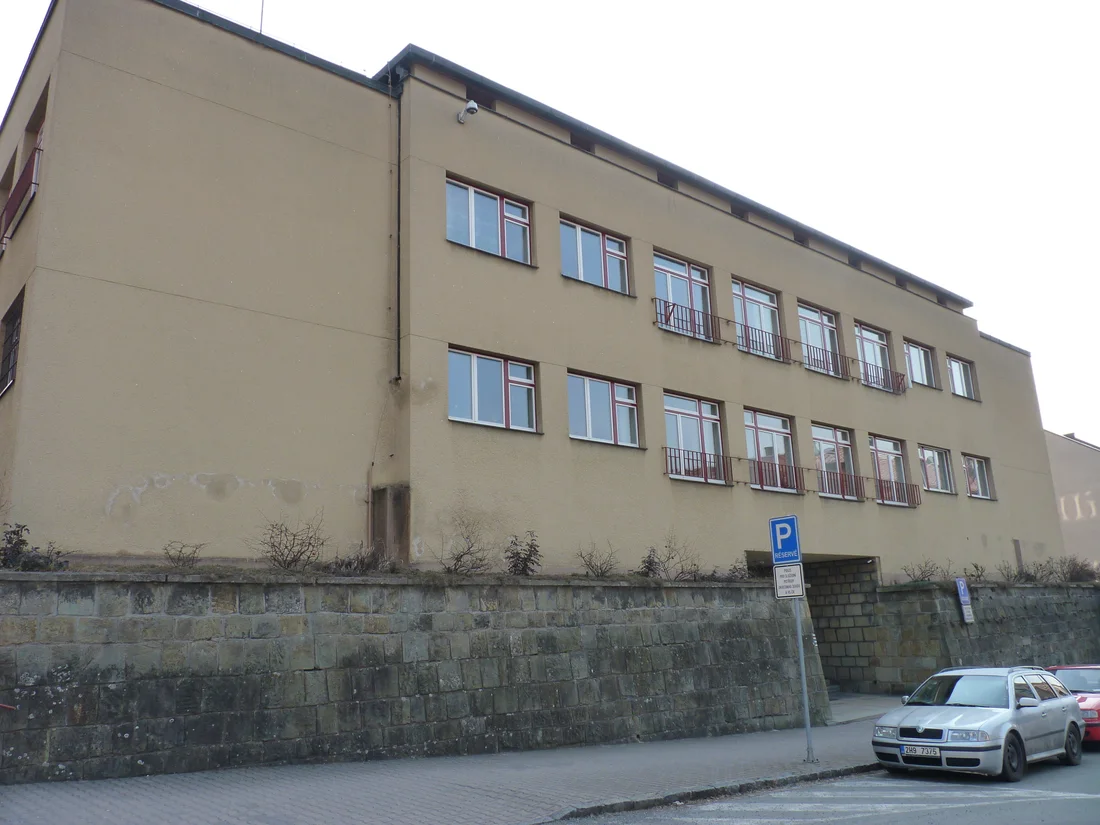
Krvesaj, Wikimedia Commons, public domain. The court building. It is not a map of patrols.
The court pronounced the judgment on 21 February 2022, when it became final. GIBS repeated that publicly in April, iROZHLAS on 19 April. CNN Prima cited the same press release. The charge was in May 2021, the indictment on 11 January 2022 [13][1].
Four dates block the sentence that "the case fizzled out into a press briefing". The judgment is a February one. April is an account. Anyone who reads only April has the impression that a punishment fell in spring as news. It fell in winter and became final at once. That usually means that no one appealed, or that an appeal is not in the account. The text does not invent an appeal. It says that finality is the date of the judgment, not the date of an article.
Two months between a judgment and a press release are, in police cases, common and costly for a reader. Anyone who in March 2022 looked for "what he got" may have had the impression that the matter was still hanging. It was hanging only in an editorial calendar. The court finished in February. The inspection repeated in April. CNN Prima and iROZHLAS copied the same GIBS. That is not three audits of a punishment. It is one spokesperson in three windows. Honest citation therefore does not go by the number of headlines, but by the February judgment and by one Nguyenová [13][16][15].
12. Up to five years is again not a judgment
Before the indictment and after the judgment the account carries "faced up to five years". That is the ceiling of the basic paragraphs of both misdemeanours, not a middle and not a promise. The court gave eighteen months with a suspension. Between the floor of one year and the ceiling of five, eighteen months are closer to the floor of the term — and at the same time a ban runs on the upper half of what § 329 itself can impose as a ban on activity beside a range of imprisonment [2][3][5][13].

The law knows aggravation by a uniform. Mitigation by a first sentence too. The public account did not carry the senate's reasons the way ČT carried them for Jakubec. Without them the sentence "the court should have gone to five because of the patrols" is a politics of punishment. The sentence "the court stayed in the corridor of § 81 and besides that imposed a five-year ban" is a citation of a source [14][7].
13. Off duty and on duty do not add into one bowl
For the year 2024 GIBS counted 36 police officers whose criminal activity fell into the performance of duty or working hours, and 29 in whom abuse of position was involved. Rychnov 2020/21 does not belong in that table by year. It belongs by a distinction: one branch of the act is expressly off duty, the other carries service knowledge. Adding both into "36" would be an anachronism. Adding both into one pocket is an error of layer [10][13].
A practical consequence: anyone who wants to punish "a police officer on pervitin" is punishing the first branch. Anyone who wants to punish "a police officer who sold a key" is punishing the second. The court punished with an aggregate. The public hears the first. The part exists so that the second is heard as well.
The figure of 36 from the year 2024 says one more thing about the unit. GIBS there counts persons prosecuted in the performance of duty, not grams and not patrols. Rychnov cannot be put back into that figure, because it is from another year and because one of its branches is expressly off duty. Anyone who turns Rychnov into proof that "36 is little when even patrols are sold" is adding a prosecution to one final aggregate. Anyone who turns 36 into proof that Rychnov is ordinary is doing the same from the other side. Both sentences need the same table and the same stage. They do not have them [10][13].
14. A civilian with pervitin is not convicted in the account
Pervitin went to one civilian. Two civilians received patrols. A colleague in the 2024 database-check case is being prosecuted — another case, another stage. Here the account did not carry the civilians' punishments. The text therefore does not supply them. That is not protection. It is a gap in a source. The case in public space is the case of an official. Grams at a civilian may be § 284, an infraction, or nothing published. Speculation that "the dealer walked away" needs a file the newspapers do not have [13][18][19].
That is not an argument that a civilian escaped punishment. It is an argument that this part measures an official, because only for him does the account carry a judgment. A series that turned silence about civilians into "the police cover their customers" would turn a gap in a source into an act. A gap may stay visible. It must not be filled with a guess that would read better in a headline than an aggregate.
15. What the account does not say about the punishment
We do not know the prosecutor's proposal. We do not know whether the accused confessed. We do not know the reasons, how many of the eighteen months the senate "assigned" to patrols. We do not know the civilians' punishments. We do not know whether the probationary period carried supervision or proportionate duties under § 82 [7][13].
We know an aggregate, money, a ban, forfeiture, finality, two misdemeanours, three handovers, two persons at the patrols, a find of cannabis. That is enough for a distinction. It is not enough for the sentence that the court "should have gone to an unsuspended punishment because". That sentence needs reasons the account did not carry.
The gap of the prosecutor's proposal is here the same as in Příbram and different from Vogel. In Vogel's case the account carries the proposal, and therefore one can say the prosecutor asked for a suspended sentence under a headline of ten years. In Rychnov that cannot be said. One cannot turn that into the claim that the prosecutor asked for five years of execution and the court reduced it. One cannot turn that into the opposite. A missing mark is not counted as mitigation for the senate or as proof that "they covered their own" [13][17].
What needs to be tested
The stage. Two paragraphs, not one. Aggregate versus a branch. Money and a ban beside a suspension. Headline versus GIBS. The sixth mark — the prosecutor's proposal — is missing again.
16. Three tests before the sentence that he should have sat for patrols
Three tests before a sentence about leniency
The first test: guilt stood on both misdemeanours. Finality is there. It is not Domašov [13].
The second test: eighteen months are in the corridor of a suspension. A five-year ban and 60 thousand are not in the corridor of a suspension — they are executed. Anyone who measures only bars is measuring the narrowest part of the judgment [7].
The third test: a comparison with Příbram. There production, here procurement plus a key. A higher imprisonment term there, more visible accessory punishments here. A ranking on one axis lies [12][13].
Before a comparison with a driver without papers
A civilian who drives without a licence did not carry § 329 as an official. He did not carry a corps ban. He did not carry GIBS. "For the same thing" again needs the same thing.
The fourth test is the regime of the shift. Off duty one can procure a substance and it will still be § 283. On duty one cannot give a map of a patrol and pretend it was the same. The distinction is not moralising. It is why the part exists beside Příbram. There the account did not carry a key. Here it carries one. Adding both cases into "a police officer and pervitin, a suspended sentence" is convenient and imprecise [21][13].
The fifth test is the civilian. One person at the pervitin, two at the patrols, punishments unpublished. The sentence "he covered a dealer and they still let him go" needs their judgments. Without them it is an impression. An impression may stay in a discussion. It must not enter a sentence this text issues as documented [13].
The dishonest answer assembles three grams, a suspended sentence and a ceiling of five years into an anger that for patrols "there was nothing". The aggregate contains the patrols. It only does not carry them on a separate line.
A practical test has six marks. Finality: 21 February 2022. Two definitions, not one. An aggregate of eighteen months with a suspension for four years. A fine of 60 thousand. A five-year ban. Forfeiture of cannabis. Anyone who of the six leaves only the first two and a suspended sentence gets a sentence the account did not bear. Anyone who leaves all six gets a bundle the law treats as a punishment even without bars [13][7].
17. The question is not whether he failed. It is which act you assign to the punishment

The public question from the opening sounds just. A person with authority who procures pervitin and at the same time sells the movement of a patrol to people without a licence has broken two things, not one. The law knows that. The court punished it with one aggregate.
The hidden cost is not that a punishment is missing. Eighteen months, four years of a probationary period, 60 thousand, five years of a ban and forfeiture in February 2022 finally are there. The hidden cost is when "only a suspended sentence for three grams" is assembled from them. The grams were off duty. The key was on duty. Money and a ban run now. The ceiling of five years was again not a promise.
The right question is therefore not whether he failed. The public source bore that. It is: which act you are assigning to the punishment just now — substance, patrol, aggregate, ban — and which dislike you are willing to bear when it turns out that you assign to the punishment only a pocket.
Part 1 said that a suspended sentence is not an acquittal. Part 2 showed that a headline can turn a suspension into bars. Part 3 shows a third mix-up: an aggregate punishes two acts, the public hears one. Anyone who after Rychnov still says "a suspended sentence for three grams" has not read the second misdemeanour. Anyone who says "nothing for patrols" has not read the aggregate. Anyone who says "he walked away" has not read 60 thousand and five years of a ban.
The aggregate punished both acts. The public hears only pervitin.
— Jiný Kontext