

The question is what happened when a Příbram police officer cooked pervitin — and whether the punishment he received for it was what it should have been. It sounds simple only until we notice that we are not comparing one thing. Running out of money to buy is not operational cover. A trip to Poland for medicines with pseudoephedrine is not a production procedure this text may set out. Two years of punishment are not two years of bars if the court suspended execution. And the headline "to prison" is not GIBS's statement of a suspended sentence. Only when these four things are separated can one read what the District Court in Příbram decided in October 2020 and what, after appeal, the Regional Court in Prague finally imposed on 3 February 2021 — and what still does not follow from that about the whole territorial department [12][23].
1. The headline, GIBS and the kitchen see three different acts
Imagine a table after a final judgment. A reader holds iDNES of 16 March 2021. The headline says the court sent a police officer to prison for two years for producing pervitin. It is right about the term of two years. It is not right about execution. In the body of the same article GIBS spokesperson Ivana Nguyenová says: two years with a conditional suspension for thirty months, final in February [12].
Next to him sits an inspector. He says the man began to manufacture when he ran out of money to buy, that with another person they went to Poland for tens of packs of medicines with pseudoephedrine, that production ran in January and February 2020 and that the police uncovered it in June. He is right about the act as GIBS published it. He is not measuring the punishment. And this text will not turn his sentence into a recipe [12].
The judge lays down a third file. The basic paragraph of § 283 gives one year to five years or a fine. Two years are inside it. Suspension is possible under § 81, because two do not exceed three. A thirty-month probationary period is longer than the sentence, as § 82 requires. He is right about the corridor. He is not measuring the headline [2][7].
A service official has a fourth paper: a final conviction for an intentional criminal offence means dismissal from the service relationship. A suspended sentence is not an exception here [8][22].
At first glance this is a dispute about "whether the police officer walked away for cooking". In fact each person is defending a different object: bars in the headline, a suspension in the judgment, an act in a press release, the end of service in the act on the relationship. That is why they can all be partly right and the shared sentence "for pervitin in uniform one does not go to prison" still wrong.
A family that reads the headline is right about the anger. It has the impression that two years mean the door of a cell. GIBS, in the same account, does not move that door into execution. A judge, if he sat at the table, would say that § 81 is a hypothesis about rehabilitation, not a discount for rank. A service official would say that after intent he has no discretion whether to keep the man. He has a duty to dismiss. Four truths. One case. The shared decision "he walked away" is still wrong, because the verb to walk away measures only bars [12][7][8].
Running out of money to buy is not operational cover.
— Jiný Kontext
2. The case has at least six layers

The word Příbram in this case looks like one scandal. In fact it is a bundle of layers.
The first layer is the person and the posting. A member of the Territorial Department Příbram. The account does not name a name. This text does not supply one. A name the public file did not carry does not belong here [12][1].
The second layer is the act with a substance. GIBS described the production of pervitin and the purchase of medicines with pseudoephedrine in Poland. That is § 283 in an account of production. It is not a map of Czech labs from article 21 and it is not a recipe [2][12].
The third layer is the motive the inspection said publicly: he began to cook when the money to buy ran out. That is running out of money to buy, not the sentence "he penetrated the milieu". The series holds this distinction against Jakubec, who at court defended a trade after operational work [12][14].
The fourth layer is time. January and February production 2020, uncovering in June, finality in February 2021, the report in March. Four dates, one act. A March headline is not the day of pronouncement [12].
The fifth layer is the punishment: two years, a thirty-month suspension, a ceiling of "up to five years", two further accused without a published punishment [12][7].
The sixth layer is the service relationship and the public impression. The law dismisses after a final intentional conviction. Meanwhile the headline sends him to prison. Both layers are real. Neither of them is the other [8][12].
Uncovering in June 2020 and finality in February 2021 means the case lived in the file for more than half a year after the seizure. That is a time when a service official could have released the man from the performance of duty even before judgment. The account does not carry that expressly for Příbram the way the regional directorate carries it for Rychnov. The text therefore does not assert a release from performance in Příbram. It asserts only the duty after finality. The gap between seizure and judgment is the place where the public most often assembles the sentence "he is still walking in uniform". Without a source that remains a sentence, not a fact [12][13].
This layering is not an academic detail. It decides whether a sentence about leniency belongs in the file. If we are talking about a motive, we cannot turn it into operational work. If we are talking about two years, we cannot turn them into bars. If we are talking about Territorial Department Příbram, we cannot turn one man into a department.
3. The best reading is the one whose mix-up you can bear
An article about a police officer who cooked breaks into five mistakes. Either running out of money becomes cover for a case. Or a trip to Poland becomes a recipe. Or two years become bars. Or "up to five years" becomes a promise the court broke. Or one convict becomes a territorial department.
| Type of failure | What it looks like | How to test | What limits the harm |
|---|---|---|---|
| Want as operational work | "He cooked to uncover the market" | Read the GIBS sentence about money to buy | Do not quote Jakubec into Příbram |
| The act as a recipe | Details of a lab | Hold that, not how | No procedure, no quantities of raw materials |
| Term as execution | "Two years to prison" | Separate imprisonment and § 81 | Read GIBS, not only the headline |
| Ceiling as middle | "He should have got five" | The basic paragraph of § 283 | The upper limit is not an expectation |
| The man as a department | "Příbram police cook" | One person, two co-accused | Do not add to the 76 prosecuted by GIBS 2024 |
That also changes the question of the part. We are not asking whether production happened. GIBS and the court recognised it by a punishment. We are asking which layer of punishment which sentence can bear.
From that it does not follow that production was "only want". It follows that a sentence about leniency must bear the error in the headline before it can bear a dispute about the statutory range. The best reading is the one that survives when it turns out you read the heading instead of Nguyenová. A bad reading is the one that turns a press release into a cookbook and a cookbook into a territorial department. The damage from the first mix-up falls on one man. The damage from the second falls on a corps that is not convicted in the account.
4. Running out of money to buy is not operational cover
The inspection's sentence is short and hard. The man manufactured drugs from the moment he ran out of money to buy them. He apparently manufactured the drug several times during January and February 2020 [12].
The point is not that "a police officer must sometimes play the dealer". It is that the public account does not assign the act to a file, to an informant, to an order from a superior. It assigns it to the fact that the money ran out. The series has other parts for operational work. Jakubec said at court he wanted to penetrate the milieu; the judge accepted part as a beginning and refused it as a trade. Vogel's covering of an informant fell at the evidence. Příbram does not belong in these two sentences, because GIBS did not put it there [14][16][12].
Anyone who turns the Příbram shortage of money into "everyone who cooks in uniform does it because of a case" is adding three cases into one motive. The law punishes the act. Motive is mitigation or aggravation under § 41 and § 42, not an exchange of the offence definition [6].
5. A trip to Poland is not a recipe
GIBS stated that together with another person they set out by car to Poland, where they bought several tens of packs of medicinal products containing pseudoephedrine. Pseudoephedrine is used to produce pervitin [12].
This paragraph may say that. It must not say how. Article 21 on pervitin in the population holds the same boundary at labs. A part on an official holds it at one flat. Tens of packs are, in the account, a circumstance of purchase, not a list of raw materials to repeat. Anyone who assembled a procedure from a police report would abuse a source against its purpose [12][2].
Poland is not a geographical ornament here. It is a foreign purchase of a precursor in a medicine, as the inspection described it. It is not proof that "everyone goes to Poland". It is one factual course of one file.
The act on addictive substances and the Criminal Code punish unauthorised handling. Pseudoephedrine in a registered medicine is a lawful item in a pharmacy. The moment it becomes a raw material of production, the account is no longer talking about a cold. It is talking about § 283. The boundary this text holds is the same: it may name the medicine and the country of purchase, because GIBS did that. It must not assemble a kitchen procedure from it. Anyone who asked for "more detail, so that it is believable" would be asking exactly for what the public interest must not get from an official — a recipe under the pretext of reportage [18][2][12].
GIBS investigated the case because the offender was supposed to be a member. Act No. 341/2011 Coll. gives it a competence that a regional directorate does not have over its own man. That is why the spokesperson in the account is not the Příbram press office, but Nguyenová. Institutional separation is here part of punishment in a wider sense: the corps did not write a judgment to itself [1][9].
6. January and February production is not a map of a territorial department
Production "several times" in January and February 2020, uncovering in June. The account does not say how many times exactly, how many grams, what purity. Article 21 may carry 184 uncovered labs for the year 2024 as a police picture of the country. This case must not turn two months in one flat into that picture [12][10].
Territorial Department Příbram is the offender's posting. It is not the guilt of colleagues. The account mentions two further accused and is silent about their punishments. That too blocks the sentence "the department cooked". Three charges are not three final judgments and are not a map of the corps. GIBS for the year 2024 prosecuted 76 police members in the whole republic; that is another year, another unit, another report [10][12].
The timeline has one more practical sense. From the act to finality roughly a year passed. That is not "justice slept". It is not proof of speed either. It is a date without which the March 2021 headline would look like the day of the main hearing.
7. Two co-accused are not two published punishments
"Together with him two further people were also charged. What punishments they received, the inspection did not publish." That sentence in iDNES is more honest than half of the crime accounts. It says what the file has and what the public does not have [12].
From that it does not follow that the punishments were not there. It follows that this part must not invent them. It must not turn silence into an acquittal. It must not turn silence into five years. The case has, in public space, one named judgment: two years with a thirty-month suspension for the police officer. The rest is a prosecution about whose punishments we do not know.
That is also a test of the series. Where GIBS did not carry a name and a punishment, the text does not supply them from a discussion under the article. A name the reader "would of course know from the region" belongs here no more than an invented term. The series names only where GIBS, a court, ČT or iROZHLAS themselves carried a name. Příbram, at the core of the account, did not carry a name. The part therefore stays with the posting and with the judgment.
The two co-accused may be civilians, they may be further members, they may be both. The account did not decide. The sentence "they cooked it under the department" needs exactly that decision. Without it there remains one final punishment for one man and two charges without a public end. That is less than a scandal wants. It is exactly as much as the source can bear.
8. Up to five years is the ceiling of the basic paragraph
"Originally the police officer faced up to five years in prison." That is the upper limit of the basic paragraph of § 283 as the account reads it: one year to five years or a fine. It is not the middle. It is not what "was supposed to fall". The court moves between floor and ceiling under § 38 and § 39: where a less intrusive sanction suffices, it must not impose a harsher one; it takes into account the nature of the act, the person, rehabilitation, mitigation and aggravation [2][5][12].
Two years are a term above the lower limit and below the upper. Anyone who says "he should have got five because he is a police officer" must bear that a uniform is an aggravating circumstance in § 42 — abuse of position, breach of a special duty — but is not an automatic jump to the ceiling. The ceiling would be there if the act carried a qualification: an organised group, a considerable extent, a child. The public account of Příbram does not name that qualification. This text therefore does not write it into the file [6][2].
§ 38 adds subsidiarity to that: where a less intrusive sanction suffices, a harsher one must not be imposed. A conditional suspension is, in that logic, harsher than a mere ban, and less harsh than execution. A court that chose two years with a suspension is moving inside this sentence of the law, not outside it. A dispute about the "right punishment" is therefore a dispute about whether the reader treats subsidiarity as cowardice or as a rule. The law treats it as a rule expressly [5][7].
Suspension has one more condition the headline never carried. The court must reasonably believe that execution is not needed to affect the offender so that he leads an orderly life. That is a hypothesis about the future, not a discount for the past. Anyone who disappoints the hypothesis in the probationary period may go to serve the two years. The account is silent on whether the Příbram convict proved himself. Silence is not proof of conduct. Proof of conduct is a decision under § 83 after the period has run, or an order of execution when he does not lead an orderly life [7].
From that it does not follow that five years were forbidden. It follows that the sentence "faced up to" measures the description of an indictment, not a judgment.
9. Two years with a thirty-month suspension is a judgment, not bars
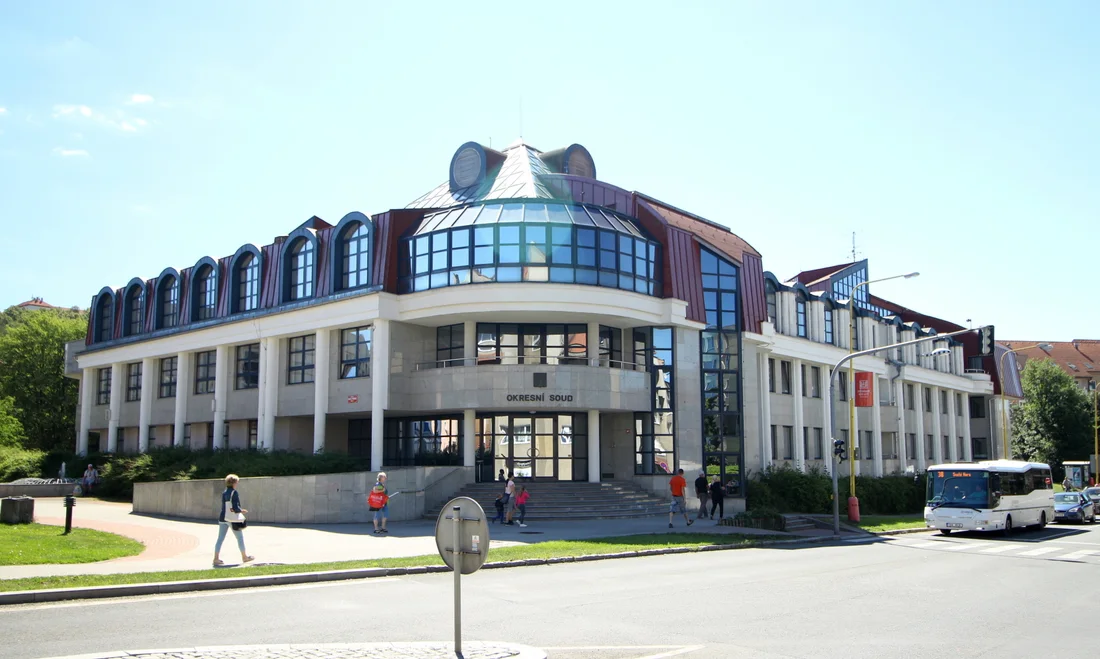
VitVit, Wikimedia Commons, CC BY-SA 4.0. The court building. It is not a kitchen and it is not a recipe.
The court first imposed a prison sentence of two years. Only then did it suspend execution for a probationary period of thirty months. It may give a suspension under § 81 because two years do not exceed three and because it reasonably believes that execution is not needed to affect the offender. The probationary period must not be shorter than the sentence; thirty months are longer than twenty-four. Anyone who does not lead an orderly life in the probationary period may have the court order execution [7][12].
The point is not that "he got a suspended sentence, so nothing". It is that guilt stood, a punishment is measured, the bars are suspended, not cancelled. The Příbram account does not say whether a ban on activity or a fine was added to the punishment. Where GIBS is silent, the article does not invent a ban. It says only what the law knows about suspension in general: if an accessory punishment had been imposed, the suspension would not apply to it [7].
Three years are the ceiling of the statutory device. Příbram is a year lower. Jakubec sits on the ceiling. Rychnov on eighteen months. Comparing them as "who got more bars" is nonsense, because none of them got bars in the judgment at once. Comparing terms as the corridor of § 81 is honest [7][13][14].
10. The headline "to prison" is not the inspection's report
iDNES chose: "A court sent a police officer to prison for two years for producing pervitin." The first paragraph under it cites GIBS on a conditional suspension. The clash is not between two newsrooms. It is between a heading and a source in the same text [12].
That is the narrowest distinction of the part. A reader who skims the headline has bars. A reader who finishes Nguyenová has a suspension. The question "was the punishment what it should have been" then breaks according to which of them he treats as the judgment. The law treats the suspension as the judgment. Journalism often treats bars as the judgment, because bars click better.
From that it does not follow that a suspended sentence is harsh. It follows that a debate about leniency that begins with a false execution is measuring a different object from the one the court imposed. Part 1 of the series carries this generally. Příbram is the case where it happened most cleanly: the same number, a different verbal aspect.
Headline and judgment do not differ here in the length of the punishment. They differ in whether someone is to start serving two years. A reader who wants to punish more may say the suspension was a mistake. He must not say the court sent him to prison if only the heading said that. The first sentence is a dispute about the politics of punishment. The second is a dispute about a fact. This part decides only the second.
11. A suspended sentence for intent is still dismissal from the corps
Production under § 283 is an intentional criminal offence. A final conviction is a ground for which a member must be dismissed from the service relationship. The Supreme Administrative Court in 2016 confirmed that this holds even where the conviction is later treated as if the person had not been convicted, because it was an amnesty. A suspended sentence is not a back door into service here [8][22][2].
The Příbram account does not carry the sentence "he was dismissed" the way ČT carries it for Jakubec. The absence of a sentence in the newspapers is not the absence of a law. This text therefore does not say it saw the particular man leave a station. It says what the law orders a service official after February 2021.
Anyone who measures punishment only by bars leaves out the layer that, for an official, often hurts longer than thirty months of probationary period: the loss of the key.
Loss of the key is not the same as a ban on activity. A ban the account would have to name. Dismissal it need not name, because the law carries it after every final intentional conviction. A reader who in March 2021 read only the headline about prison may have had the impression that the man is sitting and the corps will "still see him". The law at that moment no longer had discretion whether it would see him in uniform. It had a duty to take him out of the relationship. The account does not name that duty expressly for Příbram. This text therefore does not read it from the headline. It reads it from § 42 [8][22][12].
12. A uniform is an aggravating circumstance, not an alibi
§ 42 of the Criminal Code knows as aggravation the breach of a special duty and the abuse of employment, position or function. A police officer who cooks carries both more strongly than a civilian in the next flat. The law knows that. At the same time it knows mitigation: a first sentence, a confession, remorse, the life so far [6].
The public account of Příbram did not carry the senate's reasons. We do not know which side of the list the court weighed more. We know that a term of two years with a suspension is compatible with both: aggravation by a uniform need not mean five years of execution; mitigation by a first sentence need not mean zero. Anyone who assembles from the absence of reasons "the court spared him because he was one of theirs" is speculating. Anyone who assembles "he got the maximum possible on a suspended sentence" is speculating too — the maximum of suspension is three years, not two [7][12].
The honest sentence is narrower. The uniform was not an alibi here. The act was prosecuted by GIBS, not by a service interview. Guilt stood. A punishment fell. The dispute is about the aspect of bars, not about whether a regime of punishment existed at all.
A disciplinary sanction before a service official could run in parallel or precede. 258 files referred to discipline in 2024 — another year — show that the inspection often ends outside a criminal statutory range. Příbram did not end there. It reached an indictment and finality. Anyone who turns a suspended sentence into "they returned him to discipline" misses the instance. Discipline punishes a service delict. The court punished a crime in the basic range, as the account reads it. Both instances can exist in one life. In the public source the criminal one is visible [10][1].
Article 21 measures pervitin as a population, a lab, a seizure and a death. This part does not assemble those series from a Příbram flat. 184 uncovered labs for the year 2024 are not this flat in 2020. 38.2 thousand in an estimate of risky use is not one member. Prevalence is not added in here. The authority of an official is not added in there. The series holds both maps apart precisely so that a cook in uniform does not become epidemiology and epidemiology the guilt of a department [21].
13. Section 283 of this account is not section 329
The public description of Příbram is production and the purchase of medicines. It is not the leaking of patrols. It is not a bribe for a burglary. It is not an intervention in records. Rychnov punished § 283 and § 329 with one aggregate. Jakubec punished sale, abuse of authority and a bribe. Pardubice punished a system. Příbram, in the published sentence, punishes a substance. Comparing terms as "for pervitin in uniform one gets a suspended sentence" therefore adds different protected interests [2][3][13][14][15].
GIBS was created by Act No. 341/2011 Coll. so that criminal offences of members would not be investigated by the same institution. Municipal police is not in this regime. Příbram is the Police of the Czech Republic, therefore GIBS. That is not a trifle. It is why the case has a public inspection spokesperson at all and not only a regional press office [1][9].
Discipline before a service official is another regime. 258 files referred to discipline in 2024 — another year, another report — are not 258 Příbrams. This case reached a court and finality. It is not "it fizzled out" [10].
14. What the account does not say about the punishment
An honest list of gaps is shorter than a list of impressions and longer than zero.
We do not know the public prosecutor's proposal. In Vogel's case the account carries it: a three-year suspended sentence under a headline of "up to ten years". In Příbram it is silent. We do not know whether the accused confessed, regretted, appealed. We do not know a ban on activity. We do not know the punishments of the two co-accused. We do not know gram weight and purity. We do not know whether the court, in the reasons, expressly weighed the uniform [12][16].
From that it does not follow that the article should fill the gaps with an estimate. It follows that the sentence "the punishment was soft because…" needs exactly these data. Without them there remain the corridor of the law and the clash of the headline. That is not little. It is everything the public source can bear.
What needs to be tested
Before a sentence about Příbram leaves the table: finality, offence definition, term and suspension, what the headline promised, what GIBS said, what the law on service orders. The sixth mark — the prosecutor's proposal — is missing here. A missing mark is not counted as mitigation for the court.
15. A comparison with Rychnov is not a ranking of leniency
Rychnov: eighteen months, four years of probation, 60 thousand, a five-year ban, two misdemeanours. Příbram: two years, thirty months of probation, production, silence about a ban. The term of imprisonment is higher in Příbram. The accessory punishments are more visible in the public Rychnov account. Anyone who turns that into "Příbram was harsher" is measuring only imprisonment. Anyone who turns it into "Rychnov was harsher" is measuring the ban and the money. The law imposes both in one judgment. A ranking on one axis is a map without the other [13][12][7].
Jakubec: three years on five years of probation, a ten-year ban, up to ten in the headline, waiver of appeal, public reasons about a trade. That is another paragraph, another concurrence, another mitigation. Adding it with Příbram into the sentence "police officers get a suspended sentence for pervitin" is a truth about the aspect of punishment and a lie about the identity of the act [14].
Vogel is yet another axis: guilt did not stand, the prosecutor still asked for a suspended sentence, the state apologised. Pankrác carries two judgments about guards and a substance in a prison. Neither of these files transfers a Příbram kitchen onto a map of the corps. It transfers only that a conditional suspension for an official in this series is not the exception of one district senate. It is a repeated aspect. A repeated aspect is not proof that "everyone cooks". It is proof that the question of bars returns in these accounts because the law knows suspension for a sentence of up to three years [16][14][7].
16. Three tests before the sentence that he walked away
Three tests before a sentence about leniency
The first test is the stage. February 2021, finality. Not a charge. Not Domašov. Not an appeal on points of law. A punishment is here [12].
The second test is the aspect. Two years are imposed. Execution is suspended. The headline changed the aspect. Anyone who cites the headline as a judgment is not saying the punishment was mild. He is saying an untruth about bars [12][7].
The third test is the service one. Intent plus finality. The act on the relationship dismisses. "He walked away" in the sense of "he remained a police officer" would need an exception that § 42(1)(a) does not carry [8].
Before a comparison with a civilian lab
A civilian did not carry a service dismissal or GIBS. He did not carry aggravation by position in the same sense. At the same time he may have carried recidivism that the account does not name for the police officer. Without the same paragraph, extent and past, "for the same thing a civilian would go to prison" is a mood, not an audit.
The fourth test is motive. The account assigned production to the fact that the money to buy ran out. It did not assign it to a file, to an informant, to an order. The series has other parts for those three. Mixing them into Příbram is convenient, because the reader already knows the word operational. Convenient is not the same as documented [12][14][16].
The fifth test is the co-accused. Two further people, punishments unpublished. The sentence "a gang cooked under the department" needs exactly those two numbers that GIBS did not give. Without them there remains one judgment about one member [12].
The dishonest answer assembles running out of money, a headline about prison and a ceiling of five years into one anger. The anger may stay. The unit must not.
A practical test that can bear more than a headline has five steps and none of them is a kitchen. Is guilt final? Yes, February 2021. What definition? § 283 in the published sentence about production. What term and whether § 81? Two years, a thirty-month suspension. Does the headline say the same as GIBS? No. What does the law on service say? Dismissal after intent. Anyone who leaves out the fifth step may leave the man in uniform in his mind. The law will not leave him there [12][7][8].
17. The question is not whether he cooked. It is which punishment you are reading

The public question with which the part began sounds just. A person with authority who begins to manufacture pervitin because he ran out of money to buy has broken something other than a neighbour without a key to a database. The law knows that. GIBS prosecuted it. The court punished it.
The hidden cost is not that a punishment is missing. Two years with a thirty-month suspension in February 2021 finally are there. The hidden cost is when bars are assembled from them that the judgment did not postpone into execution, and from the bars the impression that justice lied to the statutory range. The range promised a ceiling of five years. The judgment gave two with a suspension. The headline gave prison. GIBS gave a suspended sentence. Four sentences. One case.
The right question is therefore not whether he cooked. The public source bore that. It is: which punishment you are reading just now — ceiling, term, suspension, sacking, or headline — and which dislike you are willing to bear when it turns out that you read the heading.
Part 1 of the series put that question across cases. Příbram is the first where it can be shown on one file, without Domašov and without an appeal on points of law. Guilt is there. A judgment is there. The headline is different from the judgment. The motive in the published sentence is not operational work. A recipe is not here and must not be. Anyone who after this part still reads "two years to prison" is not reading the court. He is reading iDNES over GIBS.
The headline promised prison. The judgment suspended execution. The number was the same.
— Jiný Kontext