

Section: Justice & law | Technology & AI Author: V Reading time: ~27 min Sources and further reading: 22 items Topics: mobile phone, criminal proceedings, interception, data, encryption, privacy SEO / working title: May the police search your mobile phone?
May the police search your mobile phone? The question sounds simple only until we notice that we are not comparing one thing. Seizure of a device may be lawful and reading the memory may still require another key. A message already in the phone is not a message that will arrive tomorrow. A judicial authorisation to examine content is not a technical ability to open the device. And a cloud visible from the phone without a further lock is not the whole cloud account. The text that follows therefore does not ask how to unlock a phone. It asks which of the three regimes is running, and whether it has its judicial filter.
1. A phone on the table after taking of a thing is not interception. Nor free memory content.
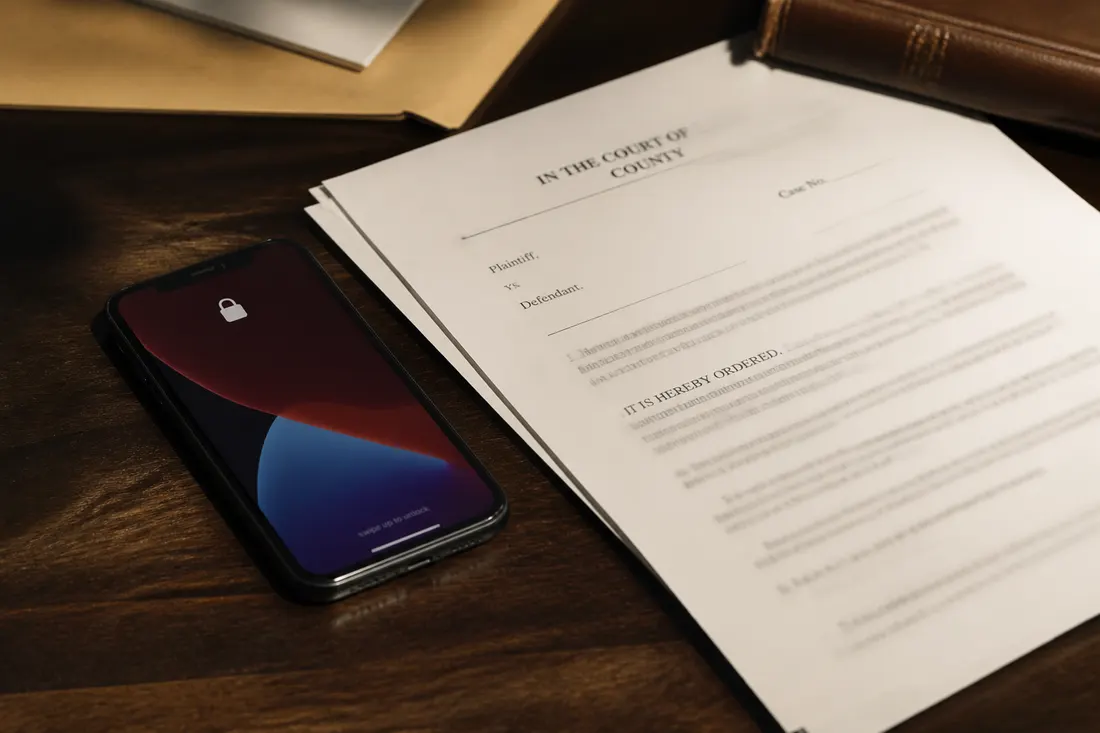
A phone lies on the table. A police authority took it after a call to surrender a thing, or took it, or found it during a search. A prosecutor in pre-trial proceedings considers whether it is necessary to go to a judge. Defence counsel does not ask only who holds the phone. Counsel asks what the state then did with it. From 1 January 2026 a judge assesses a written authorisation to examine the content of a secured portable communications device. An expert may be given the task of making a copy. The operator is not sitting at this scene. That belongs to another question.
At first glance this is a dispute about the sentence “the police searched my mobile”. In fact each person is describing a different legal key. One key opens disposition of a thing: surrender, taking, a search. The second key opens already stored content of a secured portable device. The third key concerns future communication that is only then passing through the network. The shared word search erases all three keys.
That is why they can all be partly right and the shared sentence still mislead. The police may have seized the phone lawfully, but that itself does not say whether they were allowed to read its content. A court may have authorised examination of content, but that itself does not say whether the device can in fact be read. The phone may have received a message after seizure, but that is not the same as a message that was already in it. And the operator may hold traffic data, but a seized device is not the network.
This article is therefore not a technical manual for work with a phone lock, biometrics or encryption. It does not say how to hide data. It describes only the regimes in which the state treats a device, content and communication. That is a more useful question. It does not ask whether “a mobile may”. It asks which act took place and which filter belongs to it.
Seizure of a phone is not interception. Data in memory are not a future call.
— Jiný Kontext
2. Access to a mobile has at least six layers
When a phone appears in criminal proceedings, one simple situation does not arise. A chain arises. Each link has a different purpose, a different boundary and a different kind of error.
The first layer is a thing in the state’s disposition. A phone may become a means of evidence by surrender of a thing, taking of a thing, seizure during a house or personal search, or a find during an examination. The Code of Criminal Procedure in § 78 and § 79 governs surrender and taking of a thing; after the amendment the possibility of making a copy of data instead of the carrier itself also matters [1][13]. That is the base. Without it the next step is hard to build.
The second layer is already stored content. Until the end of 2025 this problem was in practice read mainly through the difference between a carrier and interception. Opinions of the Supreme Public Prosecutor’s Office proceeded from the view that establishing content already stored in a seized device did not require an order under § 88 [5][6]. From 1 January 2026 secured portable devices that enable two-way communication have their own regime in § 113a [7][12].
The third layer is future communication. A call, a message or other traffic that arrives only after seizure is not merely the content of a thing lying on a table. It is traffic on the way. The Supreme Court in a resolution of 15 December 2000, file No. 7 Tz 9/2000, separated delivered SMS messages from SMS messages that arrived only later [3][4]. The amendment of § 113a does not cancel this cut. For future communication § 88 remains in play.
The fourth layer is the constitutional ceiling. Article 13 of the Charter protects the secrecy of messages submitted by telephone [11]. The Constitutional Court has already said of older telephony that the protection does not fall only on the content of a call, but also on numbers called, time, duration and base stations [8][9]. A smartphone adds photographs, chats, location, notes, health applications, payment trails and work accounts. The intensity of the interference is greater.
The fifth layer is encryption as a fact. The law does not forbid an investigation because a device is encrypted. Nor does it order success. The result may be simple: an authorisation exists, but the data are not readable. That is a gap in proof. It is not a technical manual.
The sixth layer is the expert. The amendment contemplates that if an expert is appointed to data under § 113a(1), the procedure is analogous under § 113a [7]. Copying without becoming acquainted with the content, and becoming acquainted with the content itself, are not the same. Here too it is important to know in which layer one currently stands.
3. The best regime is the one whose key you can name
With a phone in criminal proceedings the greatest risk is usually a procedural shortcut. Not technical complexity. That is real, but legally we ask differently. Who performed which act? At what moment? With what authorisation? And toward what content?
| Type of failure | What it looks like | How to test it | What limits the harm |
|---|---|---|---|
| Mixing the three keys | “Search of a mobile” fuses thing, memory and future traffic | Name § 78/79, § 113a and § 88 separately | Defence counsel asks about the act and the filter |
| Stored as future | A later-delivered message is read as the content of a thing | Separate the moment of seizure from delivery | Later traffic belongs under § 88 |
| Authorisation as opening | A judicial stamp is mixed up with factual readability | Separate the power from the ability to read the data | A cipher is a gap in proof, not a manual |
| An exception as a licence | An exception from § 113a is read as a free cloud | Read the scope of the exception and the limit of further security | An exception is not an infinite account |
| A phone as an operator | Network metadata are sought in the device as in the network | Separate § 88a from device content | A seized phone is not an operator |
Interpretive scheme: The same phone may be a thing, a carrier of already stored data and an endpoint of future communication. The legal regime is not determined by the brand of the phone, but by the act, the time and the content.
It does not follow that every procedural mistake automatically means the unlawfulness of everything else. It follows that without a precise description lawfulness cannot be assessed at all. The sentence “the police had the phone” is a beginning. The sentence “the police read data in a secured portable device after 1 January 2026 without the § 113a regime” is already a legal problem.
4. Seizure of a thing is not the reading of data. The reading of data is not interception of future communication.
The Code of Criminal Procedure works with a thing. A person may be called to surrender it. In certain situations a thing may be taken. During a search it may be seized. That is old procedural language. A phone fits into it as a material object that may have evidentiary significance [1][13].
But a phone is not only an object. It is a data carrier and a gate to further services. That is why it is not enough to say that a thing was seized. Seizure answers why the device is in the state’s hands. It does not itself answer whether the authority was allowed to become acquainted with the content of a secured device. Precisely this second step is, from 1 January 2026, expressly governed by § 113a [7][12].
The third step is different once more. Interception under § 88 is not the reading of what is already on the carrier. It aims at telecommunications traffic. An order for the interception and recording of telecommunications traffic has its own conditions, its own time frame and its own subsequent treatment of the recording [2].
That is the core of the whole matter. One act may lawfully precede another, but it cannot replace it. Lawful taking of a phone is not a blank cheque for reading secured content. An authorisation to examine content is not an authorisation to watch what will arrive tomorrow. And interception of future communication is not proof that earlier stored data were read under the correct regime.
5. Data already stored are not messages that arrive after seizure
The distinction between stored and future is not a new sensitivity of smartphones. In the Czech debate it already appeared with SMS. The Supreme Court in resolution 7 Tz 9/2000, dated 15 December 2000, dealt with the difference between messages delivered into a seized phone and messages that arrived only after seizure [3][4]. The first were on the carrier. The second were telecommunications traffic that was only then taking place.
Opinion of the Supreme Public Prosecutor’s Office serial No. 4/2005 followed this cut for a mobile phone [5]. Opinion 1/2015 extended it to further carriers and applications [6]. The essential sentence remains: later delivery is not the same as stored memory. It is a different moment and a different regime.
From 1 January 2026 the regime of already stored content changes for a special group of devices. For a secured portable communications device it is no longer enough to lean on the old idea of a carrier. § 113a steps in. But the time cut has not disappeared. The amendment does not rewrite future communication as the content of a thing. What has yet to arrive remains a problem of interception or other regimes, not examination of memory.
In practice that means a simple question: were the data in the device at the moment of seizure, or did they arise only afterwards? The answer will not solve everything, but without it the dispute falls apart. Date and time are not a formality. They are the boundary between two legal worlds.
6. § 88 is not § 88a. A seized phone is not an operator.
§ 88 and § 88a look, side by side, like technical siblings. They are not the same. § 88 concerns the interception and recording of telecommunications traffic. As the Code of Criminal Procedure reads toward 2026 it works, among other things, with the threshold of a crime whose upper prison term is at least eight years, and with further listed offences; one order may last at most four months, though it may be repeatedly extended [2][20]. This figure measures the ceiling of one authorisation, not an automatic overall period of surveillance in every case.
§ 88a concerns data on telecommunications traffic. It is access to traffic and location data, typically at the operator. Its threshold is different: an intentional offence with an upper term of at least three years and further listed cases [1]. That matters, but it belongs first of all to the network and the operator, not to the content of a seized phone.
A seized phone is not an operator. It has no duty under the Electronic Communications Act to retain data for the state. It is not even a network interface at which the operator ensures the intelligibility of an interception [15]. The device may contain a history of calls or messages. It may show applications. It may have local copies. But legally it does not turn into a telecommunications undertaking merely because it once communicated on the network.
This distinction protects precision. If the subject is the future content of communication, we look at § 88. If the subject is traffic data at the operator, we look at § 88a and the Electronic Communications Act. If the subject is the content of a secured portable device, from 2026 we look at § 113a. One paragraph number is not to replace another.
7. A general examination is not an examination of device content
Examination under § 113 is a traditional act. It serves to clarify facts by direct observation. A place, a thing, a body, a trail can be examined. This language makes sense for glass on the floor, a broken lock or a phone as an object. But the content of a phone is not only the surface of a thing.
§ 113a therefore introduces a special regime. It aims at a portable device enabling two-way communication that is secured by the user, and also at a copy of data from such a device [12]. The statute expressly also contemplates data in remote storage if they are accessible from the device without overcoming further security. That last sentence is a boundary, not an invitation.
A cloud visible from the phone without a further lock is not the whole cloud account. From the fact that an application shows some data it does not follow that there is a power to bypass further protection of a remote service. It follows that the statute needed to name a realistic situation: device content need not live only on its chip. A modern phone often shows local and remote data at once.
Here too there is no space for technical manuals. The legal text says when and in what scope content may be examined. It does not tell the reader how to overcome security. That boundary is both substantive and a matter of safety. The article cites it; it does not shift it.
8. From 1 January 2026 a secured portable phone has its own judicial filter
Act No. 270/2025 Coll. was published on 5 August 2025 and the relevant part takes effect on 1 January 2026 [7]. This date is not an ornament. It separates the older reading from a new procedural architecture. For a secured portable communications device, examination of content has an express judicial filter.
The default is a written authorisation of a judge. In pre-trial proceedings it is issued on a prosecutor’s motion. The authorisation must be reasoned and the statute works with subsidiarity: the purpose pursued cannot be achieved otherwise, or that would be substantially more difficult [12]. This sentence matters precisely because a phone may contain far more than one piece of evidence.
The authority is, under the statute, entitled to obtain access to the data [1]. That is a procedural sentence. It does not mean a claim to success. It does not mean a duty to describe the method. It does not mean that a physical or cryptographic obstacle disappears. It means that the state may, under the conditions of the statute, seek access to data that fall into the regime.
§ 113a is therefore the legislature’s answer to the density of a smartphone. It is not the cancellation of the possibility to seize a phone. Nor is it a confirmation of the old sentence that a carrier is simply a carrier. It is a separate filter between a device as a thing and a device as a private archive.
9. A judicial authorisation is not a technical ability to open the device
This is where most of the confusion arises. A court’s authorisation is sometimes read as a magic key. It is not one. The court deals with the power. The device, the account and the security deal with the factual availability of data. These two planes meet, but they do not fuse.

Encryption is a good example. If a device is encrypted and the content is not readable, the law is not thereby automatically switched off. The state may have an authorisation and at the same time run into a gap in proof. Such a result is possible. It is not a ban on investigating. It is not a duty of success. And it is not space for a manual on how to bypass the obstacle.
In the same way an unavailable cloud account is not the same as a locally available application. The statute speaks of data accessible from the seized device without overcoming further security [12]. Where there is a further lock, there is a further problem. This text names it legally and does not develop it technically.
Between authorisation and result there therefore still lies the record. It should be clear what scope the court allowed, which data were only copied, which were read and what remained unavailable. Without that trail it later becomes hard to tell whether failure meant a factual limit, or whether the act exceeded the original authorisation. Precisely here a technical sentence becomes a procedural question.
The right question is therefore not whether the court “unlocked the phone”. It did not. The right question is whether the court authorised examination of device content, how it marked out the scope, why it regarded the subsidiarity condition as met and what happened when it turned out that the data were not readable.
10. Four exceptions from an authorisation are not a free licence to the cloud
§ 113a does not work only with an authorisation in advance. It also contains exceptions. On the wording in the sources there are four situations in paragraph 5: consent of the entitled user, seizure during a search of premises, an unknown user, and a crime scene or a victim unable to cooperate [12][21]. Four letters are not one large free licence.
Consent of the entitled user addresses one situation. Seizure during a search of premises another. An unknown user another. A crime scene and a victim unable to cooperate yet another. Each exception has its reason. If we mix them, a procedural shortcut arises: because an exception exists somewhere, no authorisation is needed anywhere. That is not how the statute works.
Remote data have to be read with particular care. An exception does not mean infinite reading of a cloud account. The statute itself limits the cloud overreach to data accessible from the device without overcoming further security [12]. That is precisely the moment when a legal sentence must remain a legal sentence. It is not to become a manual.
The exceptions are therefore not meant to cancel the test. They are meant to refine it. We ask which exception was used, why, in what scope and toward which data. If the answer is only “there was an exception”, it is not finished. We are only beginning.
11. Urgency without subsequent consent makes the evidence unusable
The statute also contemplates urgency. That is reasonable. Criminal proceedings sometimes do not wait for an ideal order of steps. But urgency is not a magic eraser. § 113a(4) according to the sources requires prompt subsequent consent. If it does not come, evidence obtained by the examination is not used and copies are destroyed [12].
This arrangement shows that a copy of data is not a neutral shadow. It may contain an extensive private life, work communication and data of third persons. If subsequent consent is missing where the statute requires it, a hand should not merely be waved. The statute sets a consequence.
The same logic concerns notification of the user. The sources state that the statute governs notification of the authorisation, or a postponement of delivery for the purpose of the proceedings [12]. So again: it is not only whether the state can obtain data. It is whether the act is recorded, marked out and later reviewable.
Urgency is therefore a test of discipline. It may explain why one path was taken first. It is not to explain why later no one asked any more.
12. Consent to examination of content is not consent to interception of a station
Consent appears in criminal proceedings in more than one place. That is precisely why it is dangerous to speak of it in general. Consent of the entitled user to examination of content under § 113a(5)(a) is not the same as consent under § 88(5) for interception of a station [2][12].
A different provision. A different subject. A different time. For examination of content we look at data in the device or a copy, or at remotely available data within limits. For interception we look at future telecommunications traffic. That someone consented to one does not automatically mean consent to the other.
Still less does it mean consent to operator data under § 88a. There the subject is access to traffic and location data, not the content of a phone and not interception itself [1]. Consent is therefore not a universal password. It is a legal title to a particular act.
In practice it therefore pays to read the record slowly. Who consented? To what? When? In what scope? Was it the entitled user? Did the consent concern stored content, future communication, or traffic data? Without these questions the word consent is too smooth.
13. Article 13 covers content and numbers called. A smartphone is a denser interference than a keypad phone from 2000.
Article 13 of the Charter protects the secrecy of letters and other writings and of messages submitted by telephone [11]. The Constitutional Court in II. ÚS 502/2000 of 22 January 2001 said that the protection does not concern only the content of a call, but also data on numbers called, date, time, length of a call and base stations [8]. IV. ÚS 1556/07 of 3 August 2010 confirmed this line for records of telecommunications traffic [9].

These decisions are not decisions about unlocking a smartphone. That is an important reservation. They concerned records of traffic and the constitutional protection of telephone communication, not forensic access to today’s device. They nevertheless show a principle: even data that are not the content of a call can be sensitive.
A smartphone is still denser. Inside it may be communication with family, work, photographs, location, a health regime, authentication applications, notes, browsing history, documents and access to other people’s data. It is not only a box with a list of numbers. That is why the statutory answer from 2025 is logical: a special filter for examination of content. Not a complete ban on seizure. Not a claim that a phone is always the same as a house. But a recognition that it is not an ordinary thing either.
Pl. ÚS 3/09 recalls the court’s role in authorising interferences in pre-trial proceedings [17]. It is not a mechanical stamp. There is to be review before the interference or subsequent review where the statute allows urgency. The denser the interference, the less an indefinite sentence will do.
14. Encryption is a gap in proof. It is not a ban on investigating. Nor a duty of success.
Encryption is often spoken of as a legal argument. In fact it is first a fact. Data may be unreadable. An account may be unavailable. A device may be secured. It does not follow that the state may never investigate. It follows that an authorisation and a result are not the same.
This distinction protects both sides. It protects the state from the mistaken conclusion that a technical obstacle cancels the legal possibility of an act. And it protects the individual from the mistaken conclusion that a legal authorisation automatically cancels all factual boundaries. The law gives a frame. It does not guarantee yield.
The Electronic Communications Act in § 97(1) and (6) governs the operator’s cooperation in an interception and intelligibility at the network interface [15]. That is another matter. It concerns the network and the operator, not the lock of a phone lying on a table. To transfer this duty onto user security of a device would be another shortcut.
That is why this paragraph ends at the statute. It does not begin at bypassing a lock. If the result is “there is an authorisation, the content is not readable”, the legal language should say: a gap in proof. Not: here is a procedure.
15. An expert may copy without at once becoming acquainted with the content
Digital evidence often needs a specialist. Not because the law has disappeared, but because work with data requires preservation of a trail, a copy, integrity and a description of steps. NSZ opinion 9/2001 dealt with the seizure of computers during a search and questions of confidentiality [14]. Today’s phone is a different object, but the old question remains: how to separate seizure of a carrier from reading of content.
The amendment to § 105 according to the sources provides that if an expert is appointed to data under § 113a(1), the procedure is analogous under § 113a [7]. That is a precise procedural sentence. An expert is not a figure outside the law. If the expert works with content, the corresponding regime transfers onto the expert.
A copy itself can be ambiguous. A copy can be made without the authority or the expert at once becoming acquainted with the content. And one can become acquainted with the content. These steps should be separated in the record and in the reasoning. Otherwise copying turns into hidden reading.
The Supreme Court’s press release on electronic devices in the matter of T. J. shows how sensitive disputes about the surrender and erasure of data are, without itself being a manual for unlocking [16]. That is the right position for this text as well. Electronic devices are not magic. They are evidentiary carriers with a very strong private overreach.
16. Questions for defence counsel will say more than the sentence “they searched my mobile”
A practical test does not begin with technique. It begins with paper, time and scope.
What needs to be tested
First the act of seizure has to be identified. Was it a call to surrender a thing, an order to take, a house search, a personal search, or an examination of a place? If the basic act was defective, subsequent work with content has a weak foundation. If the basic act was in order, the dispute moves on.
The second question is whether it is a portable device enabling two-way communication and secured by the user. If so, from 1 January 2026 the default regime is § 113a. A free USB disk without a communications function may fall elsewhere, but even there the general limits of proof do not disappear.
Before assessing the lawfulness of a seizure
On an authorisation, ask about writing, reasons and subsidiarity. A sentence that the phone may contain evidence is not enough. It is necessary to know why the purpose pursued could not be achieved otherwise or why that would have been substantially more difficult [12]. It is also necessary to know whether an exception under paragraph 5 was used, and if so which one and in what scope.
On urgency, ask whether subsequent consent arrived and what happened to the copy if it did not. On notification, ask whether the user was informed, or why delivery was postponed. These are not formalities. They are the points by which the interference can later be reviewed.
Three tests of the regime
The first test is the thing: was the device lawfully seized? The second test is stored content: was it § 113a, an exception, or an older regime for another carrier? The third test is future delivery: are data as of the moment of seizure separated from messages that arrived later? The third belongs under § 88, not examination of the content of a thing.
This test is not “how to lock a phone better”. It is not advice on how to hide data. It is a checklist for the lawfulness of a regime. That is its strength. It turns a general sentence into concrete questions that have a procedural answer.
17. The hidden cost is one device that we read as one key
A phone tempts a simple sentence. It lies on the table, it has a screen, it has data, it has a signal. But the law does not see one thing in it. It sees an object, a carrier of stored content, an endpoint of communication and sometimes a gate to remote services. If we call all of that a search of a mobile, we lose precisely what is meant to protect lawfulness.
The claim of this article is narrower than it may seem. It does not say that the police may never seize a phone. It does not say that the content of a phone is always inviolable. It does not say that encryption creates a legal ban on investigation. It says something more practical: three different regimes must not be passed off as one.
As of September 2026 the research found no Constitutional Court judgment that would expressly decide the dispute whether the police may unlock a smartphone without a PIN. It also found no public statistic of how many phones are seized in Czechia a year, how many of them cannot be read and how often courts authorise § 113a. We therefore know neither the ordinary length of these disputes nor the average yield of an examination in Czech practice. That is not a weakness of the text. It is a limit of the evidence. Inventing a figure would be worse than saying that it is missing.
The question is therefore not whether the police may “search a mobile”. It is: which of the three keys it has just used — seizure of a thing, examination of already stored content, or interception of what has yet to arrive — and did that key have its judicial filter?
A judicial authorisation is not a technical ability to open the device.
— Jiný Kontext
Related texts in this series
- How long does an operator retain data… — a seized phone is not an operator.
- How does police location of a mobile phone work? — § 88a and a cell, not memory content.
- Can a person’s location be established from a telephone number? — private “tracing” is not a police title.